
Andrey Zvyagintsev on Marriage, Mythology, and the Violence of Family Life
Radha Vatsal talks to the director of the new film, 'Minotaur'
The emotional punch in the gut of Andrey Zvyagintsev’s debut feature, The Return (2003), about an estranged father who takes his two teenage sons on a camping trip, has remained with me, even though I first saw it more than twenty years ago at the Toronto Film Festival. Since then, Zvyagintsev has directed five more films, two of which—Leviathan (2014) and Loveless (2017)—were nominated for Best Foreign Language Film at the Academy Awards. His most recent feature, Minotaur (2026), which is set against the backdrop of mobilization for the war in Ukraine, won the Grand Prix at the Cannes Film Festival.
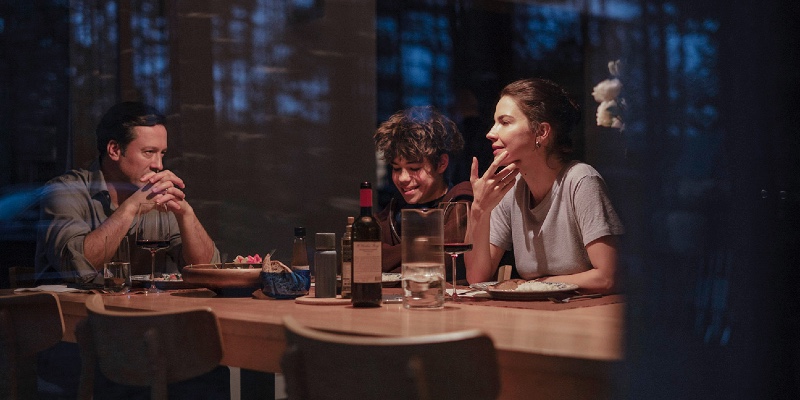
Based on Claude Chabrol’s The Unfaithful Wife (1969), Minotaur, for the most part, is an intimate family drama. Successful businessman Gleb (Dmitriy Mazurov) suspects his wife Galina (Iris Lebedeva) of having an affair. Their son, Seryozha, is being bullied at school, and the mayor of the fictional Russian city where the film is set, demands that business owners provide him with a list of employees to be conscripted as soldiers—essentially, cannon fodder.
The story unfolds methodically and slowly in the family’s gorgeous home surrounded by trees, on quiet city streets, and in Galina’s lover’s apartment—until it erupts into violence.
Zvyagintsev lives in France and is currently at work on a new film (that I thought was called Jupiter—more details below) about a Russian oligarch. We spoke on Zoom via a translator. The interview has been lightly edited for clarity and length.
A heads up: possible spoilers in the discussion.
Radha Vatsal: I want to start with some general observations: that fathers, wealth or power, and violence, often in the form of unexpected deaths, seem to be a theme that crop up frequently in your films. But there’s also a mythical dimension that we’ve seen in some of the titles like Minotaur and Leviathan, and I’m curious what draws you to this mythical element.
Andrey Zvyagintsev: Only two out of six films have a mythological reference—Leviathan and Minotaur. Only two.
RV: Maybe Jupiter?
AZ: Jupiter, no, it’s a working title.
RV: Okay. All right, so then maybe–
AZ: Jupiter is a name we no longer aim to use because in the Venice Film Festival this year, there was a film named Jupiter. So we could no longer use that name. They did it faster than we could.
[But to answer your question,] Minotaur, the film, has two sides to it. One is a personal family story, and the other is a story about society. So we could say that there are two films inside Minotaur, and they both have a very strong connection to each other. And they are represented in the title “Minotaur.”
Well, the first one, as you know from Greek mythology, is the mythological monster that lives in the labyrinth and demands human sacrifices. And then the other part, the more intimate family side—Balzac has a work called “The Physiology of Marriage” [1829] and the subtitle is “Meditations.” The interesting thing is that Balzac was twenty-five when he wrote that work. He was a very, very young man, and it’s really astonishing that someone so young has such an insight into family and married life.
There is a part where Balzac writes that marital life is like a labyrinth, where the husband wanders in anxiety and watches over his wife. And the husband experiences anxiety when he sees ambiguity, secrets, something unknown in the wife, and he waits anxiously in case there might be a lover around the corner of the labyrinth.
And there is a phrase that Balzac writes, and I’m going to try to quote it to you: That while the husband is wandering around the labyrinth, he’s waiting for the lover to jump out from around the corner; and the lover “minotaurizes”—so making minotaur into a verb—the husband. “Minotaurizes”—that’s the word Balzac uses.
The metaphor is quite simple because for Balzac to give the husband horns, as the minotaur has horns, means to cheat on the husband. But I think it’s also interesting that we do not know what this encounter will entail, and the lover may very well be also the victim of the situation.
So to go back to your question, the title works in two respects and has two sides and explanations to it.
RV: I wanted to discuss the use of interior space in Minotaur. I was very struck by the house. Like the apartment in Elena [Zyvagintsev’s domestic/crime drama from 2011], Gleb and Galina’s home feels like its own character in the film. And there’s a lot of glass and expensive surfaces. It’s also very restrained and tasteful, and it doesn’t match up to the idea we have in the west of new money in Russia being very flashy and in your face.
So I was wondering if you could talk about how you center their home, and also your choice of the décor in their home and the restraint.
AZ: I can tell you that new money—especially the Russians, you can obviously find some crazy mansions and different manifestations of wealth. Much more ostentatious. This house is probably worth $2 to $3 million, which is not a lot of money for a really wealthy Russian businessman.
It was incredibly lucky to encounter a house like this in Riga, in Latvia, where we were shooting, because most houses there have this very European kind of look to them, which is not the style of houses you can find in Russia. And so this house was definitely an exception, and we were lucky to find it.
And in the case of Elena, both Elena’s apartment with Vladimir, her husband, and the apartment where her son Seryozha lives with his family—it was all built for the film. In the case of the house you see in Minotaur, this is a house that belongs to the architect who built it, and he actually lives in it. And the only set that was built for Minotaur is the apartment of Anton, the lover. That’s a studio apartment that was built specifically for the film.
RV: The extended sequence of violence that takes place halfway through the film, without any dialogue, is so engrossing. And I was wondering whether that whole sequence was planned or was some of it improvised? It feels like it takes place in real time.
AZ: It was not improvised at all. It was fully planned beat by beat because every scene that involves blood is automatically very hard to do because you have to wash the blood away after every take and then re-spill it. So it takes a lot of time and effort to do that.
So, as I said, we planned everything well in advance and in a very detailed manner. And we spent five days shooting at the apartment. So day one was love scenes between Galina and her lover. The second day was the encounter between the lover and the husband; and then days three, four, five were all dedicated to the murder scene and the aftermath. So we gave our guy one day to enjoy love, and then the other days, he was getting murdered.
RV: Gleb’s advice to Seryozha when Seryozha tells him that he’s being bullied at school. I expected Glib to be more brutal, and I was surprised that he gave him quite mild advice of how to deal with the bullies.
AZ: You seem to be the only person to think it was mild advice. Where are you from?
RV: India, but I live in New York.
AZ: Russia is a very patriarchal country, and this is how it happens there. The man is the head of the family. And some 100 years ago, children were not even allowed to start eating before the father starts. And if they did, they could be struck with a wooden spoon on their forehead. So this is regarded by many as a normal form of communication between father and children in Russia.
And, this is an important detail: Gleb starts with saying you have to grab [the bully] by the collar, but then he says, do not touch him, but just say with the same expression, tell him very deliberately, if you do something like this one more time… So the advice has two parts to it.
I’m not entirely sure what the tool is against bullying at school and the way children sometimes relate to each other in an angry or violent manner. It’s a difficult conversation. So, it’s hard to tell what the right reaction would be.
This situation is very strange for me. If you have better advice on what to do if a child is getting bullied at school, I would love to hear it because I have a teenage son who is at school in France, in a boarding school, and he also had a problem with bullying, and I also had to give him some advice. My advice was more delicate, but I did explain to him that you have to face the person who tries to bully you and, you know, at least have a conversation.
And going back to your first question about my titles having a mythological connotation, I made a joke earlier about Venice, you know, having a film in competition that was named Jupiter.
But the truth is, I thought to myself that I probably have a few too many mythological titles. So my new film will be called something else, which I cannot tell you right now, but it will be something much better and much more interesting.
RV: Thank you very much. I look forward to seeing it.

Radha Vatsal
Radha Vatsal is the Film/TV Columnist for CrimeReads. She is the author of No. 10 Doyers Street and the Kitty Weeks mysteries, and her essays have appeared in the The New York Times, The Atlantic, the Los Angeles Review of Books, and elsewhere. She holds a Ph.D. in Film History from Duke University. You can find her on Instagram or email: rvatsal@lithub.com