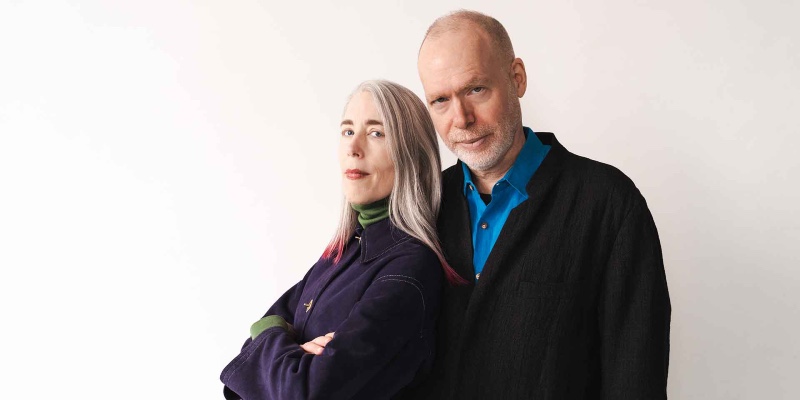
How Justine Larbalestier and Scott Westerfeld Melded Their Visions for a New Novel and Turned it Into an Epic Family Crime Saga
The co-authors (and married couple) discuss the making of their dark new novel, 'The Mortons'.
On July 21, our first cowritten novel published. Unlike many collaborations, particularly by married couples, The Mortons isn’t a two-hander. This dark tale of an ancient crime family is told from a single point of view, but informed by our distinct upbringings. Justine was raised in Australia and moved to the US as an adult. Her favorite crime writers are Attica Locke, Charlotte McConaghy, and Walker Mosley. Scott was born in Texas and grew up all over the US. His faves are Patricia Highsmith and Jim Thompson.
Scott
“What if you made it Dark Academia?” I asked.
“No. That’s your thing,” Justine said.
This was true. In our marriage of two novelists, I’m the one who’s obsessed with Donna Tartt, Mona Awad, and M.L. Rio. Who quotes Saltburn at the dinner table. (But not the bathtub scene.)
Justine’s latest novel was stuck in the mud. She’d finished her first draft more than a year before. It had gone out to our agent and writer friends for feedback, some of which was rapturous. Especially about the world building, across generations of a sprawling crime family who raise their children without empathy, a web of old money and ancient violence in the modern world.
But everyone agreed: Something was missing
“Ivy clinging to stone walls,” I tried again. “Dark rituals on the Quad!”
“We don’t have those in Australia,” Justine said.
Also true. But the Morton family of that first draft reminded me of the old-money students I’d met during my time at Vassar. A scholarship kid, I could never afford to go home to Texas during breaks, and wound up in the guest rooms of manors with wine cellars and inherited furniture.
Somehow, I recognized the Mortons from my long-ago Thanksgiving breaks.
“What if they were a legacy family at some spooky eastern college? Like, a safety school for rich ne’er-do-wells, where young Mortons learn to worm their way into the hearts of the broken scions of American power?”
“What’s a safety school?” Justine asked.
“A college for rich people who want gothic architecture, but they have bad test scores.”
“Your country is so weird.”
I could not disagree. “I’m going to have to write the Dark Academia part myself, aren’t I?”
Which was fine; Helshire College was already forming in my brain.
“A Primal Scream at midnight! Tapestries and dead drops in the library! The bell you have to ring your first week of sophomore year, or be cursed!”
“How’d you come up with all that so fast?”
“That’s just Vassar.”
“This is why you all go into debt?”
Justine
Scott is an unreliable narrator. Australia does have old universities with ivy-covered walls and I know what safety schools are. I’ve lived in the US since 1999.
My lack of interest in Dark Academia is because I was an academic. My parents were academics. I was immersed in that scholarly world since birth. The only dark rituals I encountered were scholarship PhD students attempting to live on a stipend of $15k a year, harassment complaints against tenured creeps disappearing into HR black holes, and endless internecine warfare over ever-decreasing budgets.
Why would I read—much less write—about that depressing world?
I had a different depressing world in mind—the one we’re living in. My original draft of The Mortons was about the slide into oligarchy and the connected ascendance of psychopathy. Or to put it another way: the grotesque belief amongst the billionaire class that they owe the rest of us nothing. The new noblesse are affronted that they were ever expected to oblige. Pay taxes? Contribute to the common weal? The outrage!
The Mortons live on a country estate, raising their children to be loyal only to the family, with zero empathy for anyone else. They have plenty of money, but their real power comes from “incorporating” other wealthy families, turning them into vassals by making their lives easier, while controlling them with the threat of violence. What would a darkly romantic college–called Helshire–add to the world I’d created?
Scott
It would turn the novel into Dark Academia, which contains all the themes you were going for!
America’s legacy-funded, fraternity-infested college system is a perfect embodiment of corruption. Imagine, if you will, a nepotistic monastery, beholden to contributions from the powerful, with a grafted-on sports franchise and hedge fund. A institute of learning that cares more about the acquisition of money than of knowledge. What could be darker?
In our collaborative draft of The Mortons, Helshire College looms malignantly over its surrounding upstate NY town, gobbling up real estate, providing a base for ancient crime families to extend themselves into the modern world.
As our protagonist, Jessica Morton, heads into her senior year, she starts to feel the gears of this amoral machine, and to question the certainties she was raised to believe.
On top of all this thematic crunchiness: I finally got to write a chase scene in a library! And have people climbing buildings at night, like my friends and I did in our college days. Gothic architecture has the best handholds!
The Morton family gives the same creepy vibes as Grant Wood’s painting American Gothic–an idyllic farmstead in the background, but those pinched faces, that pitchfork. You can smell the bodies buried in the soil . . .
Maybe the right term for the book isn’t so much Dark Academia as “Dark Americana.”
Justine
Stop trying to make “Dark Americana” happen.
Scott
Oh, it’s happening.
***
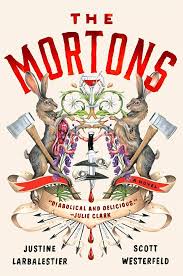

Justine Larbalestier and Scott Westerfeld
Scott Westerfeld is the author of twelve New York Times bestsellers, including the multimillion-selling young adult series The Uglies. Westerfeld's books have won many awards and been named New York Times Notable and ALA Best Books of the Year. Justine Larbalestier is the author of Liar, My Sister Rosa, and six other young adult novels. Her books have been named ALA, Kirkus, and Publishers Weekly Best Books of the Year. She is also a vintage fashion obsessive and (very) part-time model.