
That's a Honey of an Anklet: Women, Noir, and the Art of Writing Dark
Ruth Knafo Setton on noir desire.
I was fourteen when I fell in love with noir—on screen and on the page—and I never recovered. I pictured myself as Sam Spade or Philip Marlowe as I haunted the streets of my neighborhood in a man’s belted trenchcoat, chewing a toothpick the way John Garfield smoked a cigarette. I carried a small detective notebook where I jotted clues: a brass key found on the sidewalk, a torn scrap of paper with a phone number. I followed people who looked suspicious. And I wrote my first story in which a young female private eye solved sixteen murders in Budapest. Don’t ask. The story no longer exists.
But I had a problem. I wanted to be the private eye—tough yet sensitive. But I also wanted to be the Dame. The Blonde. Raymond Chandler’s blonde: “A blonde to make a bishop kick a hole in a stained-glass window.” Beautiful, jagged-edged, wisecracking, bringing a man to his knees. Lauren Bacall: “You know how to whistle, don’t you?” Or Kathleen Turner in Body Heat: “You’re not too smart, are you? I like that in a man.”
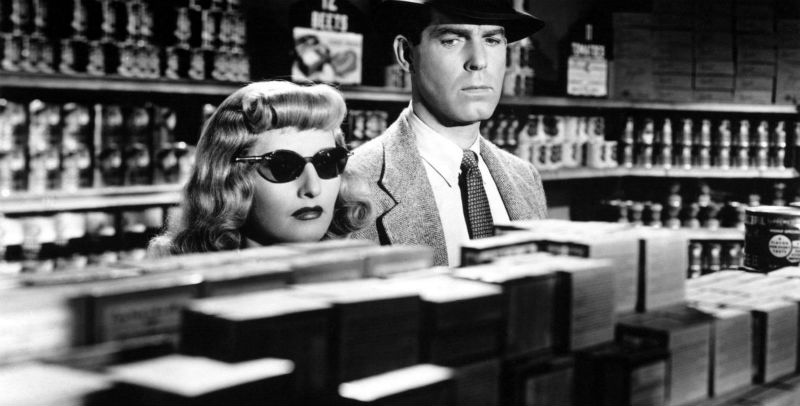
And of course, Barbara Stanwyck in Double Indemnity, as the immortal Mrs. Dietrichson. The first time Walter Neff sees her, he has to tilt his head back. We see her through his eyes—the femme fatale who will be his ruin. She descends the staircase, sits, and crosses her legs. He’s come to sell her husband insurance, but the husband’s not home, and it’s just the two of them, engaging in delicious innuendo. He says, “That’s a honey of an anklet you’re wearing, Mrs. Dietrichson.”
She eyes him, and she sees a guy who will be more than willing to break the rules and help her get what she wants. Every word and look is weighted with sexual attraction and the dangerous dance of desire that defines noir. He says he’ll return the next evening to talk to her husband, but they linger at the door. And here are five lines of perfect noir in the screenplay by Billy Wilder and Raymond Chandler:
NEFF: Will you be here too?
PHYLLIS: I guess so. I usually am.
NEFF: Same chair, same perfume, same anklet?
PHYLLIS: I wonder if I know what you mean.
NEFF: I wonder if you wonder.
Noir taught men how to want dangerous women. But women have always known how dangerous men can be. John Berger wrote, “Men look at women. Women watch themselves being looked at.” In classic film noir, the male gaze is not just a way of looking—it is the organizing principle of the entire story. We often see the woman in pieces: lingering shots of legs, lips, breasts and hips, an anklet.
Noir’s architecture was built for the male gaze. We’re supposed to side with the poor chump who gets caught in the femme fatale’s velvet claws. But Phyllis Dietrichson is so compelling, so fierce and seductive that we fall for her at the same time Neff does. She blazes with life and energy. And he’s a willing chump.
What happens when the woman stops being the pieces and starts assembling the picture? In Dorothy B. Hughes’s noir masterpiece, In a Lonely Place, she explores the mind of a serial killer, and its bleak banality is terrifying. Hollywood gave the story to Humphrey Bogart and softened the monster. We see him through the eyes of the woman who loves him—compelling, charming, and infinitely dangerous. She longs for the happy ending he promises her, but his barely leashed violence scares her into leaving him.
Desire in noir is electric because something stands between the two people who want each other. The obstacle might be a murder, a marriage, a lie, a suspicion that the person you want might destroy you. The closer they get to each other, the more dangerous the space between them becomes. That’s what makes noir desire different from romance. In a romance, the obstacles exist to be overcome. In noir, the obstacles might be the point. Neff doesn’t want Phyllis despite the risk. He wants her because of it.
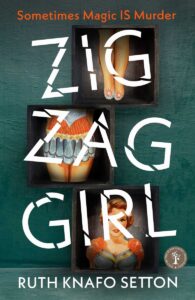
When I wrote my novel, Zigzag Girl, I wanted to write noir desire from inside the box—literally. I set the novel in Atlantic City, a town I’ve always seen as a dame: she’s been beat up, knocked out, and left for dead too many times to count. But she picks herself up, puts on Carmine Red lipstick, and gets back in the ring. Even her haunted boardwalk theatre is a dame with a past—backstage, she shows her age: eyes dark with the memory of nights gone wrong, her perfume mothballs and musk.
Lucy Moon, my main character, is a brilliant young magician who performs in that theatre alongside a sisterhood of fierce women. When Lucy’s friend is found dead in a Sawing-a-Woman-in-Half box, Lucy believes her perspective—as a woman who has been sawed in half onstage, who knows how different the world looks from inside the trick—will help her find the killer. During her search, she falls for Elvis Jones, a mysterious, charismatic magician who is one of the suspects. Both are gifted in the art of deception, and both wear masks. The dance of desire is dangerous for them both. But for her, it means life or death.
So how does a woman write noir desire? Start with the waiting. Noir characters circle each other. They talk around what they want. Even without the Production Code, desire works better when the characters don’t get what they want right away. The waiting is the tension.
Then shift the ground. The person being used turns out to be the one in control, and vice versa. You can’t relax into wanting someone when you don’t know if they’re saving you or setting you up.
And trust the woman’s gaze. Darkness is in a woman’s DNA. We prepare for it unconsciously. Before we go out, we check the threat level the way we check the weather. Will I be out in the dark? Will I be walking alone? Often, we don’t choose danger—it finds us. Shifting the gaze from the man to the woman doesn’t soften noir. It makes it more dangerous, more real.
Every touch is a gamble. Every kiss could be a betrayal. The danger a woman faces when she trusts a man is heightened by the suspicion that he might be the murderer. That tightrope, that moment when a man and woman face each other across a gulf of mistrust, fear, and desire—will she take a chance and leap?
That moment.
I live for that moment.
You can find me on the corner of Woowoo and Fuggedaboutit. I just might be chewing a toothpick.
***

Ruth Knafo Setton
Born in Morocco, Ruth Knafo Setton is the author of the novels, The Road to Fez, and Zigzag Girl—a finalist for the 2026 International Thriller Writers Award for Best Standalone Novel, and recipient of the Grand Prize in ScreenCraft’s Most Cinematic Book Competition, and the Daphne du Maurier Foundation’s First Prize. An NEA fellow, she has studied magic with Teller, Jeff McBride, and Eugene Burger, been sawed in half and in thirds, and escaped from a regulation straitjacket. She is a multi-genre author whose work has been widely published in journals and anthologies. Her screenplays have received honors from Austin Film Festival, Sundance Screenwriters' Lab, and Page International Screenwriting Awards. She has taught Creative Writing at Lehigh University and with Semester at Sea, and she writes a monthly Substack newsletter for creatives, in which she explores magic, myths, and mystery: www.ruthsetton.substack.com/