
On mall culture, stranger danger,
and the neon 90s
Nicolina Torres remembers the night she spent trapped in a shopping mall
As a Gen Xer growing up in the boring suburban Midwest, boomers repeated certain adages meant to guide me into adulthood:
“Finish your plate. There are kids starving in other countries.”
“Guys don’t make passes on girls who wear glasses.”
“If someone tries to kidnap you, just tell them to kill you right there.”
I remember wearing a Rainbow Brite nightgown and watching Saturday morning cartoons when my mother imparted that latter piece of wisdom. She swooped in without warning, and she seemed to be focused on malls in particular, the lawless parking lots of malls.
“If he shoots you on the spot,” Mom explained patiently, “you still have a chance to be saved. Someone’ll find you quickly. If he takes you with him, he can do whatever he wants. And your body will never be found.”
Hey, at least she thought about what would happen if she lost sight of me. I won’t go into the boomer parenting philosophy of sending us out on our bikes as the cure-all remedy to keeping our brains off drugs and our eyes off MTV (I was corrupted by the “Faith” video, by the way; this is a real thing), but every so often, horrifying front page news would make them tighten their grip on their latchkey kids.
Adam Walsh is the first case that comes to mind—the little boy kidnapped from Sears. He wanted to look at video games, and his mother made the decision so many parents would make. Despite Mrs. Walsh returning quickly, he was gone. I can’t imagine how confused authorities must have been as they searched every store. A mall is a crowded, safe place. Crowds are safe. There are people to hear you scream. Witnesses to see you carried off. But as John Douglas writes in Mindhunter when trying to describe the mindset of a murderer:
“…I’ve got to know how I am going to get this child out of the mall quietly and without creating any fuss or suspicion when his or her parents are probably two stores down…”
My mother was thinking of a different scenario when she interrupted cartoons that one morning, when she readied me for future combat. Most people have long forgotten Jerilyn Stanfield. She majored in fashion at the University of Cincinnati. She and her new husband lived in a cottage in Anderson Township. She worked at the nearby McAlpins and then Shillitos. And at 2:30pm on January 14th, 1982, she vanished from the Eastgate Mall parking lot.
A mall where my own family shopped with my grandparents.
There were no cell phones back then, so Jerilyn’s husband didn’t realize something was wrong until 10:30 that night. By then, she’d been murdered by a serial killer who saw her, wanted her, took her. Left her tied up in a barn.
I really didn’t need another reason to be afraid of the world around me. Spooky books were my drug of choice, and my drug dealer was the elementary school librarian in Paris, Kentucky. She’d let me check out The Creature Catalog, Edgar Allan Poe graphic novels, Scary Stories to Tell in the Dark. Vampires could be avoided, but apparently the boogeyman stealing me from my mother could not. While shopping, I warily stuck to her like those puffy Poochie stickers that would never come off the back of my bedroom door.
The 1990s hit like a freight train at the same time I went through puberty and suddenly, nothing could ever happen to me.
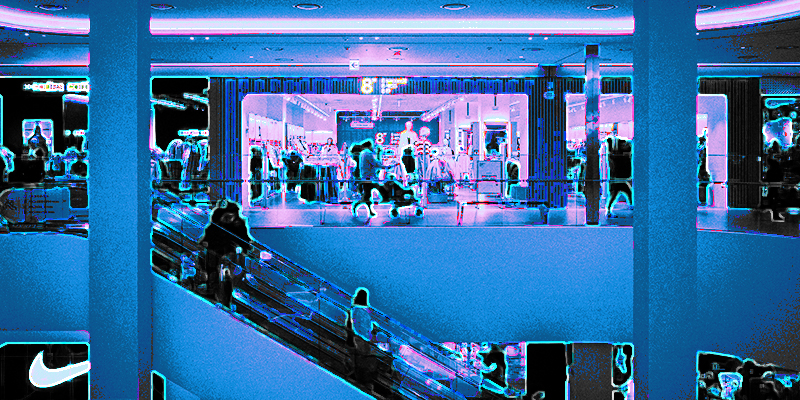
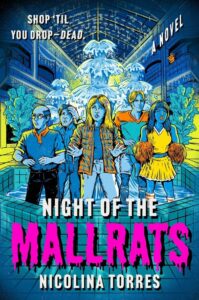
A 90s mall was a candy-colored refuge, an escape from a stifling home with a raging stepfather who had buyer’s remorse on the whole white-picket fence gig. At that very Eastgate Mall, I puked Zima in the parking lot. My best friend did doughnuts at midnight, techno blaring from his car speakers. The malls around me were always packed; kids waited for hours to see Santa; our mothers stood in line to buy Beanie Babies they swore would make them millionaires but could never really explain how. Malls filled my room with Gen X tchotchkes; Teen Beat posters, Apple Paperbacks, Ace of Base cassette singles. I’m going to go out on a limb and say suburban malls were the best representation of the American Dream during a time when it was affordable and attainable. There were different stores for different budgets—Kmart blue light specials around the corner from junior sections selling Esprit, Bugle Boy, Umbro shorts—and if you didn’t have money, you could aspire to one day shop in Express or Structure or Petite Sophisticate. My new book, Night of the Mallrats, revels in this neon hedonism; a world with hope and a middle-class and the assumption you’ll get what you want, especially that one movie at Blockbuster.
In the selfish haze of my own youth, ignorant of the troubles of others, not once did I think of Jerilyn Stanfield or heed my mom’s warning as I went off into dark corners to kiss boys I barely knew. It took one night trapped inside a mall to make me wish I’d paid more attention.
*
Though the following story isn’t the snowy fate of a character in Night of the Mallrats, it definitely inspired the mood. Over the years, I worked in many bookstores in many malls, and this event took place an hour away from home. Forced by my district manager to drive through a level two snowstorm, I cussed all the way there and parked sideways on a foot of snow as more fell from the sky like a white waterfall. As the dozen or so store employees wandered around as if lost, it was clear there would be no customers. We were snowbound. After dark, law and order thinned quickly as everyone fought over sample beds in a department store. That’s when what little survival instincts I had kicked in. Not wanting to partake in Lord of the Flies: Mall Edition, I crept back to my B. Dalton, pulled and locked the gate, and settled on the hard floor of the backroom, pretending my coat provided some cushion.
The public doesn’t know that in older malls there are secret passages thanks to the backends of long gutted-out stores, and internal alleyways for shipments. Those alleys are always covered in concrete and have flickering lights near exposed ceiling pipes that sometimes don’t work. And you never see anyone back there, you just hear footsteps.
That’s where someone hid as they tapped my store’s receiving door.
“Sleeping” only feet away, I knew I didn’t imagine the sound. Then it came again, a tap, tap, tap. I turned the key and yanked the heavy door back. I am the girl in the horror movie who runs upstairs instead of out the front door. I am the big-bosomed side character who laughs at danger before getting the knife.
No one stood there.
As I looked down both sides of the shadowy corridor, I waited for anything: Sneakers, the childish giggles of Spencers employees. I closed the door and within fifteen minutes it happened again. This time I didn’t open it.
If he takes you with him, he can do whatever he wants. And your body will never be found.
All my mother’s catastrophizing wasn’t really about the mall. It was about a stranger picking the most distracted person out of a crowd and then…just waiting.
***

Nicolina Torres
Nicolina Torres was born in Cincinnati, Ohio, and most of her works focus on the Midwest American experience. She writes long- and short-form horror, mysteries, and thrillers which have been optioned for film, television, and podcast. This Red Fire was a finalist in the Launch Pad Manuscript Competition, and Young Nation received an honorable mention. Her short story “Aunt Dorothy in the Canoe” was published in the Deception Anthology. She's written hundreds of horror movie reviews as Miss Wilkes. Nicolina was a manager for Barnes & Noble for fifteen years and now works at a courthouse in Ohio.