
David Brandon Hodge on occult murders and the origins of Ouija boards
Excerpted from Supernatural Machines: The History of Spirit Communication Devices
The Origins of Ouija
At the time of the New Planchette article’s circulation in 1886, Charles Kennard was a real estate agent who owned a fertilizer business in Chestertown, Maryland, just across the wide expanse of the Chesapeake Bay from the state’s industrial center of Baltimore. Kennard was born in Delaware on Christmas Eve, 1857, and was eleven years old when he witnessed the “wonderful workings of Planchette” during its first great craze. By 1876, he had begun “an investigation of psychical phenomenon” while living in Philadelphia, and his table-rapping experiments continued after he moved to Chestertown that same year.
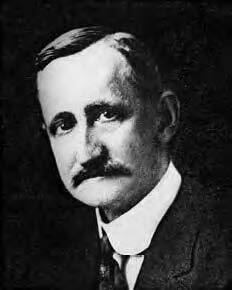 Charles Kennard
While Kennard never acknowledged any influence of the Ohio talking-board reports that appeared in 1886, it was that same year he claimed he envisioned an identical breakthrough, imagining he could receive communications quicker than raps or automatic writing “if words could be spelled by the alphabet.” He struck on what he believed was an original idea: “In 1886 I made a crude board, using a cake board and a table with four legs and a pointer, marking the alphabet and numerals in pencil,” and used the pairing to autonomously spell out messages letter by letter, joining the ranks of Armstrong, Damon, and Long as one of the earliest- known talking-board creators.
To refine his primitive efforts, Kennard claimed, he visited local cabinetmaker and undertaker Ernest Christian “E. C.” Reiche, a Prussian immigrant whose workshop was adjacent to Kennard’s office in Chestertown’s Voshell House. He commissioned “about a dozen boards a little neater in appearance than the cake board,” which he then offered for sale locally. He claimed his boards were “always being borrowed by neighbors, and those who purchased the few wanted more,” echoing similar stirrings of interest in Ohio that same year.
By his own account, he petitioned Reiche to continue the productive partnership, but as Kennard later recalled, “I asked him to continue making them for me and we would put the board on the market. This he said he would not do. He was too busy to make any more. I would have to get someone else.” Left without a craftsman to manufacture the boards, Kennard’s commercial ambitions sat temporarily idle.
Three years later, a competitive marketplace took its toll on Kennard’s fertilizer business, and in February 1890, he relocated his family to Baltimore. There, he opened a new real estate office in the Barnum Building and established new headquarters for his fertilizer company at 220 S. Charles Street. Kennard also rekindled his ambition to commercialize a talking board.10 In an account that echoes Cyrus H. Farley’s attempts to pitch planchettes in Boston, Kennard “showed the board to several who could see nothing of the future in it.”
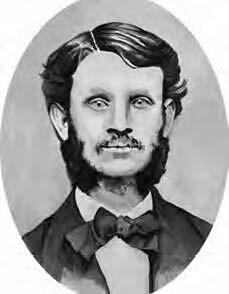 Elijah Jefferson Bond
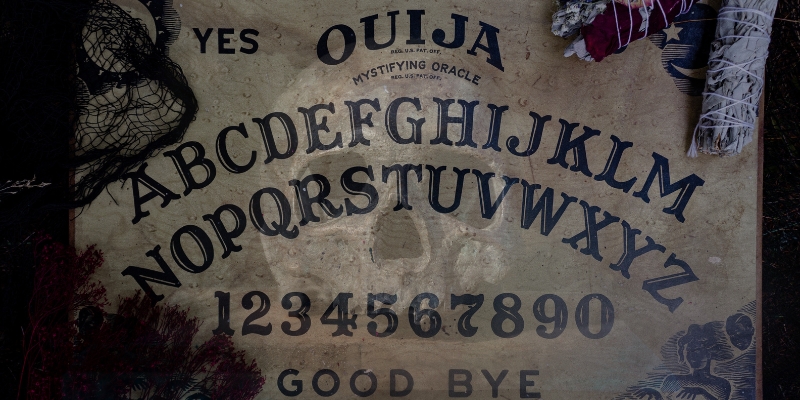
But a fortuitous meeting came with local attorney and fellow Freemason Elijah Jefferson Bond, who took an intense interest in what he called Kennard’s “witch board.” Bond recounted in later years how he made “important improvements” to Kennard’s design to get it into “marketable shape,” which included a round planchette with a sharply pointed extension that served as an indicator, setting it far apart from the heart-shaped planchettes of yesteryear. He paired the new planchette with a board that included two arched rows of the alphabet with a straight line of numbers below, closely matching newspaper illustrations from 1886.
Bond added embellishments, including a black dot representing the full moon in one upper corner and a crescent moon in the other, and black stars in the bottom corners. An illustration at the bottom center depicting two men shaking hands—an important symbol of fraternity among Freemasons—flanked on each side with the conjunction “Good Bye.”
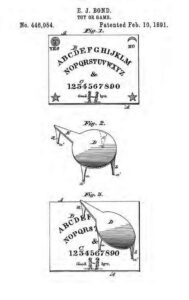 Toy patent, 1890
The pair partnered with the goal of patenting and manufacturing the idea, with Bond financing their earliest efforts with a $500 investment.
*
“O-U-I-J-A”
The duo’s new talking board had not yet been christened with its iconic name. As the two ironed out the details of the patent design in April 1890, they assembled at Bond’s home with some of his family members. Not satisfied with the initial name they had chosen, Charles Kennard proposed they ask the board what it would like to be called, as he later recounted:
The name Ouija was adopted by Mr. Bond and myself. We called this board by another name until we could secure a better one. One evening about April 1890, while trying the board with a Miss Peters, Mr. Bond’s sister-in-law, in the large boarding house at that time on the corner of Charles and Centre streets, where Mr. Bond boarded, I remarked that we had not yet settled upon a name, and as the board had helped us in other ways, we would ask it to propose one. It spelled out O-U-I-J-A. When I asked the meaning of the word it said “Good Luck.”
Miss Peters there upon drew upon her neck a chain which had at the end a locket, on it a figure of a woman and at the top the word “Ouija.” We asked her if she had thought of the name, and she said she had not. We then adopted the word.
Ouija was a strange word seemingly without precedent, and its fascinating combination of consonants and vowels, fabricated through Peters’s mediumship, added to the board’s mystique, even as unlikely as it was to have appeared on a locket. Yet her locket is an important clue that her role in Ouija’s naming may have direct ties to the Spiritualist movement.
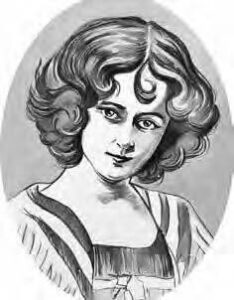 Helen Peters
Peters had no known connection to Spiritualism in her upbringing, but such influence was deeply rooted in her future husband and then suitor Ernest Herbert Donisthorpe Nosworthy. An immigrant from the UK who arrived in January 1888 to work as a traveling salesman, Nosworthy was the seventh child of Frederick Arthur and Eliza Louisa Spry Nosworthy, née Thompson, of Manchester, England, the latter of whom was a talented trance medium who “often attracted large and refined public audiences at Birkenhead by her dramatic powers.”
She was the daughter of George Thompson, himself a prominent Spiritualist who sat with Leah Fox in the United States, and had served on the Council of the British National Association of Spiritualists. The younger Nosworthy’s sister, Beatrice, was also regarded as “one of the youngest and one of the best of trance mediums” in England.
The Nosworthy family’s close bonds with one of the most famous mediums of the era may have directly influenced Ouija’s name. The family hosted famous medium Cora Hatch when she visited England, living with them for months at a time on multiple occasions during Nosworthy’s formative school years. Eliza Nosworthy was considered Hatch’s herald and was so close to the family that when Eliza’s prominent father died, the medium adopted him as a new spirit guide with the blessing of the Nosworthy clan.
However, it was another of Hatch’s spirit guides who might have inspired Ouija’s name: the specter of a woman named Ouina, Cora Scott’s most famous contact for her trance mediumship, and Spiritualists considered her a generous spirit who acted as “a messenger of peace and love between the two worlds.” Exposure to Ouina was most certainly in the environment of Ernest Nosworthy’s upbringing, and it may explain the mysterious locket with a woman’s figure and name described by Kennard in his remembrance of Ouija’s naming.
Whatever the case, Bond and Kennard adopted the enigmatic moniker and turned toward securing a patent for their newly named product.
*
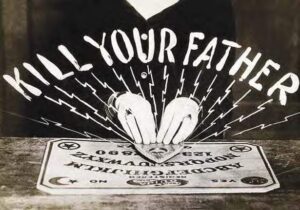
Ouija Murders
During the mid-1930s, more stories of deaths involving messages received through Ouija made the headlines of American newspapers. The first involved the Turley family of Arizona, when fifteen-year-old Mattie shot her father, Ernes, twice in the back with a shotgun, which resulted in his death a few weeks later.
The news spread far beyond local publications when reports revealed that it was Ouija’s messages that had commanded Mattie to murder her father. The story was further sensationalized by news that her mother and Ernest’s wife, Dorothea, was once voted “the most beautiful girl in America.”
Widely reprinted articles revealed how Dorothea had become obsessed with a local “handsome cowboy” named Kent Pearce and used the Ouija to manipulate her daughter into murdering her own father so that Dorothea would be free to marry Pearce. All three were charged, although Pearce denied any involvement and was ultimately found not guilty. Mattie pled guilty in juvenile court and was sentenced to an Arizona reform school, while her mother was found guilty and sentenced to prison but was freed three years later.
Another sensational Ouija murder involved the Hurd family of Kansas City in 1935. Family matriarch Nellie received messages through her Ouija that her seventy-seven-year-old husband, Herbert, was “too fond of another woman” and that he had given his secret lover “$15,000 of a hidden fortune.”
After receiving the messages, Nellie and her daughter Bertha ambushed Herbert and chained him to his bed before subjecting him to all manner of tortures, including beating him with a revolver, burning the soles of his feet with matches, and stabbing his legs with a dagger. Bertha also set to killing “the children”—three dogs and a cat—with carbon monoxide, which Nellie had commanded.
These horrible acts led to Herbert signing a forced confession admitting to his affair, which the two women signed as “witnesses.” But a few hours later, Nellie momentarily left her gun within Herbert’s reach, and he seized it and shot his wife four times before making his escape.
Police afterward discovered Herbert “running along the street clad only in his pajamas and carrying a still smoking revolver,” and he confessed to police immediately. Nellie died from her wounds, and the courts deter-mined her death to be a “justifiable homicide.” Bertha remained free after Herbert refused to press charges.
As in prior decades, these Ouija-inspired murders sparked a flurry of sensational headlines like “The Ouija Again Spelled Death!” even if Herbert’s actions were an act of self-defense, and helped contribute to the growing chorus of Ouija’s malign and diabolical associations in the media.
***


David Brandon Hodge
David Brandon Hodge is the author ofSupernatural Machines: The History of Spirit Communication Devices. Hodge is a historian, collector, and author specializing in the history of spirit communication devices. Founder of MysteriousPlanchette.com and curator of the world’s largest archive of séance artifacts, his research has appeared in Smithsonian Magazine and Paranormal Review, and has served as a consultant for museums and exhibitions worldwide, including the acclaimed Supernatural America exhibit at the Minneapolis Institute of Art and the Peabody Essex Museum’s Conjuring the Spirit World exhibit. Hodge has also appeared in many prominent programs as an expert on the occult, including Oddities, Mysteries at the Museum, and Expedition Files, and served as historical consultant and provided séance artifacts for Rick Alverson’s film The Mountain and Lasse Hellström’s biopic Hilma. Hodge is also a respected game designer and lecturer, known for his horror-themed scenarios and his work with Atlas Obscura and Coast to Coast AM. He owns and operates Monkey See, Monkey Do! toy store and Big Top Candy Shop in Austin, Texas, where he lives with his two children, Jack and Elliot, and the ghosts of several cats.