

Outsiders in the Bush: Garry Disher on Australian Outback Noir
The author of Sanctuary maps the past and present of a unique subgenre
There have always been Australian crime novels set in remote areas, but a distinctive cluster of them has appeared in recent years, prompting reviewers to use the phrase, “outback noir.” The subgenre’s best-known writers—in Australia, and internationally—are Jane Harper and Chris Hammer, whose first novels—The Dry and Scrublands respectively—were huge bestsellers and built on earlier novels such as the late Peter Temple’s The Broken Shore and my own Bitter Wash Road.
While the fallout has been too many country-town-with-a-dark-secret stories, the better novels offer compelling plots, convincing settings, and interesting departures from some of the tropes of crime fiction.
An outback setting is the obvious departure (most crime fiction is urban-based), but the Australian novels take that a step further by working with outsider main characters, new to the settings in which they find themselves. This goes against the grain of most crime novels, in which the main character is firmly rooted to the setting, having grown up in it or lived and worked in it for some time.
Contemporary examples include Jo Nesbo’s Harry Hole in Oslo, Deon Meyer’s Benny Griessel in Cape Town, and Michael Connelly’s Bosch in Los Angeles. Possessing a broad insider knowledge, these characters guide us through city streets and byways as the story progresses, revealing the pulse of a place until it becomes less mysterious to the reader (it’s never been mysterious to the investigators).
The main characters of outback noir are rarely insiders. Chris Hammer’s Scarsden is a Sydney newspaper writer; Jane Harper’s Faraday returns to a little country town that’s changed greatly since he lived there as a child; and my Hirsch (Paul Hirschhausen) novels feature a city-born policeman posted to a remote, one-officer police station.
Being a fish out of water places a strain on these characters. In fact, they’re obliged to conduct twin investigations, not only into a local crime but also the setting, especially in circumstances where the crime and its solution depend on factors related to the setting. They ask themselves: What makes this place tick? How can I survive here? Can I rely on the locals? The result is an ongoing tension as they seek an attachment to these unfamiliar places—only to find their tenancy insecure.
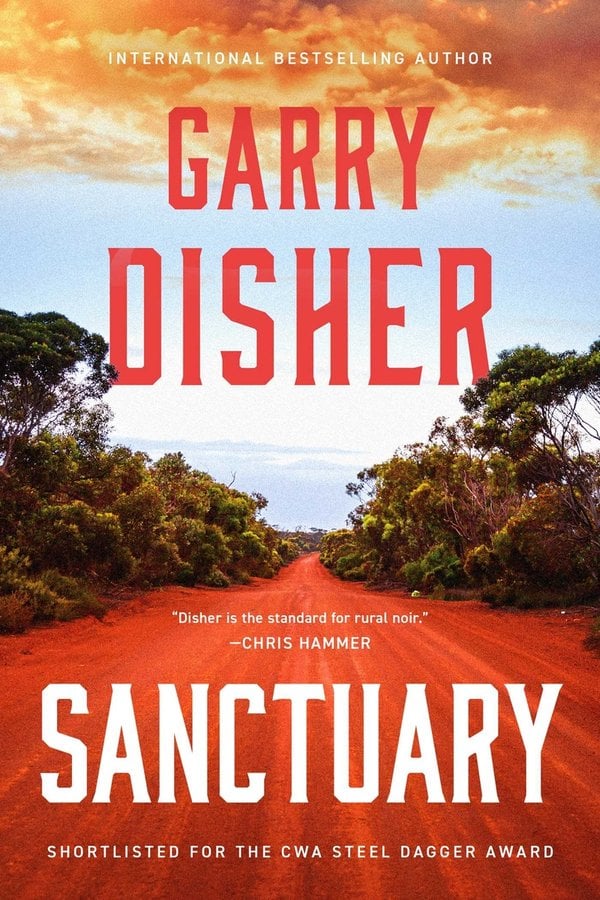
Also, they lack the authority usually found in crime fiction heroes. Hirsch is a lowly constable. He doesn’t command a team of underlings and can’t rely on useful contacts just a phone call away. As soon as there’s a murder on his patch, the Homicide Squad will arrive from the city and shoulder him aside. And some of the outback noir characters are not investigators in the traditional sense but include lawyers, reporters, and insurance agents—and even a master thief like Grace, the lead character of my new novel, Sanctuary.
And so we see these characters undertaking tasks that are not the usual lot of a detective inspector. Yes, they might investigate, and maintain law, but someone like Hirsch might find himself playing Father Christmas for the local children and helping out at a tennis club working bee. His weekly long-distance patrols ensure an ongoing police presence, but he also needs to check on situations where domestic life is under strain—an elderly widow caring for a son with Down Syndrome, for example.
He does what he can to help, but mostly that’s little more than giving reassurance, and clearly where a home has been disrupted by a murder, he can’t achieve much restoration. Hirsch has realized that “the secret to being a cop in a small rural community—the secret and the pity—was to get close but not too close. And it was never close enough” (Bitter Wash Road).
Meanwhile, Hirsch and his outback noir cohorts find themselves living in circumscribed or temporary dwelling-places that underscore their outsider or newcomer status—for example, a motel room (Chris Hammer’s Scarsden), a room above the main bar of a pub (Jane Harper’s Faraday), and three poky rooms of a cottage in which the front room is the police station (Hirsch).
In fact, Hirsch has a second cramped home: his police Toyota 4WD. It’s mostly a workspace that transports him to crime scenes, victims, witnesses and suspects, but it’s also a recreational space. He plays CDs and gazes out at a varying landscape—even as the constant jarring over potholed roads hurts his back.
Little wonder, then, that these characters each struggle to find a sense of at-homeness and community acceptance. Contrast this with Michael Connelly’s Bosch always returning to a comforting home in the hills overlooking Los Angeles, and the strong sense of neighborhood enjoyed by Sara Paretsky’s V. I. Warshawski, in her co-op apartment building in Chicago.
Not all crime fiction is sentimental about place—a character like Ian Rankin’s Inspector Rebus might love and also hate Edinburgh—but the outback noir novels challenge the long-established and sentimental view that the outback (often called “the bush”) is both the genesis and the home of a “true” and distinctively Australian way of life.
In fact, the huge majority of Australians live in cities, but locally-produced films, songs, advertisements, holiday brochures and popular novels have been keeping the myth-making alive for decades, seeing the bush as a unifying factor in our national identity, the place where the Australian character was formed.
The outback noir novels are giving readers a more realistic view. Here we see communities affected by droughts, bushfires, social distress, crime, and racial prejudice.
And global forces. The settings might be small towns and remote farms, but they’re not closed or contained like the English villages and manor houses of crime fiction’s Golden Age. There are fissures linked to matters beyond the local. Borders are not impermeable: violence permeates.
The urban biker gang riding through the outback of Scrublands is transporting drugs probably smuggled in from China or Mexico. Some of the violence occurring in Aoife Clifford’s Second Sight is intended to protect the smuggling of Australian wildlife to Southeast Asia. And Hirsch encounters members of the far right (Day’s End) and the sovereign citizen movement (Mischance Creek) who’ve adopted internet-rabbit-hole extremist ideas from Europe and the United States.
Crime scenes can be distressing spaces in any crime novel. As in real life, a murder on a street or in a home is a breach of the illusion of domestic safety, but while a big-city murder may soon disappear from the news cycle and public consciousness, a rural murder is likely to arouse a more acute sense of community injury, for the victim and the crime scene are often familiar to the local people.
The breach is more confronting if young people are sexually molested by adults, as in Peter Temple’s An Iron Rose and The Broken Shore. Fond notions are destroyed—rural spaces are not safer than urban ones after all. Homes, sheds and vehicles should be locked. Strangers—criminals—do roam. Godly men turn. Children are prey to adults. A killer might live next door.
Finally, character movement is crucial in all crime fiction. An investigation demands movement from place to place and person to person. Investigators are journeying characters, searching for answers, and this entails ongoing experiences of starting points, destinations, stops along the way and the journey itself.
At the same time, investigators are tracing movements that have already occurred—what brought killer and victim together in a certain place, for example. The movements of culprits, victims, witnesses, and investigators are tied to every place in a story. It’s just that the journeying is more critical for the outback noir investigators. Even as they travel with fresh eyes, constantly interacting with the setting so that it’s never mere backdrop but a dynamic force, the trip might be perilous, for the distances are greater, the terrain is more treacherous, and backup assistance many hours away.
It all boils down to the writing, of course. The best outback noir writers evoke convincing settings—a township, a dusty paddock, even a kitchen—that not only give readers a sense of place, but also encourage reader engagement as they trace the movements of criminals, victims, and investigators, ponder the significance of a locked door, a discarded cigarette, or a man with a limp, and see a crime scene as a place disturbed.
***

Garry Disher
Garry Disher is an award-winning Australian crime writer whose titles include the recently published Sanctuary (Mysterious Press, New York).