Pantser or Plotter: How Poe, Christie, King, and Other Greats Outlined Their Mysteries
JJ Unthank explores the craft inclinations of crime writers past and present
I’m currently stuck in the bog of plot and planning. I’ve been here for a week trying to outline my next murder mystery/fantasy mash up. Being a plotter (and being horrified by the thought of writing a novel flying by the seat of my pants), I want to have everything decided before I start wasting digital ink.
So I thought I’d seek inspiration, and see how the great mystery forebears went about planning their novels, were they plotters or were they pantsers? Should I flee the bog with reckless abandon, or should I plan a more steady route before I pull my boots from the mud?
*
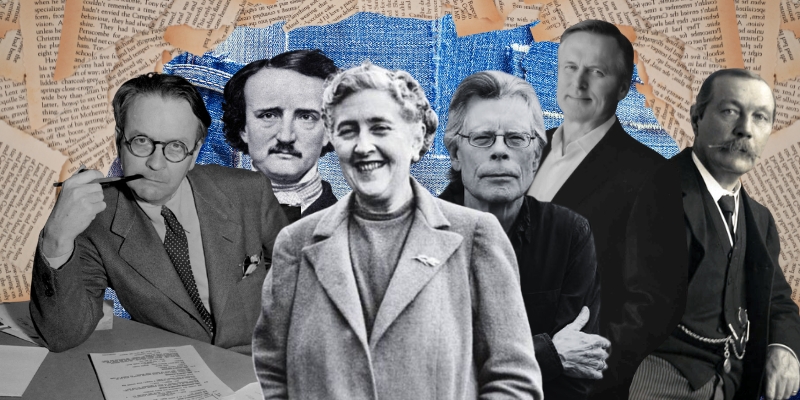
Agatha Christie: Plotter
Agatha Christie, a novelist who needs so little introduction I’ll stop right n—I’ve found many conflicting statements about her methods online, which makes sense given her prolific status as someone who’s second only to God and the Bard in terms of books sales. But hidden amongst the nonsense people spout about her “not knowing the killer till the very end of the novel,” is some evidence that she was an avid plotter.
Before writing a word she planned everything; the murder, the motives, the killer, then she’d move onto suspects and red herrings; sometimes this took many years, sometimes a week according to her autobiography. She wrote every idea down in a veritable horde of notebooks, seventy-three of which still remain of the over a hundred she used. On several occasions she claimed to have written the first and last chapters one after the other, to ensure she stayed on track whilst she wrote the rest of the novel.
Edgar Allan Poe: Plotter
Edgar Allan Poe, whilst primarily being known for his poetry and gothic short stories, is often ascribed as the inventor of detective fiction. His thoughts on the matter are laid out quite plainly in an essay he wrote in 1846 called The Philosophy of Composition, in which he states “that a work of fiction should be written only after the author has decided how it is to end and which emotional response, or ‘effect,’ he wishes to create.”
So another win for plotters everywhere, although in the same essay he does go on to describe how “the death…of a beautiful woman” is “unquestionably the most poetical topic in the world,” which to some might sound beautiful, but to me is just plain creepy.
Sir Arthur Conan Doyle: Still a Mystery
Sir Arthur Conan Doyle, the inventor of Sherlock Holmes, possibly the most famous literary detective of all time, appears to be a bit more of a mystery. Fitting. In an essay of his called “How I Write My Books,” he doesn’t state either way what his process is, but he does talk about the extensive research he did for his historical novels like “Sir Nigel” or “The Refugees.”
You could take from this that he might plot his mystery novels with the same care, but he could do all the research in the world, and then make up the plot as he went. It’ll just have to remain a mystery.
Raymond Chandler: Pantser
Raymond Chandler, an influential figure within hardboiled detective fiction, has a wonderful quote on this exact subject: “that’s the hell of being the kind of writer who cannot plan anything, but has to make it up as he goes along and then try to make sense out of it. If you gave me the best plot in the world all worked out I could not write it. It would be dead for me.”
This makes him our first pantser of the group, this quote came just after he lamented having to start a book over again from scratch. He said “I just didn’t know where I was going and when I got there I saw that I had come to the wrong place.”
John Grisham: Plotter
John Grisham, having sold over 300 million copies worldwide, is indisputably one of the most popular novelists of our time. Though looking into his writing process I’ve found some peculiarities. Another avid plotter, he’s stated in interviews that it’s “important to outline because if you don’t know where you’re going you can waste huge amounts of time.” He even backed this up with a personal anecdote about how he didn’t outline his first novel, A Time to Kill, which resulted in it taking him three years to finish.
These days he gets through a novel a year; he says he starts a new book on January 1st, which is something I’ve not heard any other author do. What’s comforting to me is that he says his outlines can sometimes take months or years to complete, which is making me feel a whole lot better about being stuck for a week.
Stephen King: Pantser
Stephen King, I don’t know if you’ve heard of him; he’s written a few books, I guess. Joking aside, he’s possibly the most famous pantser of all time. In his memoir On Writing, he sets out quite clearly his feelings that outlining a book takes away the joy of writing it.
He also details how sometimes it can go wrong; when writing The Stand, King describes how it took sixteen months to finish the first draft, where most of his first drafts are done within three. He said “I liked my story. I liked my characters. And still there came a point when I couldn’t write any longer because I didn’t know what to write….I wasn’t the first writer to discover this awful place, and I’m a long way from being the last; this is the land of writer’s block.”
*
I’ve seen people say there is no real divide between pantsing and outlining, that what looks like pantsing is just extremely knowledgeable people using their instincts to guide them through the same process. But I can’t agree. I’ve found that the common denominator among pantsers isn’t vast knowledge, but that writing spontaneously is the only way they can keep coming back to the paper.
Almost all of them say something akin to “they like discovering the book as a reader might.” Keeping the story exciting and mysterious is how they get the most joy from the process, which in truth is all that matters. If you enjoy something, you’ll keep doing it. Which only makes sense for a task that can take years or your life. I guess the answer is, as always, do what makes you happy. How quaint.
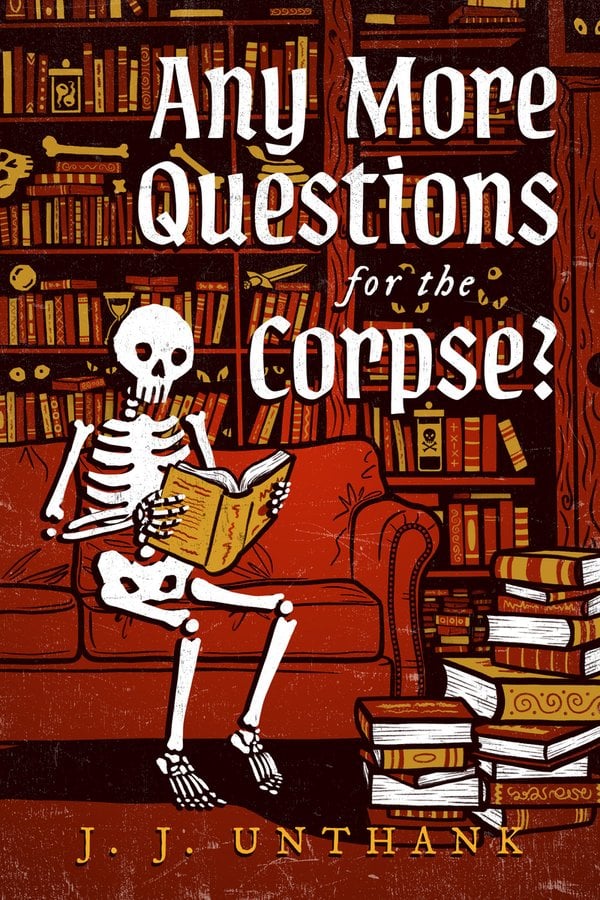
I guess that means I better get back to outlining my next novel, the first installment of which, Any More Questions for the Corpse? came out on August 25th. You better get back to work as well. I’ve given you an answer, as vague as it might be; now go on, get to it.
***

J.J. Unthank
Jack Unthank was born in Andover, Hampshire, in 1994. He regrets this but had very little say in the matter. To avoid his hometown, he stuck his head in fantasy books and video games and had a habit of writing stories of his own. He studied computer science at the University of Bath, a degree he would use for seven or so years working in the video game industry as a programmer. This career came to a close when a chronic illness crept up behind him and unceremoniously bonked him on the head, taking him out of action. With a lot of time on his hands and never getting out of the habit of writing stories, he tried turning one into a book: Any More Questions for the Corpse?. He currently lives in Cardiff with his wife and two cats.