“Profit is the Only Principle”: How 'Point Blank' Presaged Our Current Moment
Greg Wands on the timeliness of a neo-noir classic.
They say the key to comedy is timing, and I suppose the morbidly funny is no exception.
I recently enjoyed a rewatch of the 1967 abstract modernist neo-noir crime classic Point Blank at Metrograph in New York City as part of their Westlake Files series (the film is based on the novel The Hunter by Donald E. Westlake’s alter ego, Richard Stark). The long-scheduled screening happened just days after the president lobbied Congress for $152 million to rebuild Alcatraz prison—this only days after claiming the country had no money to fund Medicare, Medicaid or daycare programs due to our swelling military budget—and I couldn’t help but chuckle through gritted teeth at the synchronicity.
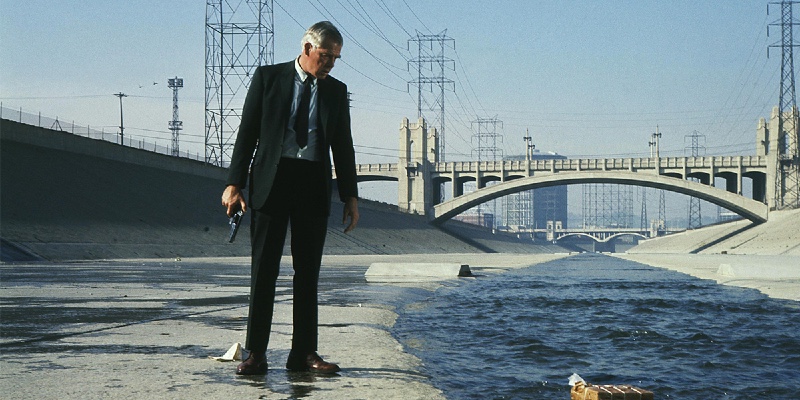
The film opens in the shuttered penitentiary and stars Lee Marvin as Walker, a savage piece of business who’s double-crossed and left for dead during a robbery by both his wife and his best friend. The betrayal kicks off a revenge spree that sets Walker on course to recover the stolen $93,000 dollars he considers rightfully his. To accomplish this goal, the thief must face down a shadowy, labyrinthine crime syndicate known simply as The Organization. The film resembles a kaleidoscopic fever dream with all sorts of existential questions and implications baked into the framework, but I won’t give away much more than that. Puzzling it out is half the fun.
As Walker begins clobbering his way up the ranks of The Organization, he’s forced to wade through a vague chain of command that shuns any sense of responsibility or accountability. He confronts one member only to have them point fingers at another, then another, and right on down the line. In this slippery outfit, the buck apparently stops nowhere. As he swiftly disposes of each, the reactions from their colleagues swing from gleefulness to objective detachment, and the viewer begins to get a sense of the level of depravity we’re dealing with.
At one point, a member of The Organization utters the line, “Profit is the only principle,” a sentiment that perfectly sums up a major theme of the film. Through this lens we’re shown how the corporate mindset operates not only indifferently toward the individual but in direct opposition to their interests. Another member of The Organization expresses incredulity about the fact that Walker is willing to risk his life for a relatively modest sum of money but offers no real options to remedy the situation. While it would be easy to assuage him with what amounts to a pittance and save lives in the process, that would negatively affect the bottom line. Even as Walker metes out retribution, there’s a queasy sense that the swath of devastation he cuts will never be enough to uproot The Organization, allowing it to continue sowing the seeds of destruction largely unhindered.
Walker himself is an emotionally stunted battering ram of a man. We don’t so much cheer for him as we do against The Organization. Along the way, Walker reconnects with his sister-in-law, Chris (a superb Angie Dickinson), who agrees to help carry out his brutal mission. Chris represents the single remaining humanistic glimmer in this sea of callousness, yet once she’s played her part, Walker casts her off and continues his relentless pursuit of fractured justice. In spite of his cold indifference, we still find ourselves pulling for the character, betrayed as he’s been by those he trusted most and ground down by a system designed for that express purpose.
The film’s director, John Boorman, has suggested that the role of Walker appealed to Marvin as a way to process the horrors he’d experienced while serving as a Marine in WWII. Nearly sixty years later, enmeshed in what appears to be a new global war, this groundbreaking work of art holds up an uncomfortable mirror to a society beset by financial violence and inured to trauma through relentless exposure to it. For anyone who’s lately been forced to fight an insurance company tooth-and-nail over a claim while its CEO vacations on their private yacht; who’s had to take on a third job to keep food in the fridge; who’s watched helplessly as their tax dollars are siphoned into the pockets of those who need them the least, the plight of a guy like Walker can seem almost noble, even as an unnerving sense of futility bleeds through.
On second thought, nothing much funny about it.

Greg Wands
Greg Wands writes for the page and screen. An avid lifelong reader, he grew up in Sag Harbor, New York, and now calls Manhattan home. Greg has a forthcoming audio original, The Gimlet Slip, in collaboration with Fiona Davis.