
Quinn Connor on body horror, queerness, academia, and southern gothic novels
Alex Dueben chats with Robyn Barrow and Alex Cronin, the duo behind Your Beloved Remains
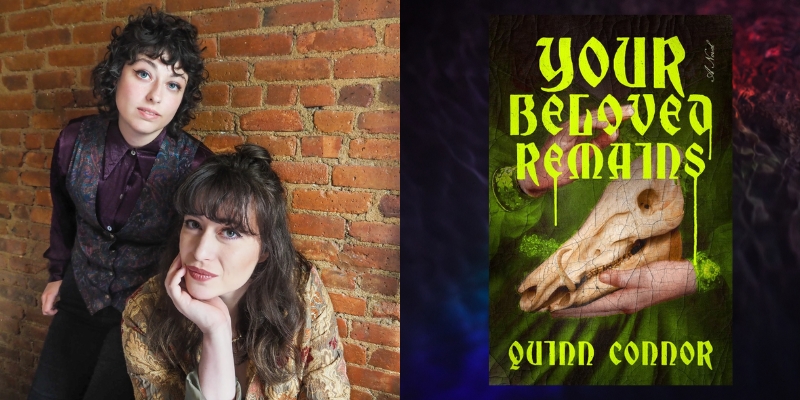
Your Beloved Remains is the third novel by Quinn Connor, and sits alongside their other Southern gothic stories. This novel is set at Basin College, a small school in a remote part of Arkansas where Celia Kiel, the school’s archivist, has spent her whole life.
After discovering the school might be closing, Celia finds a lost manuscript by the school’s founder, a feminist writer and heiress whose life and work has cast a long shadow over the school and its reputation. Working from a partial manuscript she found pickled in formaldehyde, she teams up with Joan Harriot, a literature postdoc, who is not just a gifted mimic but Celia’s academic nemesis, to forge and reconstruct the book in an effort to save the school.
The book is part mystery, part gothic horror, part dark academia, part dysfunctional romance, though that doesn’t do justice to the strangeness of the book, the atmosphere, the ideas around literature and the university that are thrown around—and just how much fun it all is.
The book tells the story of a very dysfunctional pair writing a manuscript, and so we reached out to Dr. Robyn Barrow and Alex Cronin, the writing duo behind Quinn Connor to ask about how they write together without trying to kill each other, academia, queer Southern stories, body horror, and how their writing surprises the people who know them.
*
AD: I really enjoyed Your Beloved Remains, which was so much fun. Maybe fun is the wrong word?
AC: Fun is the right word!
RB: I think it’s campy fun!
AC: We had fun writing it.
AD: From the beginning of your writing career, I’m sure people have asked, how do the two of you work together? Here you have written a book that is explicitly about a literary partnership. Was this kind of inevitable?
AC: It probably was a little bit inevitable, because it’s always been interesting to us. Just quickly on the way we work: We’ve been doing this for thirteen years now. The way it works is that I have a character, Robyn has a character, and then we bring them in conversation. We are often literally passing the laptop back and forth, line by line, switching who writes it. So it ends up being super seamless.
Of course, over thirteen years, I think we have learned enough about it to know how bad it could be if we did not truly like each other. We have strong boundaries with co-writing. We get along. We have a lot of the same tastes. We love each other. These are the things that make co-writing safe.
But because it’s so safe for us, it was really fun to explore [the question], “but what if it wasn’t safe?” Because it is so vulnerable to be co-writing and sharing a creative project. To share that can feel really scary. So what if the worst thing happened? What if all of those hurt feelings that could exist grew into something wild and terrifying?
AD: There is a scene where, not to spoil too much, but Celia gets those first pages back and she goes, this is horrible. Because she can’t give or take criticism well. But she’s also in pain because it’s so good and she knows she could never have written it, so she’s overwhelmed by anger and jealousy.
AC: Robyn and I are very lucky because we have similar standards and we have similar but different talents. We’re very compatible, but co-writing with someone who is not compatible would be really difficult. Celia finds herself in this position where she just is struggling to keep up and that is a horror for her because she wants to be the keeper of Beatrice. The keeper of this archive and of her voice. And she can’t do it. The way that Harriot describes it is Celia is “a high priestess who can’t hear the voice of god.”
AD: Which is such a great phrase, but the book resembles a lot of different genres. It’s gothic, it’s dark academia. Robyn, I know you work in academia, so I’m sure you have thoughts on the genre.
AC: Oh, does she. [laughs]
RB: We have always loved Donna Tartt and The Secret History. We loved it and around 2017, 2018, it felt like suddenly the internet discovered it. It was everywhere and it sort of ballooned into this whole genre, “dark academia.”
It’s great that there are so many people enjoying reading and writing this genre, but it has gone quite far from The Secret History. Now there’s dark academic fantasy and all these versions that, to me, have nothing to do with academia. They’re not really exploring the themes of the university that I find interesting.
When I pitched the idea for Your Beloved Remains to Alex, I was like, “We’re gonna make this call from inside the house.” This is about academic frustration. The kind of rage that can build up in an eternal grad program.
When I came up with the pitch, I was in the sixth year of an eight-year grad program. A lot of Harriot’s struggles with her career and the feelings that she has about being a postdoc, was cathartic for me to write through. Hopefully it gets back to some of the roots of dark academia. We’re re-coining this book as “academic horror.”
AC: I’m just going to parrot what I’ve heard Robyn say before, which is that often these books focus on the students, but in our book, the students are not really a part of it. It’s about the institution. The students can leave on holiday break. They get to go home. This is about the people that don’t leave. Where the university is their life. Which, for Robyn, has been a really good thing.
RB: It’s funny because since I wrote the book, I have gone on to finish my PhD and get a tenure-track job, which is like winning the lottery. That was never in the cards for Harriot. Harriot was never destined for tenure. [laughs]
AC: It’s kind of the same thing as the collaboration question. It’s an exploration of the dark side and the horrible “what if things had gone a different way.”
AD: There’s an exchange in the book. “What does it mean to want something so much you end up destroying it?” Harriot answers “it sounds like doing a PhD in the humanities.”
RB: [laughs] Exactly! Sometimes you make the thing that you love your job, which I would say is true both in academia and as an author. You make writing that you love the thing that you make money off of, and then you spend so long grinding that you actually ruin it. Harriot is so burnt out. She clearly came to being a literary scholar because she loved reading, and now she’s so cynical and so lost because of all the years of struggle with that.
AD: You said that students are kind of the point of academia, but they’re only there for a few years, but there are people who spend their whole lives there.
RB: Since most people who write books about academia have only ever been undergraduate students, they see themselves as the center of the system. But they’re really the compensatory engine of a system that is producing something that is actually not their education. I think that is fascinating. I truly care so much about my students. My students are the reason I want to be in academia, but for many researchers and faculty members, students are not the reason that they are doing their job.
AC: Also, the people who run the college, the board and the President, they’re looking at the bottom line. There’s this question that’s the propulsive engine of the first act: Is Basin College going to close? Celia cares because of the archive and because it’s her home. But there’s also the question of what about all of these students that are currently there. What’s going to happen to them?
There is this unspoken understanding that the board doesn’t care about them. It’s not about them. They’re a part of this system and nobody is thinking about them at all.
AD: They’re running a business.
RB: The book was coming out of a moment when it felt like universities were operating as these hedge funds for the wealthy. We started writing this book in 2023. Now higher education is under threat. I think that the university is a really good and important thing in our society. I want to defend it and I want to be a good voice in the university.
AC: I think there’s a big question in the book, “how do you love something?” Celia’s version of loving it is excusing any of its wrongs and pretending it’s perfect. Harriot’s version is critiquing it almost to the point of picking it apart.
I think that’s how we feel about the university. Yes, it’s wonderful. It’s something that we need. It also is worthy of critique and could be improved and made better. There are these questions of how you engage with something that you love, and because you love it you are frustrated by it greatly.
AD: Historically most universities were set apart from cities to let people study and work. And there’s a way that attracts people like Celia who use it as a place to hide from the larger world.
RB: It’s got a monastic quality. That can also go into a cult-like quality. Harriot is really running from her past by arriving at Basin College, which is a very particularly isolated and spooky version.
AD: It is very remote, but also, there are a lot of colleges in the middle of nowhere.
AC: Beatrice Donahue created it specifically for that reason. She said, “my husband is finally dead, I have money, I am free. I want to go do exactly what I want to do.”
What she wanted to do was find some place remote where she and the women in her life and her lover could be themselves in all of their weird, witchy, queer glory. A lot of universities were not created for that reason, but it was fun to think about this university that was and how these things can start from such a seed and still become so institutionalized and twisted and different from the starting place.
RB: I do like that point that Basin College in its foundational message, was meant to be a safe place for women and a safe place for queer people to live as their true selves. I feel like the university can be that way. The ivory tower is a place where you see many different kinds of people getting to ask the kinds of questions they’re interested in. I feel like that is a beautiful thing about college. But it all depends on who’s in charge
AD: It does get at that, which is so important for people. Also it touches on how a lot of schools that may have become institutions, but were started by people who were strange or even crazy.
AC: [laughs] Beatrice is, but she’s gloriously powerful. She’s dead but she has cast such a long shadow. She brought these women who did not fit in society. One of our inspirations was Victorian tea rooms, which was one of the few jobs back then that women could have. So Beatrice had a tea room. Women were finding ways to exist and to be free under incredible constraints. That’s what Basin College was for her.
AD: It’s a queer book about how queer spaces have always existed just as queer people have always existed. And that these spaces and institutions have existed through time.
RB: This is our third novel and in our previous work we’ve had queer storylines that have been a reclaiming of queer joy, which has been really wonderful. In this book we wanted to just have freaky scary lesbians doing bad things and not apologizing for it. Just ripping the world down.
AC: There’s all sorts of different ways that queer people can be portrayed. Because they’re people. You almost have to start with a portrayal where they are good, because there are a lot of people that may not have knowingly met a queer person. You almost have to start with, guess what, you can love a queer character. The more these stories come out, the more freedom you have to add grittiness and reality into that portrayal.
It’s wonderful to be able to have queer characters that behave badly and it doesn’t feel like a condemnation on queerness as an entire experience. For us, being able to write through queer joy gave us the freedom to write queer messiness as well.
RB: This is coming from our background as Southern women, as well. I feel like up in these parts it can feel that queer pain is a distant memory for many people, but for us, coming out in 2018 was a completely different world. Writing Southern stories about queer people means a lot to people in Arkansas and these places.
AC: There’s people that would have you believe that queerness doesn’t exist there. Or that it needs to be kept very quiet, or regulated extremely heavily. Or made illegal. But there have always been queer people in Arkansas.
There’s also the idea that the North is the home of the ivory tower. That New England is where you’ve got all these schools, but there’s always been incredible intelligence like in Arkansas. These things, that they would have you believe don’t exist, have always been there. These people, that they tell you don’t exist or don’t deserve to exist, have always been there and been a part of it.
AD: As you were talking about the messiness, I keep thinking about how the book takes place over a few months. It opens with the fall semester and the school is functioning as it has been, and by the Christmas holiday, everything unravels and descends into chaos.
RB: We have Beatrice Donahue’s dark secret at the center of the novel. You don’t find out right away, which has made it hard for me at times to know how to pitch the novel. I feel like this is a key element that you don’t want to spoil. Beatrice lost her lover and the aftermath of that grief and where she goes with that is super kinky and interesting and transgressive and queer.
Then you have these women in the 1980s that are excavating that and discovering within themselves how they feel about that and how they feel about each other. It’s fun to surprise the reader with that part way through. It’s good to highlight for readers that the book is spicy and bizarre. And a great time, hopefully.
AC: We’re thinking about all of these highfalutin ideas, but we’re also playing a game of chicken with each other. We’re trying to freak each other out a little bit when we’re writing. We’re trying to make it fun.
Sometimes I write something and then I’m sitting there waiting for Robin to get to it so I can get her reaction. There’s a lot about the book that is intentionally fun because we were having fun. Everything that the reader feels, we felt as we were writing it and surprising each other and grossing each other out and delighting each other.
AD: I’m sure. Going, what if she cuts her foot, what if it gets infected, what if we have this body horror scene.
AC: What’s weird is that we wrote all of that, but it grosses me out to think about it. One of my friends was reminding me about a particular scene with the foot. I remember us writing that, and I have not gone back and read it again because it grosses me out! [laughs]
AD: I’m pretty sure I know the exact scene you’re talking about.
AC: [laughs] It’s a weird way to feel about something you wrote.
AD: At the center of the book is this lost manuscript of Beatrice’s, and in writing the book you had to figure out how much of that book to write, how much to include so it doesn’t overwhelm the story.
AC: A couple people have asked about this, actually. One friend said, “you should do Dreams of the Rose, the entire book from Beatrice Donahue.” Our answer has consistently been, “no!” My gosh, that was so hard to do.
RB: One of the big influences in the book that I don’t think we’ve talked about before is Possession by A.S. Byatt. I love that novel. It’s absolutely amazing. In that book there’s a lot of the writing of the authors in the book.
With Beatrice Donahue we wanted the kind of unreachability of her to be center stage. What’s on the page is all of the writings of Beatrice Donahue that there is. There’s no additional pages. We found it extremely tiresome to do.
Harriot has this power of mimicry where she can hear the writing of someone else and then produce it. That came from my own perception of my own writing. I feel like I can really get the sound of someone else’s writing and copy that or produce that, in a sense. Beatrice Donahue is a shared character, but I would read Mary Shelley and Poe and nineteenth-century work and then I would write these passages of Donahue.
I’m very attuned to word choice. I feel like it’s so easy to get taken out of that kind of writing with a misplaced word or something that just doesn’t hit quite right. This is just someone in the present pretending to write about the past. I wanted it to have a strong truth claim. Starting with the note from the editors and then all the writing, I wanted it to feel really immersive. This could have been true.
AD: You mentioned before that each were the primary writer of one of the characters. Who did you write?
AC: I wrote Celia. To the great surprise of most people, I wrote Celia.
RB: For some reason, Alex’s friends were like, “she couldn’t have done that.”
AC: I think because the wildness of Celia and where we go in her perspective is pretty stark. I think that a lot of people that know me are just surprised because I’m an introvert. There’s a lot that comes out in Celia’s perspective that people maybe didn’t think we were capable of, who have read our other books or know us personally.
AD: I think Celia would have to be written by an introvert.
AC: That’s how I feel! She’s got a very rich inner world, and it’s twisted in there.
AD: It’s also funny that you wrote the foot scene and then went, this is disgusting, I can’t read it again.
RB: Alex writes way grosser stuff than I do.
AD: That is interesting. Do people have a somewhat misunderstood sense of what you write or how you write?
RB: I think there’s definitely a pattern between the three books. Alex’s characters are always extremely vulnerable and very emotionally open. Which is interesting because between the two of us, she’s definitely more emotionally unavailable in the real world. My characters are a bit more closed off and they’re usually cool. [laughs] I’m the least cool person, but then I write these cool characters. To my best friends, it’s pretty obvious that Harriot is me. She’s like my shadow side.
People do have a good time guessing. We go back and forth, should we tell people who wrote what? Should we keep it a secret? Because obviously we want the experience to be seamless.
AD: You mentioned one struggle has been finding a way to talk about the book without spoiling too much. Which I understand.
RB: I’ve been thinking about the pitch for the book and if we’re pitching it correctly. I think what it’s really about is that Celia longs for more than anything, the love of this Victorian author that she’s always admired. In her desperate reaching for that, she recruits her academic nemesis who has this talent for mimicry to go with her on this journey that leads to a total shit show descent into complete chaos in this snowy remote college.
That’s what I think the book is about. There’s many, many bizarre and spicy surprises along the way. [laughs]
AD: It’s true, and a lot of what we’ve been talking about, the gothic elements and academia and the two falling for each other, that’s the first half. The second half, just buckle up for the ride.
RB: Someone asked us, do you provide aftercare for your readers at the end of the book? I was like, we don’t. I feel like the book is just like a rock and roll roller coaster and you get spat out at the end. I hope that you’re sitting there, staring at the book going, what did I just read? [laughs]
***


Alex Dueben
Alex Dueben has written for The Believer, Vulture, The Millions, The Los Angeles Review of Books, The Brooklyn Rail, and many other publications. He is the writer and editor of the artist monograph Hurricane Nancy, and his debut novel is forthcoming.