

Remembering Mark Pryor, beloved crime novelist and iconic Austinite
"Everyone was welcome in his world"
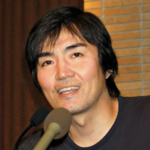
On October 8th, we lost Mark Pryor, a great craftsman of entertaining mysteries and thrillers, and an active and much loved member of the crime fiction community. He conceived unique heroes and anti-heroes with vivid settings. Not only was he a writer we admired, he was one we called a good friend.
His story was cool before he was even born. His father travelled on motorcycle across America on holiday from Britain where fell in love and brought the American lady home to marry. Mark and born and grew up in England with a love of soccer, where he studied journalism, then law. He used his dual citizenship to make a home in Austin, Texas where he practiced law as a prosecutor, mainly in Juvenile Court, and later as a defense attorney. He most valued his time with juvenile law, feeling he had leeway to hopefully get the perpetrator’s life back on track as well as get justice. However, what he valued most was his wife Sarah and three children, Blake, Henry, and Nicola.
His first novel, The Bookseller, he introduced us to Hugo Marston, the character he wrote about the most. Hugo, a former FBI profiler from Texas, worked as the chief of security for our embassy in Paris. When not indulging in his love of collecting and reading books, he finds himself dealing in mysteries often involving international intrigue. He is often assisted by his wild card of a CIA-connected buddy, Tom Green, his sometime girlfriend, French journalist Claudia Roux, and Parisian cop Lt. Camille Laurens, one of the first reoccurring trans characters in a mystery series to be written with dignity.
“He didn’t give readers a superficial tourist’s version of France,” explains James Ziskin, a friend who started out with him, roughly the same time when they were label mates at Seventh Street. “He wrote details that only an habitué would think to include. He knew the locations, the history, the language, and day-to-day minutiae that make a foreign setting ring true. Second, he was fearless in drawing his characters, for example Camille Laurens, a transgender police lieutenant who appears in several of the Hugo Marston books. It would have been much safer to write a policewoman or policeman. Then there’s his knowledge of the law, his sense of justice, and the expert plotting that runs through all his books. He was a gifted wordsmith, too.”
“His imagery was always so vivid,” adds friend and fellow writer, Puja Guha. “He could set the scene of where things were in a case, or how something happened along the Seine, or anywhere else, in a way that just made you see it in your head so clearly.”
Mark presented Hugo with just a few touches on his background, then revealing a little more with each book. However, he proved to be fully formed as Puja explains. “Hugo’s a great hero. Strong, capable, but also vulnerable and emotional. A really well-rounded character. I always just wished he could find real love in the series!”
His next protagonist, Dominic, proved to a complete opposite. Like Mark he worked as a juvenile prosecutor in Austin, but he was also a musician, as well as a dangerous sociopath. The books are a bitter, but oh so sweet, a dark chocolate mix of Richard Stark, Jim Thompson, and Patricia Highsmith. (For the record, Mark had only read Highsmith before he wrote the first book, Hollow Man.) When the two of us had dinner one night with noir queens Megan Abbott and Alison Gaylin, he listened intently while we talked about the genre. He later told me he was taking notes that evening for the book. When I asked if he ever thought of doing a book where he pitted Hugo and Dominic in a book, he told me if he was being true to the characters, Hugo could probably survive two chapters.
His last series lead, Henri Lefort, turned out to be his most complex. Introduced in Die Around Sundown, Henri, a homicide detective with a past, works the streets of recently occupied Paris. With small historical details and rich characterizations, he depicts the emotions and humiliation of living in a conquered society. He does have fun putting him in the same apartment Hugo will reside in in the future.
Recently, he returned to Hugo with The Most Mysterious Bookshop in Paris. Hugo retires from the embassy to open up his own bookshop. It opens with a beautiful passage with Hugo taking a morning stroll to the store, taking in the poetic glory of the city that reflects mark’s love for it. Of course, his old skills and reputation pull him in when he is asked to help a chocolate maker faced with blackmail. He delves into the making of the confections with fascinating detail. Many of the supporting cast returns. Pryor finished a second book, A Vintage Murder In Paris, that will be published in spring.
Mark was one of the most sociable writers I ever worked with. He often asked to tag along for dinners I’d have with authors who came into town for book events. One of these dinners led to a strong friendship he had with Phillip Kerr. He was a mainstay at Bouchercon, beloved by both authors and fans, all drawn to his charm and dry wit. To be around the god natured ribbing between James and Mark of who was the better author was hilarious. “I loved sparring with Mark. Of course, Mark landed more blows than he received, I can tell you that. He could slice you to pieces with his wit, and make you laugh at yourself anyway. We used to insult each other publicly whenever we got the chance, but it was all in good fun.“
Fellow Austin author, Mike McCrary described his personality in a nutshell. “Mark was the person you wanted to sit next to at that boring dinner. The one you hoped would be at the thing you didn’t want go to because he’d make it fun. He always made me laugh and rarely caught him without a smile.”
“He had the most mischievous smile,” says Ziskin. “That English accent. His generosity. His willingness to protect victims and champion the underdog. And, of course, his sense of humor. Everyone liked Mark.”
Mike recalls his mischievous one evening. “Noir at the Bar in Austin. A great example of his wit and his never-ending push to play with the unexpected. He went up on stage before me and he knew I was next. As he wrapped up he turned to the audience and said, “Be nice to Mike. He’s not used to crowds this big.”
One of my favorite memories of Mark is when I hung out with him at a Bouchercon opening party. He had a little too much to drink that evening and was feeling pretty loose. When he saw me the next morning he said with all sincerity and Cary Grant charm, “You were with me most of the night, who do I need to apologize to?”
“I feel like we became close friends after our first couple of conversations,” recalls Puja. “He always made sure no one felt left out and brought people into the discussion.”
He encouraged his fellow authors, reminding us that we were all in this together and we should take pride in what we can do in crime fiction and if you were friend, you knew you had someone who always had your back. He often helped out people who had legal questions about there book. He used Mr. Ziskin’s skills to do both a map and fictional family tree in two of his Hugo books. “Mark mentioned that he liked a map that had appeared in one of my books, so I told him I’d drawn it and offered to do one for him if he wanted. He told me which landmarks he wanted to include and I did my best. The family tree must have come about in the same way. It was something you do gladly for a friend.”
He used his books as a way to show his love for others. He often roped his kids into making funny promo videos. Many of his friends’ names popped up in his books for characters. I believe one of the reasons he turned Hugo into a bookseller was so he could namecheck his colleagues and promote their books in his own. With Mark, everyone was welcome in his world, whether the real or fictional one.

Scott Montgomery
A legendary crime bookseller, Scott Montgomery runs The Hard Word blog, https://www.thehardword.me. Always a crime fiction fan, Scott Montgomery worked on the sales staff of the acclaimed and influential The Mystery Bookstore in Los Angeles for four years.