Ron Currie Talks Craft,
Crime, and Creating the
World of Babs Dionne
"[Y]ou have to root your characters in something bigger than themselves"
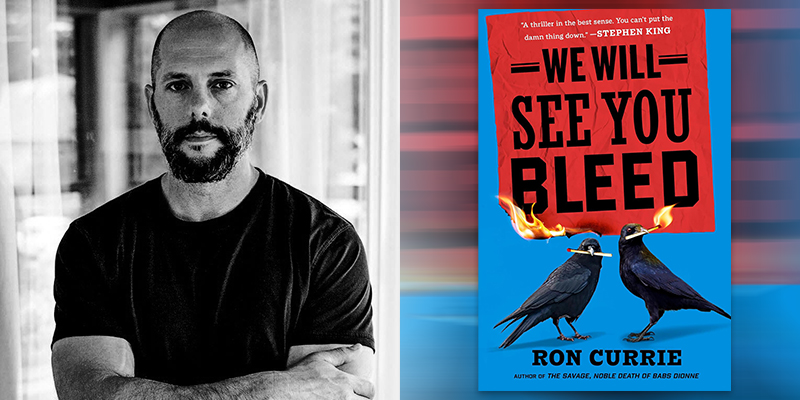
Last year, my best friend recommended Ron Currie’s The Savage, Noble Death of Babs Dionne, a book which had somehow avoided my own discovery until then. In Currie’s novel, we meet the titular Babs, a vicious, funny, and determined woman who will do anything to protect those people who are hers, these people she loves. The initial book is beautiful, hilarious, bleeding every emotion and raw bit of vulnerability that Currie is willing to share with us, but I never expected we would be gifted a prequel, We Will See You Bleed—a novel so intense, funny, suspenseful, and dangerous, I wanted to read both books back-to-back repeatedly. I was able to sit down with Mr. Currie and interview him about writing, his process, the books he loves, and where he plans on going from here.
Matthew Turbeville: Ron, I am so thrilled to speak with you about your newest novel, We Will See You Bleed. Before we dive too deeply into the novel, I wanted to ask you about your process and writing schedule and what really drives you to finish and polish and a book. Are you a morning or an evening writer? Do you have a certain number of words, pages, hours, or something else you measure your writing day by? What sort of setting or surrounding do you need to do your very best writing?
Ron Currie: I’ve found over the years that it’s best not to be too precious about how and when I write, though certainly, as with anything else you hope to do well, one should make a habit of it. When I work and the level of output I’m shooting for changes. When I’m in the midst of a first draft, it’s usually 500 words a day, five or six days a week. If I’m really pushing to finish something, that can shoot up to 2-3 thousand words, every day, and often that requires some kind of self-imposed exile; when I was finishing the draft of We Will See You Bleed, I ran away to Maine’s western mountains for a month with the dog. There’s no question that, if your life allows for it, going away and immersing yourself in nothing but the story can work wonders.
But anyway, the basic point, for the kind of person who cares about such details (other writers, I’m guessing) is to do your best to treat writing like any other kind of work. Show up to your job. Stay engaged with it for an honest amount of time. Results will vary, but if you do those two things often enough, sooner or later you’ll probably find you’ve written a book.
MT: It brings back a favorite character of mine from another one of your recent novels—Babs Dionne. There are so many elements at play, so many different parts, and I have to ask when you started writing Bleed and how far into the publication of The Savage, Noble Death of Babs Dionne? How much of this story was formed already?
RC: I started writing We Will See You Bleed well before Babs was published. I remember writing the scene where the first scab worker is kidnapped from the paper mill when I was in Los Angeles one afternoon while on a pre-pub tour for the first book. Putnam wanted a long runway to publication of the first book, which gave me a decent head start on the second.
I think maybe what you’re getting at with the question, though, can be answered this way: the larger story of Babs and her family and her girlfriends and her neighborhood had already, even before the first book came out, taken on a more expansive, mythic scope in my mind. I was aware of an entire world and timeline waiting for me to discover and articulate it. Which was a tremendous stroke of good luck. I’m still eyeball-deep in that universe and loving it as much now as when I started.
MT: I’m always a fan of prequels that work, and boy does We Will See You Bleed work. It feels like a novel almost entirely independent of Babs Dionne, and it packs so many punches, surprises, and even tender moments this prequel alone deserves a good rereading. How do you write a prequel to a novel without recycling everything you’ve said before, and how do you keep so much from us still about what happens before Bleeds, perhaps indicating there may be another prequel in the works?
RC: Thanks for the kind words! I think to successfully keep yourself from saying the same things or telling the same story, you have to root your characters in something bigger than themselves, and always approach them with that thing in mind. To me, with this story, it’s about viewing Babs and her people through the lens of recent American history—deindustrialization, misguided and poorly executed foreign wars, the perennial phenomena of prejudice and cultural violence. The failure of institutions, and how people respond to those failures at the ground level, which often means crime of some kind. That’s how we end up in a place where we’re writing a “crime story” that is hopefully about much more than the designation would suggest.
MT: Growing up, what books, movies, television shows, news stories, and more helped shape you as a writer? What do you feel or two or three that still find themselves in much of what you do, and how do you think they affect you as a writer?
RC: There’s no way to answer this question succinctly, so I’ll just offer something sort of anecdotal to illustrate how the many stories I consumed as a kid shaped the kind of writer I became. I was a voracious fan, even as a young kid, of the comic strip Bloom County. I think what I responded to was the combination of being genuinely funny in multiple registers (both clever and silly, sometimes all at once) and having a palpable moral seriousness that grounded all the shenanigans. I remember one Sunday strip in which the character Binkley has gotten it into his head that he wants to never harm another living thing. So he does the obvious stuff—stops eating meat, no leather in his wardrobe, etc. But then he realizes that even eating plants harms something and just walking around you’re likely to squash a bug or two. By the end of the strip, he’s hanging upside down from a tree branch by a length of rope tied to his toe—and he realizes that just by breathing, he’s massacring billions of microbes. The lengths he goes to are absurd, of course, but the whole thing also illustrates, with real seriousness, how difficult it is to act morally.
[I]nstitutions…fail when we cease caring about anyone but our own people. And when institutions fail, people will take the functions of those institutions into their own hands.
MT: Babs Dionne has got to be one of my favorite characters I’ve discovered in the past few years, and I love that she’s at times completely unlikable, and yet you root for Babs so hard. What’s the key to writing tough, (often, if not always) unlikable characters, and developing your novels so that the reader will root for them, and keep rooting for them past the final page? Do you have any examples of characters like this you love in other novels and stories?
RC: I’ve thought a lot about this kind of thing over the years, and the honest answer is I’m not really sure how to do any of that. What I do feel like I know is my obligation as a novelist is not to provide characters that readers like. Rather, I have to render characters in a way that makes it possible for readers to understand and believe the choices those characters make, however much they might dislike the characters for making them.
MT: I love you fully embracing the crime novel with your last two novels, your voice rough and as deeply a part of your characters’ world as their setting, their own personalities, the people and actions that make up their day-to-day lives. What made you decide to write a crime novel to begin with, and what makes rural Maine so perfect for these books?
RC: I like a good frothy yarn as much as the next guy, and ultimately, I just want to do my own little part to undermine what seems to be a cultural belief that stories can either entertain or show us something startlingly true about being human, but not both. Put another way, I want to lead by example in demanding that meaningful stories not bore us and entertaining stories not cost us five IQ points every time we read one.
MT: We were talking about prequels earlier—well, I guess we have been talking about prequels this whole time—but do you think you’ll write another prequel to Babs Dionne, either set before We Will Make You Bleed, or one set after and before The Savage, Noble Death of Babs Dionne?
RC: I’m already working on a novel set eight years after the events of Babs, which makes the story more or less contemporaneous: 2024 or thereabouts.
MT: I love in the beginning of the book you reference different writers and their chosen (made up or real) locales to set their stories in. You claim “and we…had a dying, decaying mill town perched on the edge of a river,” in your dedication to Gary David Socquet. What do you think is so important about establishing a place, a whole community of people and wild and interesting individuals who can populate your stories and appear again and again in your work set there, in Little Canada, but at different times, different events?
RC: Well, it’s important for a whole host of reasons, not least because utterly convincing the reader of the reality of your world is critical to a story’s success. And following characters/families across time in the same place, if you do it well, can make a story feel larger than its own small circumstances and events. It creates the sense that real life is teeming at the edges of the place and time you’re writing about. It gives a sense of continuity, the relentless passage of time, maybe even a sense of the eternal nature of creation, and how we’re all less than nothing in its grip.
MT: Why do you think this book is so necessary right now? What do you think Americans, as well as readers abroad, will gain from reading and understanding the stories of these characters and how their bad decisions and poor choices in judgment create a terrifying storm none of them can control?
RC: I mean, I don’t want to give the sense that these stories are terribly didactic—I intended for them to be proper shitkickers—but that said, I think one sort of thematic takeaway could be that institutions—government, the law, democracy itself—fail when we cease caring about anyone but our own people. And when institutions fail, people will take the functions of those institutions into their own hands. Often, we call this phenomenon “crime.” But Babs would tell you that crime, as we think of it, only exists within the context of a legal system that protects and restrains all in equal measure. Otherwise, the law is rendered illegitimate, and what you call crime someone else likely calls survival.
MT: Do you think it’s wrong to write about politics in fiction? I know that’s kind of a hot topic now, and while I’m impartial, I do have to ask how it’s less stirring to have someone beaten and murdered in a novel than discussing an important issue at hand in our country today.
RC: As with anything else, it all depends on how you do it. If you’re writing “about politics” in the service of a story that’s really about very particular people with very particular problems and is honest about what we are as a species, then congratulations—you can write about politics. If you’re writing “about politics” principally because you have an axe to grind or an agenda to push, your story will be bad, guaranteed.
MT: Thank you so much for allowing me to interview you, Mr. Currie. It has been so excellent getting to know you and your writing. I’d love to close up by asking after anything you might have coming up soon, whether you have future books planned, a book tour, or anything else in mind. I really hope everyone will read all about Babs Dionne.
RC: I’ve got a little tour for the new book, and then I’m shooting back to Los Angeles, where I’ve been busy adapting Babs’ stories for television. Hopefully there will be more happy news on that front before too long.

Matthew Coleman Turbeville
Matthew Turbeville is a librarian and writer based out of South Carolina. He has published short stories and essays in various publications, including Deep South Magazine and the South Carolina Review. He frequently interviews writers across all genres on www.writerstellall.com.