
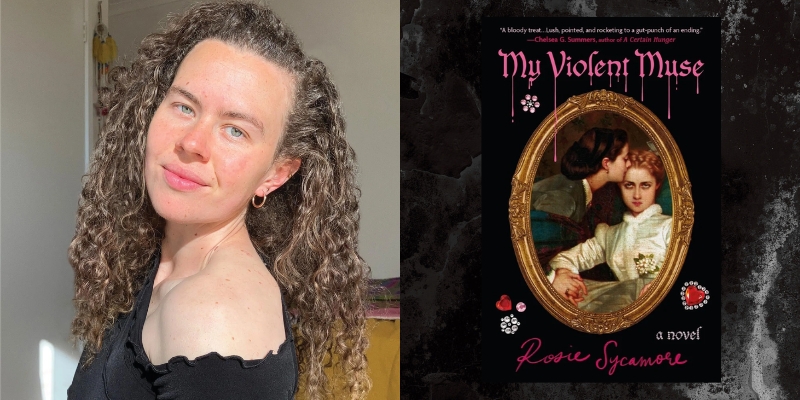
Rosie Sycamore on Horror, Female Rage, and Feminist Critiques of Animal Exploitation
The author of My Violent Muse draws lines between artistic expression and exploitative cruelty
Horror is huge right now. We’re seeing it in the furious surge of female rage in books, and we’re seeing it on the screen, too, such as Curry Barker’s Obsession. But what if this rabid hunger for horror in fiction claws beyond the page or the screen? What if our artistic expression itself becomes composed of cruelty?
Agustina Bazterrica drew a poignant and visceral spotlight onto a similarly stranger-than-fiction state of reality in her novel, Tender Is the Flesh: what if we lived in a world where humans became the food source? Bazterrica refers to her work as a “meditation on what capitalism is—[that] it teaches us to naturalize cruelty,” further stating that patriarchy is a part of the capitalist system.
When Dorothy Daniels derobes a man of flesh with meticulous precision inside his own abattoir, in Chelsea G. Summers’ iconic A Certain Hunger, it is horror. But replace that man with an animal, suddenly it is cruelty we deem acceptable and desirable. Sometimes, we call it art.
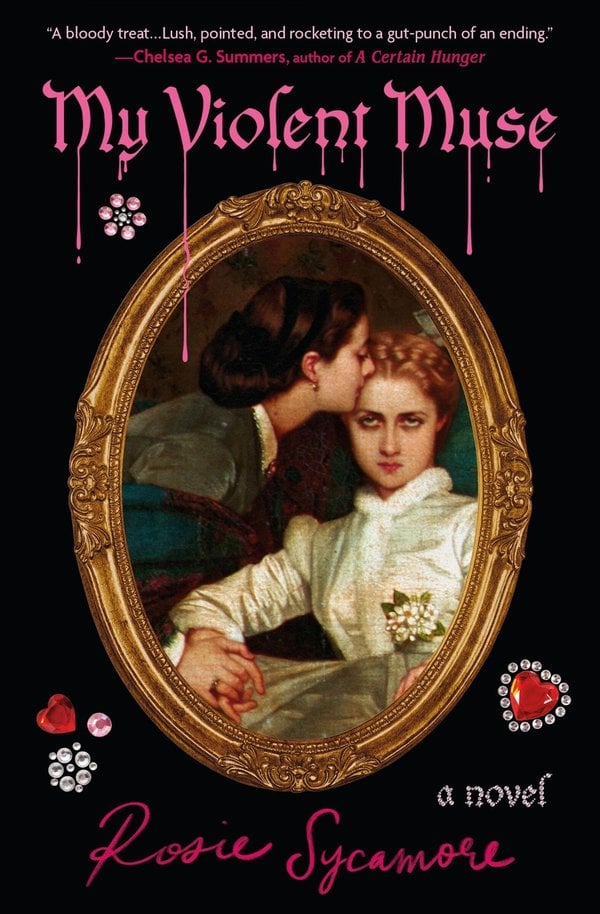
This concept of moral rot wove itself into my novel, My Violent Muse. The idea that if a man is willing to objectify and exert his will over a life for his own benefit and desires, how can we trust what kind of life that might be? Because exploitation of animals inherently requires entitlement to their bodies and lives. That, as recognized by Rob Percival in his 2022 book, The Meat Paradox, there is a total absence of consent in our decision to use and consume their bodies for our enjoyment.
In Obsession, Bear denies Nikki the right to consent, despite numerous grim hints that she is suffering beneath his wish, because the girl of his dreams is finally his! In Drew Hancock’s Companion, Josh’s idyllic relationship shatters when his AI girlfriend, Iris, gains autonomy.
The darkest sides of objectification are all over horror fiction—perhaps because it’s not such an unfamiliar landscape. With our very-real collective decision to objectify, exert dominance, and deny animals the respect and right to life, it makes me wonder how far this ideology might creep.
In artists’ Sun Yuan & Peng Yu’s Dogs That Cannot Touch Each Other (2003), a pair of fighting-bred American Pit Bull Terriers were placed on opposing treadmills and conditioned to run toward each other, observably to exhaustion, with the work framed as an examination and critique of systems of power and control.
The video-recording of the work was pulled by the Guggenheim in 2017 following pressure from animal rights groups, and has since met backlash over the rights of artists to show their work, with some claims that our right as humans to express ourselves artistically should override an animals’ right to life. The dominance and control exerted over the dogs by the artists is a clear statement of their intention—they are exercising systemically normalized control over another creature in order to provoke conversation, because they can.
This incites the question, to what extent is it acceptable to engage in dominance and control over another for the purposes of art? Is it ever morally acceptable to refuse consent in pursuit of artistic expression? And where, exactly, do we draw the line on engaging in exploitation in art for the purposes of commentary on exploitation itself?
The use of animal lives in art is not niche. There’s Guillermo Vargas, who in 2007 as part of a work titled Exposición N.1, captured and tied a stray emaciated dog to a wall with the phrase “You Are What Your Read” spelled out in dog biscuits and placed out of reach. Allegations arose that the dog either starved to death, or was re-released as a stray following the exhibition.
Vargas refused to comment on the fate of the dog, instead noting that, despite vocal uproar after the exhibition, no effort was made by the public to free the dog during the work. Vargas framed this as a statement of hypocrisy over the lack of aid offered to those starving on the streets.
Or there’s Adel Abdessemed, an Algerian contemporary artist who stirred fury with his 2008 exhibit titled Don’t Trust Me, which featured looped video recordings of animals being bludgeoned to death. Whilst Abdessemed might claim such demonstrations as provoking attention over his own experiences of violence in Algeria, it begs the question—why is it acceptable for us, as humans, to inflict trauma on others in order to make a statement?
It appears to be a consistent theme amongst these artists: the intention to use their work as a platform to create conversation over hypocrisy and ignorance. They seem to speak as if their actions are for the animals, as if that should override the grotesque heart of self-promotion, entitlement, and potential profitability.
A similarly flawed-altruism can be seen in Belgian artist Wim Delvoye’s claim to be “saving” pigs from Chinese slaughterhouses by tattooing their skins, and later slaughtering them to display the skins as artworks. Whilst the pigs may have been rescued from an immediate death, it is worth considering that Delvoye intentionally carried out his work in China due to lax animal welfare laws. Delvoye painted himself as a savior for gifting these pigs what he deemed a valuable existence as art-pieces, rather than butchered meat.
This level of objectification and enforcement of a value system demonstrates a blatant lack of respect for beings who, effectively, are silenced. This self-serving cruelty and objectification perhaps mirrors what we see in Obsession’s Bear, and Companion’s Josh, both men repeatedly choose the versions of Nikki and Iris, respectively, who lack autonomy and voice.
The power they hold over these women suits them, despite numerous attempts by both women to protest this dynamic. They prefer when Nikki and Iris don’t talk back, the same way that animals are not able to when being provoked, starved, bludgeoned, or tattooed.
Feminism by nature rests on the will to de-centre systemic patriarchal systems and to demand equality across all individuals. It asks us to reconsider social norms and capitalistic hierarchical power structures.
Thus, it seems necessary to me when considering the objectification, entitlement, and dismissal of consent inherent to use of animals for art, to acknowledge exploitation of animals as a feminist issue. Let us as humans not be the kind of collective that silences, exploits, and perpetuates horror and suffering of others for the sake of our own expression and desires.
*

Rosie Sycamore
Rosie Sycamore is an Australian author. When not writing or reading, you'll find her following the sun, trying to befriend every animal in sight, or re-watching her favorite films and TV shows. My Violent Muse is her debut novel.