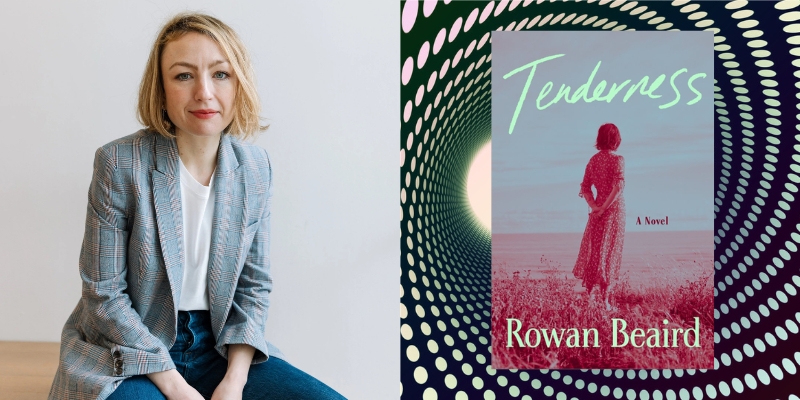
Rowan Beaird on the Enduring Allure of Cults in Times of Uncertainty
The author of Tenderness reflects on a culture's shared obsession
Over the past few years, when I would tell people I was working on a book about a cult, everyone seemed to be an expert on the subject. Had I watched the series about the one out in Oregon? The one about the kids at Sarah Lawrence? Did I know about the one where the founder ingested colloidal silver, the one that prescribed orgasmic meditation, the one where they inexplicably played volleyball every night?
I started to realize that this obsession I had with cults—something I’d often consciously avoided talking about, not wanting to silence dinner tables with mentions of mass suicides and thetans—was actually a shared obsession.
I was not unique in my fascination, and I wanted to know why. What about our current moment draws people to these fringe groups, whose beliefs and practices often feel so incomprehensible?
My novel, Tenderness, is set in the 1970s, when there was a surge of cult activity in this country. The trial of the Manson Family made headlines, and the Children of God took root in California. Synanon, the organization that one of my characters joins, and Scientology aggressively expanded, and countless Americans moved to the desert, started communes, and founded “communities.”
The idealism of the 1960s—the belief that this country could change for the better—was fading, and the world was feeling increasingly unstable. Paul Ehrlich, a frequent guest of Johnny Carson, published a book called The Population Bomb, warning that a famine was imminent and hundred of millions would be dead within the decade. The Vietnam War raged on, and Watergate proved that even presidents were criminals.
Scarcely a year passed without a major food and drug scare: synthetic hormones in beef and nitrites in 1972, red dye number two in 1976. Gas shortages left people unable to fill their tanks.
Doesn’t this sound familiar? Unjust wars, corrupt politicians, devastating climate shifts?
The 1970s was also a time of huge technological advancement—the birth of modern, personal computing and the invention of the cell phone, the VCR, and the portable cassette player. Alexis Redding, a professor at the Harvard Graduate School of Education, recently unearthed unpublished interviews with Harvard students from the 1970s, where they’re lamenting that they’ll never get jobs because of technology in the exact same way students today fear that AI will make them unemployable.
Everything was changing. Everything is changing. In 1974, French President Valéry Giscard d’Estaing said, “The world is unhappy. It is unhappy because it does not know where it is going and because it senses that if it knew, it would discover that it was heading for disaster.”
In my research, I found that people are most likely to join a cult when they’ve experienced loss. When they leave a church, leave a home, leave a marriage. When a foundational structure in their life is collapsing, they look at the rubble surrounding them and wonder, where can I find shelter?
I used to find comfort in the idea that I would never be susceptible to a cult. I have a college degree, a stable family, and a strong community of friends, but in my reading, I found this is true for most cult members. They’re people just like you and me, who happen to be preyed upon in a moment of instability, much like the one we collectively find ourselves in.
When Obama was elected, many of us believed that the moral arc of the universe was indeed bending toward justice, but now, it doesn’t feel like there’s an arc at all, only a chaotic tangle.
I think we’re obsessed with cults right now because we’re all much more vulnerable to them than we realize. Because we understand the pull to the desert, to the commune, to the group of people telling us that yes, everything we thought we knew is a mirage, but don’t worry—they’ve figured it all out. Sell your belongings. Take these courses. Move into this house. You don’t have to be alone anymore, and you don’t have to question anything, because we have all of the answers.
In a time of fear and uncertainty, what isn’t appealing about that?
In writing Tenderness, I not only had to think deeply about why someone would join a cult, I also had to consider why someone would leave one. I believe that part of what draws us to a cult—the desire for connection and community—is also what can pull us out. The title of my book is inspired by the early name for Synanon, which was Tender Loving Care, an ironic collection of words for an organization that would treat many of its members so brutally in the years to come. I fixated on that word, “tenderness,” because I think it’s both the illness and the cure.
We join cults when we feel at our most vulnerable, but in order to find our place in the world and change it for the better, to stop endlessly repeating history, we have to be our most tender selves. We have to be open and honest with those we love and let them know when we need help. We have to show up for family. Make new friends. Talk to strangers. And if we need an icebreaker, the good news is: nearly everyone enjoys talking about cults.
***


Rowan Beaird
Rowan Beaird's fiction has appeared in The Southern Review, Ploughshares, and Gulf Coast. She lives in Chicago with her husband and daughter. She is the author of the novels The Divorcées and Tenderness.