Ru Marshall on the Curious Lives and Legends of Carlos Castaneda
An excerpt from American Trickster: The Hidden Lives of Carlos Castaneda
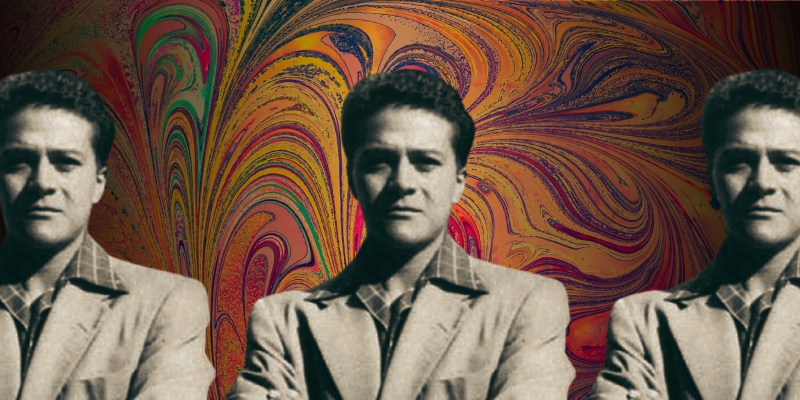
Carlos Castaneda began his rise to fame in 1968, while he was still a graduate student at UCLA, with the publication, by the University of California Press, of his first book The Teaching of Don Juan. It told of his apprenticeship with a mysterious Yaqui shaman, don Juan, who, using three psychotropic plants—Datura, mushrooms, and peyote—supposedly introduced the fledgling anthropologist to a mode of cognition never before revealed to a “westerner.”
Castaneda’s books, hailed at first as a groundbreaking contribution to anthropology, would go on to become among the bestselling nonfiction titles of the seventies, and would make him a hero to such figures as Joni Mitchell, Bob Dylan, Octavio Paz, Federico Fellini, George Lucas—who derived his concept of “the force” from Castaneda—and the philosopher Gilles Deleuze. It took five years before someone—that someone being Joyce Carol Oates in a letter to The New York Times—would publicly question whether the books were in fact novels (she was right, they were).
It would take many more years for anyone to learn of the highly secretive cult Castaneda had begun assembling the same year he’d started work on The Teachings. Not until the nineties, when book sales finally began to slump, did the group go public, holding workshops around the world. In which Castaneda and his “witches” taught a movement technique called Tensegrity—a term he’d nabbed from Buckminster Fuller—which, Carlos claimed, had been passed down by twenty-five generations of Toltec shamans, and which, he promised, could, if practiced with sufficient diligence, bring his followers not only physical agility but also, perhaps, eternal life.
*
Cultic groups invariably start small, often with just two people: the leader and his first follower (although there are female cult leaders, the vast majority are male). In Castaneda’s case, it’s fair to say there were two. Both of whose stories remain mostly shrouded in shadows.
In the era of AI, it’s a common error to believe that all knowledge is easily available. But most of what happens in the world is never recorded. And in Castaneda’s group, what was recorded was often later destroyed. Numerous aliases were also employed. His first two followers would, over the years, go by many different names. One would seem, to her family, to have vanished from the face of the earth. In 1960, when they first met Carlos, they were Judy and Joanie. Before he had witches, he had his “winds”—they were his first. They were both good girls.
Carlos first met Joanie Barker and Judy Ames through his best friend, Alan Morrison. Alan and Carlos had met in 1956 in Vernon King’s creative writing class at Los Angeles City College. Carlos had arrived in the United States five years earlier from Peru, where his name had been César Arana. He’d had multiple reasons to leave Peru, and would change his name many times; when Alan met him, he was going by “Carlos Aranha.”
One day King announced to the class that one of the students wanted to read a poem, but didn’t speak good English. Could someone read it for him? Alan volunteered. Fifty years later, he still remembers two fin-de-sieclish lines: “Death the Lady / Came creeping in on butterfly wings.”
Alan and Carlos soon became friends. At first Alan thought Carlos shy. “He always presented himself, when he first met you, as a peasant. He’d act as if he couldn’t speak English very well. But his English was better than mine. Carlos was very well read. A scholar as well as a bullshitter.”
Both Alan and Carlos drove taxis. Both were aspiring writers. Carlos had studied art in Peru before coming to the U.S. in 1951; he still sometimes sculpted but no one—himself included—seemed too impressed by his output. “I once made a pretty good monkey,” he’d later tell a disciple.
He and Alan discussed literature: Melville, Joyce, Robbe-Grillet. They were both movie addicts, and shared a dark, anarchic sense of humor. Carlos, Alan recalls, always wore a suit to school. He rarely met Carlos’s other friends. “He knew a lot of people but kept them compartmentalized. Carlos was always standing me up. Never had a phone, so it was impossible to reach him. But you couldn’t stay mad at him. Everybody loved him. Even my mother-in-law, who was a total racist. But Carlos charmed her.”
He didn’t just seduce mothers. Alan: “He had more women than was possible. He wasn’t attractive. But he charmed the hell out of the female world.” Among the women he charmed was Margaret Runyan, a mystically inclined and strikingly beautiful telephone operator to whom he was briefly married.
In 1960, in the wake of the marriage’s breakup, Carlos seemed, to Alan, like a lost soul. That spring, Alane invited his friend to come live in a small apartment building Alan managed on Madison Street, near the LACC campus. He and Carlos called the building the Figgy—since it was owned by a Mr. Figgy. After graduating with an associate’s degree from LACC, Carlos had gone on to UCLA, where he planned to complete a BA in psychology and to continue studying writing. Alan had gone on to Cal State, where he enrolled in a class on British literature taught by Christopher Isherwood. In which he met Judy Ames.
Readers of Castaneda’s later books may remember the fearsome witch, La Gorda. What none could have known was that she was loosely based on Judy. Besides La Gorda, the other names Carlos would give the woman he once dubbed “Judy Names” would include Cassandra, Cecilia, and “the fatso” (she was at most ten pounds overweight).
Changing your name can be liberating, unmooring you from familial and societal expectations. This unmooring can also, in cultic groups, make you easier to control. Judy sometimes also, while in his group, used the name “Beverly.” This was in fact her birth name, although, growing up in Alhambra, a suburb east of LA, she’d never used it, going instead by Judy.
Attractive and shy, Judy didn’t date, drink, or smoke. Her father, Walter Ames, a TV critic for the LA Times, knew many stars. At Christmas, Dean Martin and Frank Sinatra would send gifts. Judy worshiped him. Her mother Dorothy was prone to nervous breakdowns and was treated with electroshock. Dorothy was a Christian Scientist, but Judy became disillusioned when she failed in an attempt to spiritually heal her dog.
Judy enrolled at the University of Redlands in 1956, but left after two years, and enrolled at Cal State. Alan would, years later, recall the first time he saw her. He was smitten—at first by her legs, then by her intelligence. He began to pursue her, albeit in a half-hearted manner. He was married, and although the marriage was on the rocks, he was deeply devoted to his young son, and worried he’d lose him if the marriage broke up.
Judy took Alan to meet her parents. They weren’t pleased she was dating a married man. Back at the Figgy, Carlos wasn’t pleased either. Alan’s indecisiveness disappointed him. To be able to discuss Judy in front of Alan’s wife, Carlos came up with a code. “Have you seen Dr. Livingston?” he’d ask. He wanted Alan to fuck her.
But Alan explained to Carlos that because Judy was living with her parents, this wasn’t going to happen. Carlos wasn’t convinced. In the Don Juan books, drawing on and paraphrasing Sartre and Nietzsche, Castaneda would stress that, to become a warrior, one needed to act decisively, to grasp one’s “cubic centimeter of chance.” In 1960, the year that, in his fiction, he met his indigenous mentor, he was constantly pushing Alan to be bolder.
Alan, as the building manager, got to select the Figgy’s tenants, and had curated a semi-bohemian scene—mostly young men who aspired to be writers (there was one pornographer also in residence). The young men would hang out, drink, read poetry, play records. One of the tenants sang opera. “People would request arias,” Alan remembers, “and he’d sing them.”
Mild as a wild night of opera might seem, the young men still got drunker—and louder—than Alan liked. Carlos, throughout his life a teetotaler, felt the same way. Both were part of the group, both remained on its fringe. “We were trying to write,” Alan recalls.
Sometimes the noise made this impossible. One night Carlos came down to the basement. I was working there. He said, “How are we going to shut these guys up?” I said I didn’t know. He said, “Morrison, why don’t you turn off the electricity?” I told him, “I can’t do that!” Carlos said, “Sure you can.” So I did. Then we went to the movies. When we came back, everyone was wandering around outside. Carlos and I played innocent.
Judy moved out of her parents’ house, into an apartment on Veteran Avenue. She had three roommates. Alan: “They were always there. So we never had sex.” Castaneda, underwhelmed: “Take her, Morrison, take her. If you don’t I will.”
One of the three who thwarted Alan’s ambivalent desires was Mary Joan Barker, always called Joanie or Joan. Later, Castaneda would give her the name Stephanie and call her “don Juan’s first student.” She too would go on to study anthropology. He’d say he owed her a great debt. For?
Joan had a job working as a clerk-typist at the UCLA library, where, while supposedly in the Sonoran desert with don Juan, Carlos did much of the research for his first book, likely with Joan’s help. She may also (like Margaret) have helped financially.
And she’d grown up in Banning California, near the Cahuilla reservation, where, just months before he met her, Carlos had been taken by his friend, the future anthropologist Lowell Bean, who’d introduced him to Salvador Lopez, the last of the Cahuilla fire-eaters. And to the Malki Library, where Carlos would have access to information about the mythology surrounding the use of Datura in initiation ceremonies, knowledge he’d later say had been imparted by don Juan.
Joan’s father, whom Carlos would take a liking to—Joan would be one of his few disciples not required to cut off her family—was a rock-ribbed conservative who ran the local savings and loan. Although Alan found his daughter mousy, Banningites remember Joan as perky. Growing up, she played tennis, joined the Girl Scouts, and, after Banning High, enrolled at Redlands, where she majored in art, and met Judy. After graduating, she was hired to work at the library (Alan recalls Judy working there too).
Carlos had, in the fall of 1959, taken mostly psychology classes. But in the spring, he’d switched his focus to anthropology. The curious catalyst for this decision seems to have been his reading of The Sacred Mushroom by Andrija Puharich, a CIA backed psychic investigator who’d conducted a supposedly scientific investigation of a Dutch sculptor, Harry Stone, who, channeling Ra Ho Tep, an Egyptian from the fourth dynasty, had revealed the secrets of a long lost ritual involving sacred mushrooms.
In Puharich’s book, Castaneda read about R. Gordon Wasson, the banker and amateur mycologist who’d been introduced by the curandera Maria Sabina to psylocibin mushrooms, and who’d in turn gone on to introduce shrooms to the North American public.
The next semester, Castaneda signed up for three anthropology classes, including in Methods of Field Archeology, taught by Clement Meighan, in which he was given an assignment: interview an Indian. The paper he turned in, which related his supposed encounter with an as-yet-unnamed informant who related his experience with Datura, greatly impressed Meighan, who would become one of Carlos’s prime UCLA sponsors. It was from this assignment that the don Juan books were born.
Carlos kept begging Alan to introduce him to Joanie. Alan wasn’t sure why. He was certain she wasn’t his type. But he agreed. “Carlos liked tall women. Statuesque. Joanie was skinny, frizzy-haired. About as straight as you could get. So was Judy.”
One night, Alan invited Carlos over to the apartment on Veteran Avenue. He soon learned that he’d been wrong about Joanie’s appeal. What he might not have counted on, besides Joan’s father’s connection to the Cahuilla reservation and her job at the library, was the depth of Carlos’s need not just to seduce—but to control. Put another way, his need to have others who would reinforce his imaginary world.
Margaret, who’d had her own spiritual path, hadn’t been much interested in the stories Carlos was starting to tell about the mysterious man he’d met in the desert. That night, Alan went into the bedroom with Judy. Once again, he failed to do the deed. When he and Judy came out, Alan was surprised to find his friend deep in conversation with Joanie.
They were soon an item. Carlos cut Joanie’s hair—she now looked, Alan would recall, like Audrey Hepburn. Alan, Judy, Carlos, and Joanie, were briefly a social foursome. One time Alan was out with Judy and Joanie. Carlos had told them he was working at Schwab’s Pharmacy in West Hollywood. They decided to stop by and visit. But Carlos wasn’t there. Soon after, they stopped in at a nearby grocery store. There he was, stacking cans. Everyone, Alan remembers, had a good laugh.
But later he’d wonder: why had Carlos lied about something so unnecessary? “Everything was a twisted thing…that was the essence of Carlos. He felt it was his obligation—or his destiny—to make up stories.”
Years later, when doubts about the veracity of Castaneda’s work began to arise, his defenders would argue that the scale of his alleged deception was so grand that these charges seemed improbable. Why would anyone go to so much trouble? But for Carlos, it wasn’t trouble. Lying for him was an art, and he did it exceptionally well.
And knew, like the best practitioners of this art, that bigger lies worked better. In the fifties and sixties, he’d often tell Alan that his “compulsive truth telling” was a form of privilege. And was lazy, too.
With Joanie in the picture, something in their dynamic began to shift. Joanie was more and more at the Figgy. She acted, Alan felt, very protective of Carlos. “She was like his guard. She treated me like an interloper. I got a contract for the two of us to paint the halls at the Figgy. It was supposed to have been one hundred dollars. We were going to split that.”
When Alan came to collect his share, he found that Carlos had, for unknown reasons, renegotiated the contract down. They’d only been paid fifty dollars. “I hadn’t renegotiated it, so I wanted my fifty. Carlos gave it to me, meekly. But then Joanie thought I was taking his money.”
*
Perhaps frustrated with Alan’s ambivalence, Judy began seeing another young man, Al Guilford, a Yale student who was visiting relatives in Los Angeles and taking classes at UCLA. She soon became pregnant. She didn’t want to marry Al, nor did she want to keep the child. She made a plan: she would go to Europe, have the child there, give it up for adoption. But when her father got wind of this, he ordered her to come home and marry Al. Judy, who adored her father (a trait shared by many of Castaneda’s women), obeyed.
She married Al. They moved east.
In 1962, Carlos entered the graduate program. His admittance, due to a less than stellar transcript, was hardly guaranteed. It was facilitated by the fact that Meighan was, that year, the department chair, and by the support of the anthropologist Ralph Beals, a specialist in Yaqui culture, who would later come to be one of the few faculty members at UCLA to own up to having been deceived.
But Castaneda’s greatest champion at UCLA would be Harold Garfinkel. Garfinkel was the founder of ethnomethodology, a school of sociology that focusses on the hidden assumptions that make daily life possible. One of ethnomethodology’s central principles is that “reality is an agreed upon description.” When Carlos reported to Garfinkel that don Juan had said precisely the same thing, his mentor took this as confirmation, not as mirroring. Or mimicry.
In 1965, likely in part out of fear of taking his qualifying exams—he’d always had a fear of exams—Carlos dropped out of the program. As far as many in the program knew, he seemed to have disappeared. Then, in 1967, he appeared in Meighan’s office. He handed him the manuscript of The Teachings, which Carlos hoped to have published as an academic monograph. But when Meighan read it, he told him it should be a trade book. And instructed him to take it to his friend Jim Kubeck at the University of California Press.
Which published The Teachings in the spring of 1968. It had an introduction from the highly influential and powerful Walter Goldschmidt, the head of the anthropology department, who would soon go on to become the president of the American Anthropological Association. With Goldschmidt’s endorsement and Garfinkel’s behind-the-scenes support, enthusiasm for the book spread rapidly in academic circles.
Then, on August 14th, it was reviewed in The New York Times by the novelist Charles Simmons. The Teachings, wrote Simmons, “is an extraordinary spiritual and psychological document. Its style is so severe and yet easy, its narrative effects so expert, that if it had been published as a novel it would be, I think, destined for fame.”
Simmons had gotten it backwards. Among the most radical aspects of Castaneda’s fiction was the choice to present his novel as nonfiction, to break down the barrier between art and life as he would do in an even more extreme manner in his cult. In which he would turn his followers into characters in what he’d refer to as his “theater of the real.”
But Simmons wasn’t wrong about the Teaching’s prose. There is a spare and haunting quality to Castaneda’s first book that he’d never quite again achieve. This is likely due in part to the help he received from Al Guilford, the young man who’d impregnated and then married Judy. After the shotgun wedding, Al had finished his semester at Yale, and then returned to California, where, on May 7, 1962, their son Adam was born. The new family had then gone back East, where Al got a job as a salesman for the Oxford University Press.
Carlos and Judy had remained in touch. Back in California, he’d tell friends that he had a job selling books door-to-door for the OUP. He didn’t. In the Don Juan books, he’d plagiarized, often brilliantly, from the work of other anthropologists as well as accounts of the experiences others had had with psychotropic plants—this was in part what lent The Teachings its aura of authenticity. Similarly, he constructed the story of his life from tales borrowed from others.
He was, he once remarked, “a bag of stories.”
*
The Guilfords’ marriage had soon begun to deteriorate. Pip Howard, Al’s girlfriend at the time of his death in 2001, recalls, “Al was always on the road. Parties, drinking. He was very charming. Women followed him.” Judy was miserable. She wanted to move back to California. She remained in contact with Carlos.
In an attempt to cement the marriage, Al and Judy had another son, Eric, who was born April 16, 1965, and soon diagnosed with dystonia, a disease similar to Parkinson’s. “Judy had bonded intensely with Adam but couldn’t with Eric,” recalls Pip. Her unhappiness increased. The couple moved back to California, to Berkeley, where Al worked for the Livermore labs. Soon after, unexpectedly, Judy’s father died.
Adam Guilford: “The way my dad put it was that Walter’s death was more devastating to Judy than any death had ever been to anybody in history.” Meanwhile, Al drank heavily and was likely seeing other women. In August 1967, they filed for divorce. Judy moved back to LA, where her mother lived.
As did Joanie and Carlos.
Judy got a job teaching kindergarten. And Al began helping Carlos with his manuscript. The details of their relationship remain murky: Al, who spoke freely about most everything, would, until his death, remain silent about his famous former friend.
Adam, however, recalls Castaneda clearly.
I was about five. Carlos would come visit quite regularly. He’d cut my hair. He’d say, “I cut your hair straight ‘cause the barbers don’t know how.” He’d take us interesting places. He believed in the idea of the power spot. Which isn’t nonsense—there’s substance to some of what he says. He’d take us to a place near Chávez Ravine, close to Dodger’s Stadium. There was an area with these really interesting sculptured gardens where Mom and Carlos liked to spend time. They’d just sit there and talk while us kids went back in the woods and played.
We loved Carlos. He was very nice and affectionate. He bonded with us. It seemed like he was really fond of us, especially me. But I did suspect they were having an affair. He and my mom would disappear behind closed doors, in her bedroom, at night. I do believe I walked in one morning and they were in bed together.
*
Carlos, who’d been on a sort of unofficial leave of absence from the grad program—he’d basically just disappeared for three years—was readmitted. Although many reviewers assumed The Teachings had been his PhD dissertation, this was not the case; it served, ex-post-facto, as his master’s thesis.
To promote the book, he toured up and down the West Coast, giving talks at colleges. Superlative reviews continued to appear, including a second one in The New York Times, this one in the Sunday Book Review. Theodore Roszak, writing in The Nation, concluded that “one cannot avoid feeling that something of the hidden origins of our religious consciousness is being laid bare.” A highly positive review also ran in American Anthropologist.
Jim Kubeck, one of Castaneda’s editors at the University of California Press, understood that Carlos needed an agent, introduced him to Ned Brown, who represented clients as diverse as Jackie Collins and John Barth. Brown soon made the arrangements for Carlos to meet with Michael Korda, the newly appointed editor of Simon and Schuster, who would be instrumental in transforming Castaneda from a counterculture sensation into the massive international bestseller he would soon become.
*
While all this was happening, Carlos continued to write at a prodigious pace. And to put an extraordinary amount of work into the assembling of his alt-family. Adam Guilford would later be told that after she moved back to L.A., his mother had begun seeing a psychiatrist. “He was the one—story goes—who suggested she give up her kids.”
Judy had never succeeded in bonding with Eric. It couldn’t have been easy: dystonia causes involuntary muscular contractions, trembling, terrible cramping pain. She wanted to keep Adam, send Eric to Al. But Al told her, “This isn’t a business. You can’t pick and choose.”
Maybe a psychiatrist did urge Judy to give up her kids. More likely the “psychiatrist” was Castaneda. Perhaps it’s unfair to Judy to see her as merely manipulated by Carlos. She would, while living with him, go on to become a skilled martial artist. She took courses at a business school, and managed the group’s financial affairs (Carlos called her the “business school wind.”) She cooked, and she typed Castaneda’s manuscripts for him in the garage of his Westwood home.
In his fifth and sixth books, The Second Ring of Power and The Eagle’s Gift, La Gorda, the Judy-based character, more or less takes on the role played earlier by don Juan. Who has, by this point in the narrative, ascended into the heavens, accompanied by his “sorcerer’s party”—as Carlos told his followers he too would. In the books, Castaneda frequently professes awe for La Gorda’s ruthlessness—particularly when it came to breaking attachments to children.
One night, at dinner with two young male apprentice sorcerers, while Carlos regaled the group with a story about don Juan, she started hooting—to the young men’s amazement—”bullshit, bullshit, bullshit!”
*
The years passed. Oates’ letter appeared. A few months later, Time Magazine published an expose revealing that almost everything Castaneda had said about who he was and where he came from had been untrue. This didn’t deter UCLA from, eighteen days later, granting Carlos a PhD.
Nor did it deter The New York Times from running an adulatory review of his fourth book, Tales of Power, released in 1974. It would take years for some of his academic colleagues to distance themselves from Castaneda. This was a result both of his enormous personal charm and the difficulty everyone has in surrendering emotionally-held beliefs.
In 1976, Carlos purchased a house on the corner of Pandora Avenue and Eastborne in the Westwood section of Los Angeles, just blocks from the UCLA campus. There, the women practiced karate. Experimented with the occult, and more and more with the dark arts.
In the nineties, book sales at last having slowed, a new source of revenue was needed. As well as a new sense of purpose, and a new source of young women, and ego-reinforcement, for Carlos (sympathy may not be called for, but all cult leaders are deeply damaged beings).
And so the group went public. A corporation, Cleargreen, was founded. Its purpose: to promote Tensegrity. A series of videos were produce by the novelist Bruce Wagner, who was given the sorceric name “Lorenzo Drake.” Workshops and seminars were held around the world. Thousands came to see the show. Some spent their life savings. In apartments throughout Los Angeles, young women waited to be called over to have ritual sex with Castaneda.
More and more, there was talk of “the leap” the group was going to take. In order for Carlos to “navigate infinity,” he needed, the witches and Carlos told the followers, “to have the energy of the mass.” A sense of excitement grew.
Now and then, explicit talk of suicide was mixed in, often in a joking manner (a technique not unknown among cultic leaders, both in small groups and in larger, totalitarian (or would-be totalitarian) contexts: to say something outrageous, something that pushes the boundaries of the conceivable, but to allow the possibility that it was all a joke).
It wasn’t all a joke. In the summer of 1997, Castaneda was diagnosed with liver cancer. This was kept secret. For years, Carlos had taught that illness arose from a failure of the will. It could not be admitted—it made no sense—that he was gravely ill.
The story had to be kept going.
Immediately following his death on the morning of April 27, 1998, five of his women disappeared. In 2006, the remains of one, his adopted daughter and lover, Nury Alexander, would be identified in Death Valley. The others have not been found.
*
Judy was not one of those who vanished. There are, however, many meanings to disappear. Cleargreen continued to maintain for years that the women who’d “left,” including the witches (and former anthropology students) Florinda Donner and Taisha Abelar, were sending instructions from afar. As far as can be discerned, no one in the group ever reported them missing (raising the possibility that their disappearance was not an unexpected event). For most of their families, the event did not register—from their perspective the women had disappeared long ago.
As, from her friends’ and family’s perspective, had Judy. They tried to find her. A rumor circulated that she had gone to Alaska. What precisely Al Guilford knew remains unclear. After Castaneda’s death, he would remark that the last person who knew what happened to Judy was now gone. Guilford himself died in late 2001.
Six years later, I began to look for her. I spent nearly two years trying. Jennifer Stalvey, the private investigator with whom I worked on this and on other aspect of this story, told me that she’d never encountered a group that was as good at covering its tracks as were Castaneda’s followers.
Name change after name change after name change. Judy’s last known known name was Cecilia E. We compiled lists of all the Cecilia Es in the United States. A few looked promising. None of them panned out.
Had she left the country?
Then, in 2008, Jennifer came across a Cecilia E. who, along with other members of the teachers’ union to which she belonged, had made a donation to Barack Obama’s campaign.
This Cecilia checked out.
She hadn’t gone abroad. She lived a few blocks from the house on Pandora. White sheets hung in her window. I spoke with a number of psychologists about the best way to approach cult survivors. I wondered whether I should immediately tell Adam. I worried that if I did, he might contact her impulsively ina way that would drive her to disappear again. Before I had the chance to talk with her.
I worried that by waiting to tell him, I was acting unethically.
*
In the future, I’m now told, research will be conducted by machines. It remains to be seen how they will handle such situations.
*
The world isn’t data.
*
Joanie was also not among the women who’d vanished after Castaneda died. Until just before his death, she was still living, as she had for two decades, in an apartment above the garage of Castaneda’s home on Pandora Avenue in Westwood. Although she’d been at the group’s center for years, at the end she was on its periphery. “She is with us but not with us,” Carlos would tell his disciples.
After he died, Joanie moved, briefly, to Northern Arizona, and later to Northern California. She remained active in a librarian’s organization, maintained an interest in anthropology, and appears to have suffered from failing vision. And stayed in touch with Judy. Her disinclination to participate fully in Carlos’s group during its last decade likely stemmed from what had happened to her longtime friend. The woman on whom Castaneda had based the fearsome La Gorda had suffered a nervous breakdown in 1985.
In the group’s mythology, Castaneda, who always loved to play with words, would translate Judy’s “meltdown” to her having “burned from within.” He had her committed to the CPC Alhambra Hospital in Rosemead. Her family wasn’t notified. When she was released, she was no longer welcome in the group. They found her an apartment nearby. When Carlos and the witches began holding their public seminars, she would attend. They would mostly ignore her. One follower, who knew her identity, described her to me as “a blown rose.”
But for fifteen years, before she was replaced at the top of the hierarchy by Florinda and Taisha, she’d been at the group’s center. A powerful magical being. There are many reasons people become involved in cults and cultic movements. Among them is the sense of meaning that is given to their lives. We will fail to understand this phenomenon if we ignore the depth of this need. Just as Castaneda seemed to provide meaning—in spades—to the culture at large, so he provided it on a one-on-one basis.
At first, in the presence of the charismatic leader, the follower feels transformed.
*
On May 27, 2009, I sat in a rented car outside Judy’s apartment building with Dave Sullivan, Jennifer’s PI mentor. We rehearsed and rehearsed what I’d say, and how exactly I would approach Judy when she returned from the nearby school at which she taught. Dave regaled me with one colorful cult tale after another. The afternoon wore on.
Then there she was. I stepped out of the car. She seemed polite, composed; not as haggard as in some of the contemporary photos I’d been able to obtain. I began speaking. Thought for a moment I was getting somewhere. Then I said “Castaneda.”
Judy turned immediately, walked away, shut the gate behind her.
It was time to tell her sons.
*
Before joining Carlos’s group, Adam recalls, Judy had been in a deep depression. “She’d instruct me not to smile for school pictures. She cut her hair very short. I was angry about it. Picture this: we’re in the backyard. I’m six. I climb up in a tree part way, just a little way in a little tree. For some reason I call her ‘Mom.’ She gets angry. Says, ‘Never call me that. Call me Judy.'”
In May or June of 1969, around the time Carlos met Korda, Judy put her sons, ages seven and four, on a plane to visit Al’s parents in Kansas City. She told Adam she might not see him again. “Oh, Mom,” he replied, “of course I’ll see you again! I’ll be back after the summer’s over.”
Neither Adam nor Eric would ever see their mother again.
***

Ru Marshall
Ru Marshall's novel, A Separate Reality, was released by Carroll & Graf in 2006 and was nominated for a Lambda Award for debut fiction. Marshall is also the author of American Trickster: The Hidden Lives of Carlos Castaneda. Their writing has appeared in Salon, N + 1 online, The Evergreen Review, The Kenyon Review, The Michigan Quarterly Review, Waxwing, The Barcelona Review, Your Impossible Voice, Another Chicago Magazine, and many other publications. They have twice been nominated for a Pushcart Prize and received the 2016 Hazel Rowley Prize from BIO, the Biographers International Organization. Their visual work has been exhibited at Participant Inc., Jennifer Baahng Gallery, Studio 10 Gallery, Art in General, White Columns, Baxter Street, Cathouse Proper, and numerous other venues. They have received grants and fellowships from Macdowell, Yaddo, The Virginia Center for the Creative Arts, and the New York Foundation for the Arts.