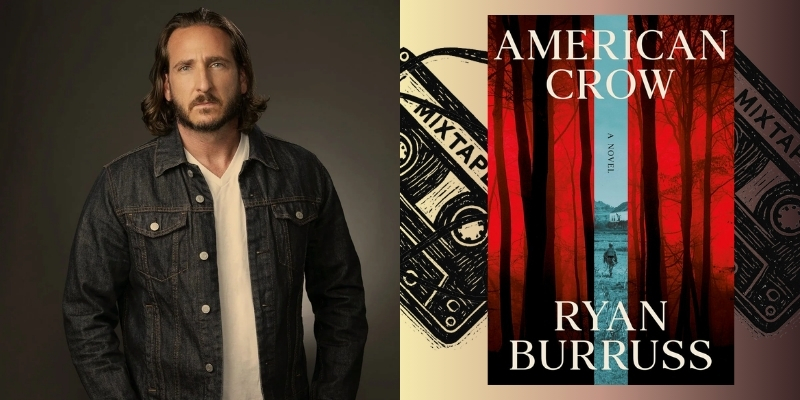
Ryan Burruss on Monstrously Mashing Up Genres in His New Novel
A meditation on multi-genre mixtapes from the author of American Crow
Back in the 1900s, we had albums and cassette tapes and, eventually, CDs, but you still couldn’t burn songs onto those in the beginning (at least I couldn’t). Regardless, those shiny discs like strange dreamcatchers came later. In my beginning, there were just the albums and cassettes—the latter’s magic being that you could record from the former (or itself). I am now, of course, invoking the sorcery of mix-tapes.
My first was pilfered from what lay around the house (mostly my father’s collection): All cheap plastic casing magnetized Mylar, my first tooth-eyed spell was a mash-up of Kenny Roger’s The Gambler, The Best of Sha Na Na, and whichever Disney compilation album featured “The Unbirthday Song” (I was six years old at the time, but it admittedly remains a personal favorite). Harmonized doo-wop “Hound Dogs” and tea party poker games perpetually threatening to go so sideways you might need to run.
This is how we re-wrought the world: A splice here, an overdub there. Pressing buttons together as a leap of faith until the click and hiss of recording kicked in. Radio DJ voices layered over an ear-worm song’s bookends. Collages of sweat, intent, and love.
The on-the-nose equivalent in classic literature is Mary Shelley’s Frankenstein, her creature too something of an unintended collaboration, built up in the disparate remnants of other lives and sewed together into some new intimacy and symbiosis: A man-shaped mix-tape. Hit record, conjure a little spark of lightning and—viola—It’s alive.
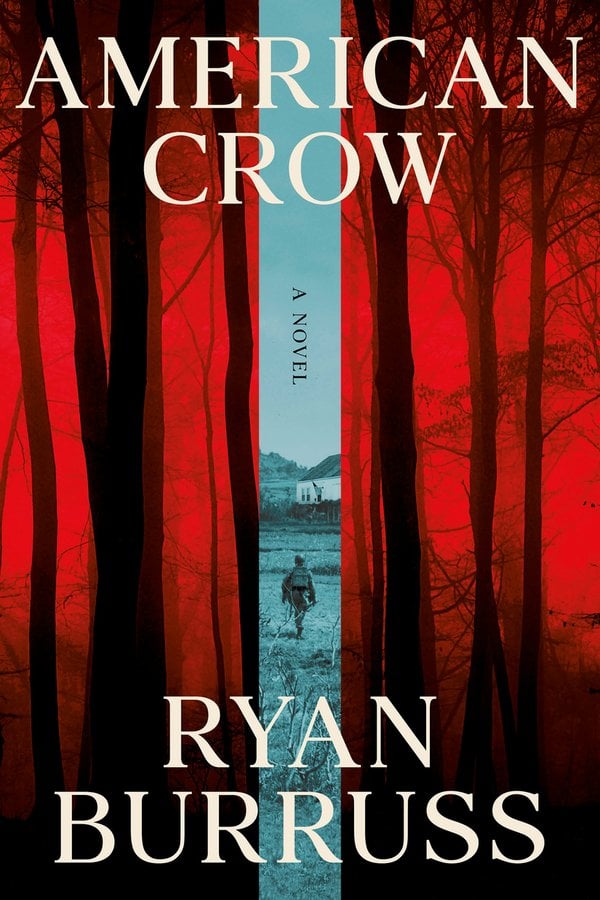
In my new novel, American Crow, I tip the cap to this phenomenon in a fairly overt and minor way: Without too much setup or spoiling, the art of bookbinding features prominently throughout the story, and at one point a character rebinds signatures from several old and unrelated tomes to create mash-up productions he christens “Frankenstein” books. It’s admittedly obvious as hell, but also perhaps an avenue to understanding how we as writers and readers can help keep genres vital and growing and avoid unnecessary narrowing and rote imitation that risks stagnancy and over-segmentation.
For American Crow, I knew from the outset I wanted to explore the community and romance inherent in some of the magic realism stories I loved growing up (Marquez’s Macando looming large) through the prism of my own Mid-Atlantic hometown. At the same time, I gravitate (to this day) to the pulpiest of pulp of the American midcentury—the hardboiled crime, the horror, the UFO-obsessed science fiction—and wanted to play in those tones as well.
So out came the knives, bonefolders, and thread. And, hopefully, a little bit of spark or strike to give the whole makeshift monster new life.
By working through the collisions of these pieces—everything from whole subgenres to specific legacies and voices—the idea is that we can wrestle with, against, and overtop the tropes or notions laid out before to crack open new understandings and enjoyments for others who will then one day come after to crack us open themselves. Good genre finds a way, to paraphrase a character from another mash-up. And it often arrives through stepping outside of the genre itself.
Bear with me, because I’m going show by doing and make a hard narrative turn here, but I promise I’ll get back on the road proper: Consider briefly the Ptolemaic Dynasty of Egypt—admittedly, more circa 80-ish B.C. than “the ’80s,” but relevant here. A thing you might not know about that era: There wasn’t just one Cleopatra. The one we all (think we) know, with Caesar and Mark Antony and immortalized by lavender-eyed Liz Taylor, was just the end of the line—the unlucky seventh of seven.
Here’s another: Most of them (and their kings, when left alive or relevant) were hopelessly and unapologetically inbred. Brothers and uncles married sisters and daughters and on and on and over and back. The Ptolemaic bloodline, it turns out, was convinced they were living gods (or at least godlike) and to procreate with mere mortals unrelated would befoul their line and diminish their power (genetic science had not yet reared its Mendelian head).
Now history and the humans living it being complicated concerns, I cannot point to rampant inbreeding as the sole reason for the dynasty’s downfall—but it sure didn’t help. Beyond the purely physical doubling down, each narrowing generation also enjoyed less and less room for other perspectives and new ideas, wagons so circled as to be inescapable. In some metaphysical way, you could say they choked on themselves until the Romans finished the job.
Which brings me back to today’s algorithms and the hard sub-categorization of literature—and those magical mix-tapes of my youth. I have no soap box I wish to hop on over bookstore shelving logic or the publishing business at large—art and commerce have been rasslin’ each other into special hugs since some so-and-so first slapped a shiny bauble down so some other would paint pretty on their cave wall.
I will just argue that the so-called safe assumption of “I want what I want when I want it”—as facilitated by various digital applications and consumerist mentalities—may best survive itself and maintain some balanced vitality only through a proactive allowance for some free radicals into the mix.
Of course folks should and will record what’s trending on their favorite pop station. They should also raid their mom or dad’s stash from time to time. Track down that haunting melody they heard coming from some thatch-roofed bar they stumbled upon after some wrong turn. Listen to that obscure recommendation from the weird kid at the roller rink who smells funny but is always grinning.
Remember that silly song you loved back when you were six? Throw it in the blender with all the sophisticated things the machines point you to today.
If I plug All the Pretty Horses and No Country for Old Men into a streaming service or recommendation engine or whatever other flux capacitor we deputize to lead the way, I’m going to get a lot of sparse and dark meditations set in the American West. And the algorithm would not be wrong! I dig those things! I would probably appreciate a lot of what it spits out.
But if I’m passively beholden only to what is presented as such, I may never stumble upon The Virgin Suicides or “A Perfect Day for Bananafish”—dark mediations wholly different and maybe not a straight line to what I proved to have liked before. Hell, I may not even be offered Cormac McCarthy’s earlier and luscious Appalachian work if it is all too fine-tuned.
And perhaps more to the point of this particular article—I or someone like me might not be inspired to make a mess in the basement lab with all of these wonderful ingredients that “we didn’t know we didn’t know” to create some new monster that gives fresh life to a weary tread. We might just become that last Cleopatra painted into her corner.
Instead, I invite both readers and writers to break loose of their comfortable rabbit holes every now and again—and broadly enough to clear its gravity. I promise the genres and subgenres will be there when you get back—they may even be stronger for it.
What if, for instance, that old gambler didn’t just walk away but ran to the moons of Jupiter? Or to a spectral mining cabin? Or to an unbirthday doo-wop party? Can you imagine what that might look like? Sound like? How cool that collision might accidentally be?
Can you imagine? Try.
***

Ryan Burruss
Ryan Burruss has enjoyed fiction bylines in Prairie Schooner, The Carolina Quarterly, Whiskey Island Magazine, and New Orleans Review, among many others. He is the author of American Crow. A native of the East Coast, Ryan now resides on Colorado’s Front Range. He is a participating member of the Lighthouse Writers Workshop.