
Elly Griffiths' 5 favorite female detectives in fiction
The author of The Killing Time extolls lady sleuths from Miss Marple to Stella Darnell
Women have always solved crimes. I’m sure Eve knew immediately who killed Abel, although admittedly there was only one suspect. Grendel’s mother, in Beowulf, is one of the greatest justice-seekers in literature. The Wife of Bath would make a formidable sleuth, specializing in domestic cases.
It was some time, though, before crime-solving women appeared in print. In The Female Detective by Andrew Forrester (the pseudonym of James Redding Ware), published in 1864, Mrs Gladden is thought to be a dressmaker but is, in fact, a detective. The Revelations of a Lady Detective by William Hayward, also published in 1864, features Mrs Paschall, recruited by the Chief of Police to form a squad of women officers. In Mr Bazalgette’s Agent by Leonard Merrick, published in 1888, Miriam Lea is an aristocrat who becomes a private eye after falling on hard times.
Interestingly, these first women sleuths were professionals, in that they earned their living from detection. The era of the talented but overlooked amateur, exemplified by Miss Marple, comes later.
When I created forensic archaeologist Dr Ruth Galloway, I was drawing on the tradition of the civilian expert, often a woman, who assists the police. There many great unofficial detectives in modern crime fiction; Freida Klein in Nicki French’s books, for example, or Rhona Macleod in Lin Anderson’s series. There are also many terrific women police officers: Val McDermid’s Karen Pirie, Sarah Hilary’s Marnie Rome, Nadine Matheson’s Anjelica Henley, Jane Casey’s Maeve Kerrigan.
Here are five of my favorite female detectives, official or otherwise.
*
Marian Halcombe
She’s not, strictly speaking, a detective but Marian Halcombe in The Woman in White by Wilkie Collins, is surely one of the greatest sleuths in crime fiction. Laura Fairlie is ostensibly the heroine but Marian, clever, brave and intrepid, is the beating heart of the book.
The Woman in White, published in 1859/60, is known as one of the great “sensation novels” and the sweeping narrative includes abduction, organized crime and murder. One of the most thrilling scenes has Marian clambering over rooftops at night in order to overhear a conversation between the villains Percival Glyde and Count Fosco. She’s in her petticoat because her voluminous silk skirt would have rustled too much. No wonder even evil Fosco is more than half in love with her.
Jane Marple
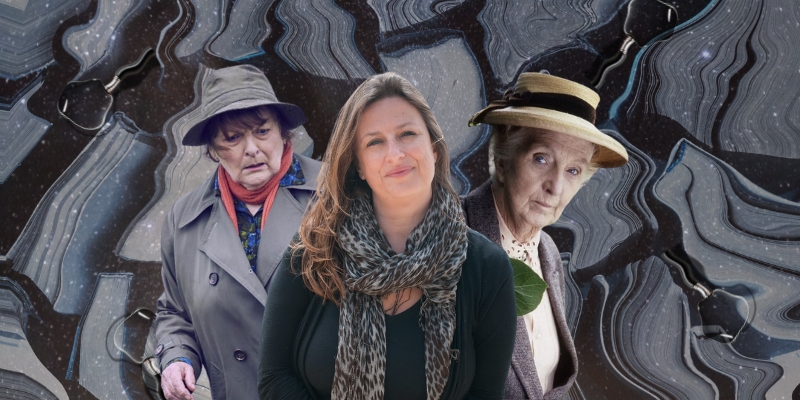
No list would be complete without Agatha Christie’s famous spinster sleuth. Jane Marple was apparently inspired by the many unmarried women after the first world war, who, as they grew older, were often ignored by the world around them.
Miss Marple, poised with rose clippers in her garden or bent over her crochet, makes the most of her invisibility. Almost every crime reminds Miss Marple of something she saw in her home village of St Mary Mead. She’s caustic, quietly brilliant and ruthless when on the trail of a murderer. In A Caribbean Mystery Jason Rafiel describes her as “Nemesis in a pink shawl.” Miss Marple is also surprisingly well-travelled, helped by a generous nephew and a doctor who is always happy to prescribe a holiday.
I was delighted to be asked to contribute to Marple, a new collection of short stories featuring the divine Miss M. It was a daunting task made easier by the fact that we all think we know Miss Marple but she can still always surprise us.
Vera Stanhope
Ann Cleeves meant The Crow Trap to be a standalone novel. She was as surprised as anyone when, after a death at an isolated cottage in the Pennines, a rather unusual detective arrives to solve the case.
DI Vera Stanhope is “a large woman, amply covered” with a bulbous nose, man-sized feet and pitted skin. She’s scruffily dressed and carries a plastic bag containing her notes. She’s also brilliant, unconventional and frighteningly forthright. There are now thirteen Vera novels with a fourteenth, rumored to be the last, scheduled for 2027.
The TV series Vera, starring Brenda Blethyn as the eponymous detective, has run for fourteen seasons. Through the years we have learnt more about Vera’s history and her deep connection to the Northumbrian countryside but we can never second-guess our heroine who, like the similarly disheveled Columbo, always has the last word.
Miriam Birdseye
Nancy Spain wrote six fantastically funny and atmospheric crime novels starring the indomitable Miriam Birdseye. I’m sure she would have gone on to write more if she hadn’t been killed in a plane crash at the untimely age of forty-six. But in Miriam, Nancy has given us a detective for all time.
Miriam is a wildly glamorous “vaudeville star” whose modus operandi seems to be to get engaged to the prime suspect as quickly as possible. Miriam’s sidekick is the Russian ballerina, Natasha Nevkorina, whose ambition is to do as little as possible. Miriam is always prepared to dress up in the name of detection. Was there ever a better chapter heading than this, in Cinderella Goes to the Morgue–Enter Miriam, Disguised as a Principal Boy?
Manon Bradshaw
Susie Steiner also left us tragically early, dying of a brain tumor in 2022. She only wrote three novels featuring DS Manon Bradshaw but she created one of my favorite modern detectives.
Manon, named after the operatic heroine, is a terrific character: clever, kind, funny and often frustratingly stubborn. Manon’s relationships with her colleagues, Davy and Harriet, and, especially, with her adopted son, Fly, are beautifully described; full of warmth, nuance and humour. I’m sorry that there aren’t more novels about Manon, but this trilogy is crime-writing perfection.
Stella Darnell
Stella Darnell first appears in The Detective’s Daughter by Lesley Thomson. Stella is the daughter of a police officer who died before he could solve his most important case. Stella had a complicated relationship with her father and has taken another path; she’s a cleaner.
Through the course of ten intricately-plotted books, Lesley Thomson charts how Stella, reluctantly at first, becomes a private detective whilst running her own cleaning agency. She solves crimes “stain by stain.” Along the way, Stella acquires a wonderful collection of assistants, including Jack Harmon, a tube driver who can sense murder….
***


Elly Griffiths
Elly Griffiths is the author of the Ruth Galloway and Brighton mystery series, as well as the standalone novels The Stranger Diaries, winner of the Edgar Award for Best Novel; The Postscript Murders; and Bleeding Heart Yard. She is the recipient of the CWA Dagger in the Library Award and the Mary Higgins Clark Award. She lives in Brighton, England.