
Sam Beckbessinger: A Brief History of the Female Werewolf
"To modern eyes, a female werewolf feels like a twist of the norm. But really, the older subversive strain has always been there"
When I was a kid, my mum had a collection of old medical textbooks. In the days before the internet, if you were a hypochondriac and wanted ideas for obscure medical maladies to stress about, you had to build your own WebMD in the form of a home library. One book I was particularly obsessed with was The Hirsute Female, about all the genetic and hormonal conditions that could cause a woman to grow excessive body hair. I remember hiding underneath a table poring over the patient photographs, because there was something taboo and perhaps erotic to me about their naked bodies, anonymized with a black bar across the face, hair sprouting from chests and bellies, unruly and untamed.
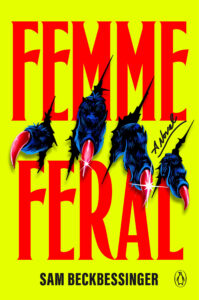
This image has stayed lodged in my unconscious all my life. I recently published a novel about a woman who thinks she’s going through perimenopause, but is actually turning into a werewolf: Femme Feral. It takes its place among a growing pack of lycanthropic women in contemporary fiction, from Nightbitch by Rachel Yoder to Such Sharp Teeth by Rachel Harrison. The girls are out on the prowl.
These stories feel subversive precisely because for most of the past century, the werewolf has been one of the most stubbornly male-coded monsters. If vampire films were often exploring cultural anxieties around deviant sexuality and aristocratic decadence, werewolf stories were typically exploring the masculine fear of one’s own violence. This was the theme of the stories that codified the werewolf myth in contemporary culture, the 1930s and 40s Universal Pictures Wolf Man movies, and they became even more testosterone-soaked all the way to the canonical 1980s films An American Werewolf in London and The Howling. Even by the time we get to Stephenie Meyer’s Twilight series in the early 2000s, the vampire family are evenly gendered, but among the whole pack of werewolves there is only one woman, Leah. She, notably, is infertile.
Think about what makes the typical werewolf movie feel different to the typical vampire movie. The motivating energy of your classic vampire film is seduction: a character finds themselves lured somewhere remote, ideally a Transylvanian castle, where they must fend off the advances of a monster they are simultaneously attracted to and afraid of (AKA the straight female sexual experience). The motivating energy of the prototypical werewolf story is transformation: a character is attacked in a random act of animal aggression, and then goes home, and begins to fear their own growing capacity for violence – the realization dawns that they might kill the people they love most. The werewolf is structurally a Jekyll/Hyde story, a civilized man horrified by the inner beast he can’t fully repress (what theorist Chantal Bourgault de Coudray called “anguished masculinity”). In a werewolf story, the monster is you. And, almost always, a dude.
It’s even in the name. The “wer-” root from Old English means man, in the specifically masculine sense. If we were being pedantic, a female werewolf should properly be called a “wifwolf”, which just sounds too silly to take seriously.
So the glorious exceptions that do center female werewolves usually tread quite different thematic territory. Unlike male werewolves, who are usually infected through a random physical attack, female werewolves are more likely to see their transformation linked to a moment of innate reproductive change: menarche, childbirth or menopause.
Female werewolves are more likely to see their transformation linked to a moment of innate reproductive change: menarche, childbirth or menopause.
My very favorite example is Ginger Snaps, a 2000 John Fawcett and Karen Walton film which uses the werewolf as a metaphor for female puberty, like Teen Wolf (1985) had done for male puberty. The story is about two very close, death-obsessed sisters, Ginger and Brigitte, who are both late in starting their periods. The older, Ginger, finally experiences menarche, and she’s attacked when the scent of her blood draws a beast to her. She begins to change in ways that mimic the normal changes of puberty, but dialled up to eleven. It’s a film that’s as obsessed with body hair as I was when hiding under the table reading The Hirsute Female. There are multiple scenes of Ginger obsessively shaving. In one, Brigitte finds a razor disgustingly clumped with hair; in another, Ginger’s legs are covered in nicks because she has to press so hard to get through the fur. But the shaving doesn’t work. Her body can’t be tamed.
Ginger does become more aggressive, but Brigitte’s far more worried that she becomes sexual. She passes on the infection not by biting someone, but by having unprotected sex. The tragedy of the film is the all-too-real heartbreak of Ginger abandoning their shared girlhood world in favor of making out with boys (and murdering bullies). Brigitte tries to cure her, then ultimately kills her.
Or take Nightbitch, where an exhausted new mother finds herself turning into a dog. There is no infection from an outside attack. The trait was inherited from her mother, and the trigger is matrescence.
The story which draws the connection between the lunar cycle and the menstrual cycle more clearly than any other I’ve read is Alan Moore’s foundational comic “The Curse” (Swamp Thing, vol. 2, no. 40). The story begins with a woman buying sanitary napkins, coming home and growing increasingly furious at her terrible husband (PMS?) until she transforms into a raging beast. This story, too, posits the “The Curse” as something inherited, something belonging to all women, connected to the image of the red tent that Biblical women must withdraw to while menstruating: “She understands at last the nature of her women’s curse, and she shrieks her despair at the moon-bleached sky”.
In my own Femme Feral, the infection is given to the protagonist by an older woman (through an act of care, rubbing spit in an open wound, rather than aggression). The protagonist, Ellie, finds herself changing in disturbing ways that are exaggerations of the real changes of perimenopause. I had great fun naming each chapter for an ambiguous symptom: changes in the texture of your body hair, trouble sleeping, brittle nails, and uncontrollable rage … and of course the core joke of the novel is that doctors know about as much about perimenopause as they do about lycanthropy.
This common pattern in female werewolf stories reflects how our culture perceives women’s reproductive abilities as (in the words of Victorian doctor William Pepper) “fixing women’s place to the animal economy.” If male werewolves fear their own violence, women werewolves fear their own bodies— already animal, already transforming.
A long history of subversion
The great feminist werewolf retelling of the last century is Angela Carter’s The Bloody Chamber, a collection of dark fairy tales featuring three distinct werewolf stories. My favorite is a Little Red Riding Hood retelling called “The Werewolf”. In this version, when the girl going to visit granny in her blood-coloured cloak is set upon by a wolf, she doesn’t shrink in fear, no: she fights. The girl manages to slice off its paw, but the beast escapes before she can kill it. She wraps the paw in her basket and continues on her way. But when she arrives at her grandmother’s house, she finds her grandmother sick, clutching the bloody stump of her arm, and when the girl checks her basket she finds the paw transformed:
“It was a hand, chopped off at the wrist, a hand toughened with work and freckled with old age. There was a wedding ring on the third finger and a wart on the index finger. By the wart, she knew it for her grandmother’s hand.”
The wart, in this telling, is a witch’s nipple, and the child alerts the villagers who stone the grandmother, and the granddaughter claims her house. The little beast!
It’s a short story, but it offers several tantalizing clues to the female werewolf’s much older history.
All cultures have animal shapeshifter myths, but the European werewolf tradition, specifically, starts from two places: ancient Greek texts (Lycaon from Ovid’s Metamorphoses is the origin of the term “lycanthropy”) and the Old Norse tradition of warriors wearing enchanted wolfskins to “become” wolves in battle.
By the Middle Ages, werewolves are well-established in folklore all across Europe, to varying degrees, but there are only a couple of notable women in these stories. There’s an Irish story about the Daughters of Airitech (which appears in the Acallam na Senórach from around 1200), who are three wolf-women who live in the wild and are a nuisance to local villagers because they eat their sheep. They have a weakness for certain elements of human culture, though (in some stories harp music; in others cooked meat), and turn back into human women to enjoy them, in which state they are vulnerable enough to be either murdered or (worse) married off. There’s also a story of the Werewolves of Ossory from 1188’s Topographia Hibernica, which features a man and woman who must live seven years at a time as wolves, transforming (like the Norse) when they don wolfskins. In these stories, the werewolf isn’t violent so much as uncultured.
by the early modern period (1500s to 1800s) the folktales had become a deadly criminal matter, and there were full-on werewolf trials. …many of the people prosecuted as werewolves were women.
The wolf got more and more demonic as Europe became more Christian, and by the early modern period (1500s to 1800s) the folktales had become a deadly criminal matter, and there were full-on werewolf trials. As Hannah Priest (ed.) details in the introduction to her brilliant essay collection She-Wolf, there was a blurring around this time between the werewolf and the witch, with some people being accused of being witches who could turn into wolves using a magic ointment, or rode wolves, or had trained demonic wolves to be their familiars (the Malleus Maleficarum, for instance, the best-known handbook for identifying and prosecuting witches, defines lycanthropy as an act of witchcraft). Therefore, many of the people prosecuted as werewolves were women.
You can trace Angela Carter’s severed hand through several stories around this time. A French jurist named Henry Boguet was an obsessive witch-prosecutor in the early 1600s, and published a popular witchhunting handbook called Discours des Sorciers (An Examen of Witches). He tells the story of a woodsman from Auvergne who was attacked by a wolf and managed to cut off its paw. Upon escape, he examined the paw and found it had turned into a woman’s hand, which he recognised from a ring as the hand of his wife. I’m going to go out on a limb here (ha ha) and say this probably did not really happen, but the consequences were all-too-real for the accused woman: Boguet says she was burned alive.
Boguet was the chief prosecutor in another famous case of lycanthropic witches from 1598: the Gandillon family. He claims that Perrenette Gandillon believed she was a wolf and would run around on all fours, and one day in her wolf-madness she attacked two children. She was lynched by villagers, and then her sister, brother and nephew were all accused of being witches who could also turn into wolves, and had lured children to demonic rituals. They, too, were executed.
We can’t know exactly how many people were really killed for being werewolves, because it’s impossible to tease apart the myth and the history. In what is now Germany, a sensationalist broadsheet was published in 1591 called the Werewolves of Jülich claiming that hundreds of women had been executed as werewolves in one small region; but this certainly never happened (fake news was not invented twenty years ago). What is clear is that this was a time the werewolf became a potent fear in the European mind, and while many men were prosecuted as werewolves too, the stories often carried a specific undercurrent of fear about women. The most common accusation of early modern werewolf trials was that the witch in question had killed and/or eaten children. Sometimes the extra lurid detail was added that the witch had engaged in bestiality with real wolves.
In 1865, a priest named Sabine Baring-Gould published a collection of as many of these werewolf stories as he could find, in a book called The Book of Were-Wolves, in an attempt to canonise early modern werewolf beliefs (the subtitle “Being an Account of a Terrible Superstition” should give you a clue about how this Very Rational Victorian Gentleman felt about the veracity of these stories). This became the text that really cemented the Victorian understanding of the werewolf. In the chapter debating the natural explanations for werewolf stories, he considers how pregnancy can awaken a desire for cannibalism:
“A woman in an interesting condition [pregnant], near Andernach on the Rhine, murdered her husband, to whom she was warmly attached, ate half his body, and salted the rest. When the passion left her she became conscious of the horrible nature of her act, and she gave herself up for justice.”
Baring-Gould’s book shaped the popular Victorian understanding of werewolves, which is where it enters the horror novel. Bram Stoker relied heavily on it when researching Dracula (in Gothic literature, there’s still a lot of blurring between werewolves, vampires, demons and witches – and Dracula can transform into a wolf). There was a female werewolf story in Frederick Marryat’s popular 1839 novel The Phantom Ship, which features basically every female werewolf trope (she’s a beautiful, terrible stepmother who murders and then eats her stepchildren). And in the 1890s, we finally find the first two werewolf stories authored by women: Clemence Housman’s novella The Were-Wolf and Rosamund Marriott Watson’s poem “A Ballad of the Were-Wolf”.
In Gothic literature, the female werewolf is a child killer, a sexual temptress, and basically (worst of all) a bad mother.
Both of these stories, to me, read as though they’re playfully poking fun at the reproductive anxiety underlying the folktales. In Housman’s novella, a gorgeous, independent young woman named White Fell seduces one of twin brothers, then proceeds to murder several members of the household (after smooching them). The other brother, who’s the only one who sees her for the werewolf she really is, chases her into the snow and kills her. There’s been long debate among literary theorists about whether this is a straightforward allegory about female wickedness or a subversion of it, but it seems relevant to note that Housman later became a suffragist, and also that White Fell is a monster but is also a liberated babe having a blast right until she’s killed. Watson’s Scots-dialect poem, similarly, features a sweet pious “gudwife” who seems to be the very picture of domestic propriety right until her husband comes home to tell her he’s killed the wolf that’s murdered all their children, he even managed to cut off its paw … (you see, by now, where this is going):
She strechit him out her lang right arm,
An’ cauld as the deid stude he.
The flames louped bricht i’ the gloamin’ licht–
There was nae hand there to see!
In Gothic literature, the female werewolf is a child killer, a sexual temptress, and basically (worst of all) a bad mother. And that’s still the thematic foundation for most women werewolf stories today. It tickles me that in some discussions the female werewolf is called a “werewoman”, because etymologically that means “man-woman”. And I think in a way, that’s correct. The female werewolf has always been a character who (violently) refuses the feminine domestic/reproductive role.
And if we’re talking about gender blurring, I’m afraid we have to talk about the Omegaverse (I’m lying; I’m delighted).
Werewolf as Man-woman
You might have managed to avoid knowledge of the Omegaverse completely, in which case, congratulations, you have a much more wholesome media diet than I do. For the uninitiated, the Omegaverse is a whole subgenre of erotic fanfiction that initially developed around the TV show Supernatural but has become its own subgenre with well-established tropes and conventions, and has spawned countless published novels. To give you a sense of scale, there are about 300,000 Omegaverse works on just AO3, one of the major fanfic websites.
In the Omegaverse, there’s a parallel gender system that exists alongside male/female/intersex sexualities, where people are innately Alphas, Omegas or Betas. Alphas are dominant and strong-willed, Omegas are sweet compliant subs, Betas are boring normies and almost-always sidekicks. Your basic BDSM power dynamic stuff. Except it also gets a lot weirder than that, because all Omegas can get pregnant, all Alphas have a phallus, Omegas go “into heat” when they become sex-crazed maniacs, and there are plenty of other little biological quirks (I’m not going to tell you about “knotting”; Google it if you’re feeling freaky). These people also usually happen to be animal shapeshifters but that’s almost beside the point. The fun part is that the vast majority of Omegaverse literature is written by women featuring only male characters, often exploring the experience of male Omegas who are subject to typically-“female” reproductive experiences. But there are plenty of stories featuring women Alphas, too.
Funny sidenote, but when I was writing Femme Feral, I told myself I had to read a lot of women Alpha Omegaverse novels (purely for research, you understand!) but didn’t realize that my Kindle was automatically posting everything I was reading to Goodreads until a friend got in touch to ask if I was okay, having read nine Omegaverse stories in a single week.
These are fantasies of queerness and subverted gender dynamics, the werewolf as “man-woman” or “woman-man”. Romance, not horror, is the genre in contemporary popular culture where the werewolf is most thriving (and fucking).
Even in more literary and highbrow werewolf literature, it’s because the werewolf was so male-coded for most of the twentieth century that it’s become such a powerful metaphor to explore gendered experiences.
In Femme Feral, I was exploring the question of how women are socialized out of being able to recognize our own instincts for aggression, and wondering what happens when long-repressed rage can no longer be contained.
To modern eyes, a female werewolf feels like a twist of the norm. But really, the older subversive strain has always been there, living in parallel, probing questions about women’s bodies and women’s violence, about the traits in women that we find monstrous, about the forms of power that can be claimed by women who refuse to be cowed when the fingers point at us and call us a she-wolf or a witch.
As a child looking at the photos of The Hirsute Female, I was staring into something long and bloody and old, a history of women whose natural bodies were deemed wrong by a patriarchal world, who were burned or drowned or catalogued in medical textbooks for being untamed.
***
Note: In an attempt to keep this piece somewhat brief, there are so many fascinating threads I’ve left out, like the interplay between the hirsutism taboo, European racism and the racial backgrounds of female werewolves in literature; the film Cat-People and the historical reasons women more often turn into cats than wolves; Guy Endore’s Werewolf of Paris and masochistic women in werewolf fiction … and much else! If you’re interested in these questions, I highly recommend Hannah Priest’s She-Wolf, to which I am much indebted (specifically to Carys Crossen’s analysis of Housman and Watson, published therein)
Sam Beckbessinger
Sam Beckbessinger is a bestselling South African author who teaches creative writing, pens horror stories and kids’ TV shows, and once wrote for Marvel. She grew up on a farm with a pet donkey named Mr. Magoo, but now lives in London. Femme Feral is available at all major bookstores from 14 May 2026.