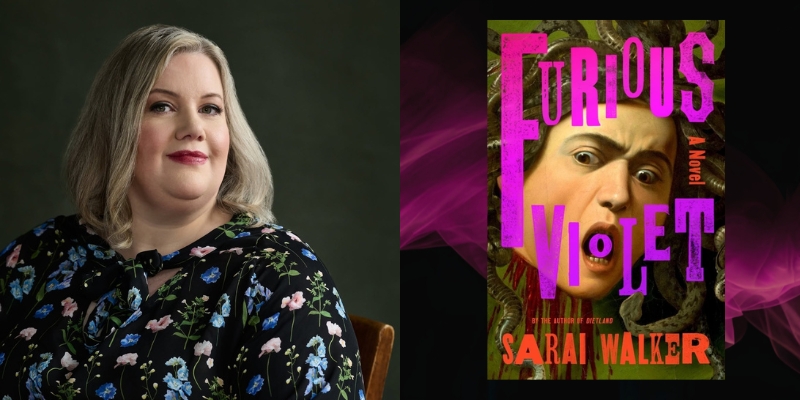
Sarai Walker on Sylvia Plath, Academic Satire, and Creating a Fictional True Crime Author
Alex Dueben talks with the author of the tragicomic thriller Furious Violet
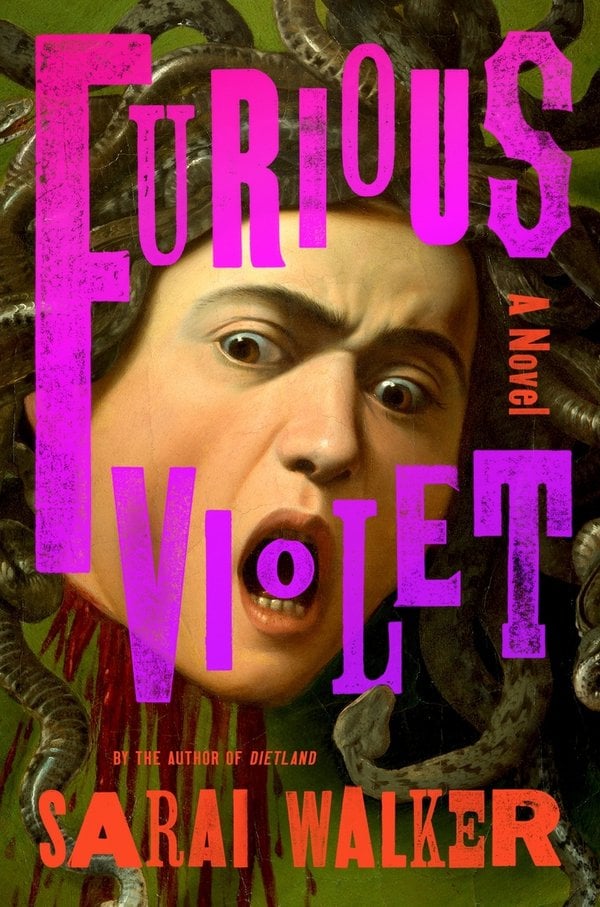
The new novel Furious Violet is the story of Violet “West” Shelley, a snarky true crime writer whose mother, an iconic Sylvia Plath-esque poet named Juliet Bellwood, committed suicide. Raised by her uncle in Colorado, West returns to her hometown to finish her new book about a serial killer while being stalked by someone claiming that West is her mother. Meanwhile an academic conference around her mother involves a different kind of stalking that threatens to alter her relationships to her mother and her past.
Readers of Walker’s previous novels Dietland and The Cherry Robbers know that she’s a writer whose books are shaped by many ideas and influences, but at their center are very human stories about characters whose voices shape the narrative, even as they feel increasingly out of control of their own lives and stories. Her books are as carefully crafted as they are bonkers– her words, not mine.
One part harrowing thriller, one part laugh out loud academic satire, Furious Violet interrogates the meaning of true crime and our culture’s obsession with the tragic lives of women. It’s about the academic search for understanding, and the ways that it can overlap with true crime’s search for answers. The way that genre can flatten and distort stories and people. A nuanced and thoughtful consideration of trauma, and how the ways that we understand such events from a distance and close up can be very different, and how that can change over time.
It’s a remarkable accomplishment, and both times I read the book I rushed through it because the book so deeply entertaining, even as I can’t stop thinking about it.
Walker and I spoke recently by phone, going to great pains not to spoil anything.
*
Alex Dueben: You have a Ph.D., you have an MFA, you’re coming off being a visiting professor over the past year. I’m curious how much that experience in academia, and the way people talk about writing, helped to shape this novel.
Sarai Walker: [laughs] I think I know what you’re getting at. One of my colleagues at [The University of] Memphis read an advance copy, and he said, “you’re really vicious towards academia.” [laughs] My writing about academia is in some ways a satire, so I had fun pushing things to an extreme.
AD: I understand, and by this point, you’ve become accustomed to people writing about your work in a way that’s very different from your experience of it.
SW: You can never control how a reader interprets your work. They can have wildly different interpretations of it. People can read the same book, and one person says, “this is my favorite book of all time,” and another person says, “this is the worst book I’ve ever read.” I don’t know how both those things can be true, but I’ve seen it in reader reviews of my own work.
AD: One of the ideas in the book is about true crime and that as a genre it can flatten people and stories. I kept returning to the academics who are distorting Juliet Bellwood in a different way, but I wondered how much this connection was in your mind from the start?
SW: I did start to see, as I was writing the novel, a connection between the Juliet Bellwood character in my novel (who is inspired by Plath) and true crime, which came about organically as I was writing. I was speaking the other day with a Plath scholar who said that there have been scholars over the years who have drawn that connection between Plath and true crime, which is fascinating. I feel like there were connections there that weren’t obvious to me when I started writing, but became obvious as I got deeper into the book.
Part of the appeal of Plath for many people, and of the poet character in my novel, is that they are women who are tragic figures, and there’s this morbid curiosity about their deaths. As a society, we are drawn to narratives about women as victims, in true crime and elsewhere.
AD: I would imagine sometimes in writing a book there comes a point where you realize these unconnected aspects are actually connected.
SW: That happens a lot– if you’re lucky. [laughs] When you start writing a book, you don’t see all those connections and then they come alive through writing in lots of different ways. This was one of them for me.
When a person is dead, whether a figure like Plath (who was born in 1932 and could still feasibly be alive today) or a murder victim in a true crime story, you can’t talk to that person, obviously. You want to figure out what happened to them and the real story of what they were like. There’s an attempt to make sense of the tragedy, to understand it. So there is some overlap here between true crime and this kind of literary obsession, which I find really fascinating.
AD: I kept thinking about your last novel, The Cherry Robbers, which was described as a Gothic novel even though it wasn’t, but it had elements of that. It felt like here you were interrogating this idea of fitting too strongly into a genre.
SW: One thing I’ve learned as an author now with my third novel is that genre can be a helpful way to categorize things, but at the end of the day it’s almost meaningless. People were interpreting The Cherry Robbers all different ways. Crime Reads wrote about it. It was nominated for Best Horror Novel on Goodreads. It was in all these different categories, which made me laugh.
I love to play around with genre elements, but at the same time they don’t mean as much as a lot of people think. There’s genre fiction in the sense that there’s work that very much adheres to genre conventions, but there’s countless novels that play around and subvert genre. Writers like Colson Whitehead or Michael Chabon or Margaret Atwood do this and I really like that. I’m definitely not as rigid thinking in my thinking about genre as I was when I first started writing.
AD: All three of your books are very different but they do have some overlapping themes and concerns. Haunting of one generation to the next, reinvention.
SW: Intergenerational trauma and haunting. I think that my books on the surface, are pretty different, but they do have this underlying thread that connects all of them.
AD: To be fair, intergenerational trauma is broad. That’s every family. [laughs]
SW: [laughs] Yes, how does it manifest in this particular family? Of course, I always push things to the limit so that it’s more interesting. Someone said that Furious Violet is a bonkers book. I’m aiming for that a lot in my writing. [laughs]
AD: Some of that is the character of West, who I really loved. She’s haunted, but she goes to therapy, and is a hot mess in deeply relatable and unrelatable ways.
SW: Dietland and The Cherry Robbers were really rooted in trauma. The characters were very traumatized. I wanted to have fun with my third novel and not write something that put me in a depressing head space.
West has trauma, but it doesn’t consume her life. She had this horrible thing that happened to her when she was three months old. She didn’t have a mother. But she just gets on with life. Everything that happens in Furious Violet is because someone else is coming into her life and causing all this turmoil that she wasn’t seeking out.
Her snarky, cynical narration was really a lot of fun to write, but it was hard bringing her into existence. I’d written fifty pages and it was fine but it didn’t sing. I did a couple different things. I did some free writing to get the voice and get her vibe.
At the same time, I was reading Michelle McNamara’s I’ll Be Gone in the Dark and Truman Capote’s In Cold Blood. It was a coincidence that I read these books at this time, but I started to see West as a true crime writer and then she started talking to me. Voice is usually my way in. Once I got her voice, the novel came and I enjoyed writing her and getting to know her.
AD: It’s interesting that voice is your way in, although your books are all so centered around the characters’ voice. I did want to ask about the West, because this book is very claustrophobic in some sense, but the landscape is so vivid. What has the Western US meant to you?
SW: I am from the West. I was born in Palm Springs and lived there until I was eight, but then we moved to Utah, which really shaped me. My dad’s family is from Denver. I really wanted this book to be set in the Mountain West, to write about the experience of living in that kind of environment. There’s not as many big cities and populated areas and instead there’s these wide open spaces, which can be intoxicating.
In Furious Violet, I wanted to contrast this vast openness with a claustrophobic feeling. In the mountains, in the wild, people can hide or completely disappear—the openness can be a threat.
AD: You said earlier that the book is about what happens to West. True crime is so often about what happens to people. It’s about the intersection of people and violence and systems. Were you conscious of this as you were working and thinking about the book?
SW: This past semester in Memphis I taught a creative non-fiction class with the theme of true crime. In almost every book and essay we read, the authors were justifying why they like true crime. [laughs] It’s as if they’re required to say, “I know it’s horrible, I know it’s problematic, but I still like it.”
I personally love true crime. I had a lot of fun writing about it in the novel and I completely immersed myself in it. If we think critically about the genre, we know there are a lot of problems with it, and which stories are told, and which victims are considered worthy of attention—this is a serious issue. But bigger picture, it’s human nature to want to solve mysteries and to understand how people can do such horrible things, and being fascinated by that.
AD: It’s trying to explain what happened to people, understand what people did. Trying to make sense of the world.
SW: Trying to understand why people do such horrible things, which ultimately can’t be understood. I think it’s fascinating in that sense. I wanted to explore that.
In the novel, West starts to question the genre once she becomes a victim herself. That evolution felt organic as I was writing. I enjoyed interrogating these complicated feelings we can have about true crime. Some survivors and victims’ families find it to be really exploitative. But on the other hand, when I went to CrimeCon, some victims’ families were there, they wanted to be part of it and share their loved ones’ stories. It’s a real spectrum. You can’t give a pat explanation.
AD: You touch on this. West is interviewing people for a book and some people want to talk, some don’t, some don’t want their names mentioned, and some of them change their mind. The events don’t change, but one’s relationship to them can change. The book acknowledges how complicated it all is.
SW: One of the books we read last semester was a James Baldwin book about the Atlanta child murders, which doesn’t ever get classified as true crime. There are books that are true crime, but we don’t think of them in that way, and these works can expand our understanding of the genre. James Baldwin and Truman Capote, two of our greatest writers, have written true crime. It can run the gamut from really trashy stuff to literature. It really depends a lot on who’s telling the story and what their motivation is.
AD: One of the things I enjoy about reading your books is that I can say this tackles Sylvia Plath and scholarship around her and academia and true crime– but the experience of reading the book is so radically different from all of these ideas.
SW: I like to take real-life inspiration but then I make the material my own. I enjoyed playing around with the Plath myth through fiction, because I’ve been a fan of hers since I was a teenager. I’m actually writing an essay about her for LitHub. But ultimately, my character, Juliet Bellwood, is fictional, which meant I could do whatever I wanted to do and that was really liberating. That’s the fun that you get to have when you’re a novelist, as opposed to being a biographer or scholar.
AD: I did laugh out loud at the mention of the bad Gwyneth Paltrow movie about Juliet Bellwood. Everyone who knows will read that and laugh. [laughs]
SW: [laughs] Someone tried to get me to take that out and I was like, nope, it’s not coming out. I still haven’t seen that movie, Sylvia—I just couldn’t bring myself to watch it. Gwyneth Paltrow as Sylvia Plath? No thanks.
AD: One of the things I loved about Furious Violet is that it’s a mystery story that does not have a detective. I don’t know how much that was a conscious choice, or how much you were thinking about what that means.
SW: Miss Marple, who I reference in the novel a couple times, isn’t a detective, and in her time she never would have been given the opportunity to become one, so she has to navigate this world where she’s smarter than all the male detectives. I really love a character who is positioned like that.
Similarly, I didn’t want Furious Violet to be from the perspective of a cop or detective, and I didn’t really want the police to be a big part of it. West has her friend Blasco, who’s a retired FBI agent, but he’s not really in it that much. And the police chief in town hates her.
I wanted the story to be outside that world of law enforcement. I think about Furious Violet as a detective novel, but West is an amateur and what’s more, she’s also the victim of the sinister plot she’s trying to unravel. This makes it more intense, where she can’t just go home at the end of the day and put her feet up. She’s being hunted.
Don’t get me wrong, I love TV shows like Mare of Easttown or Top of the Lake, but I just don’t feel like I could write a character like that. I don’t see the world like a cop or FBI agent would see it. That doesn’t appeal to me as a writer, even though I have started writing another thriller that does feature a real detective as a secondary character.
AD: A thriller, but I’m guessing very different from this in almost every aspect.
SW: Pretty much, yeah. But still bonkers. [laughs]
***

Alex Dueben
Alex Dueben has written for The Believer, Vulture, The Millions, The Los Angeles Review of Books, The Brooklyn Rail, and many other publications. He is the writer and editor of the artist monograph Hurricane Nancy, and his debut novel is forthcoming.