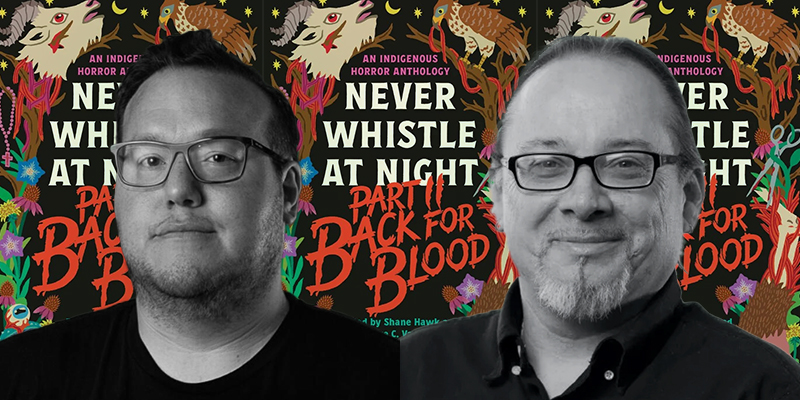
Shane Hawk and Theodore C. Van Alst Jr. On Putting Together An Anthology of Indigenous Horror While the World Burns
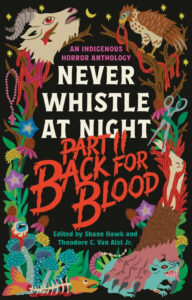
The co-editors of "Never Whistle at Night, Part II: Back for Blood" talk short-form storytelling amidst the horror renaissance
MO: What’s one essential lesson for editors to know before putting together an anthology?
TVA: Have a vision but be prepared to change it. The stories, like stories we write, sometimes change the ending on their own.
SH: Trust your open call. With Never Whistle at Night and its successor, we’ve proven that some of the strongest fiction today is coming from open calls wherein emerging writers put everything they’ve got into a piece. Most Big Five anthologies rely on the same familiar names—and for good reason—with maybe a slot or two for newcomers. But our model has proven that you can acquire up to half of your table of contents from an open call and still have a b*tchin’ anthology. In fact, those raw, uncompromised stories might be the main reason your anthology is b*tchin’ in the first place.
MO: What is your advice for story writers when it comes to crafting a gripping short-form narrative?
TVA: Write what scares you! If you’re not scared, your audience won’t be.
SH: My advice is to keep economy and scope at the forefront. Word economy matters so much in short fiction—every single word, hey, even syllable, matters in short stories. Wield a machete wherever you go and use that sucker more often than you think you should; less is more. There’s also economy of character, i.e., limit the number of characters your short story focuses on. For me, that’s almost always one or two. And with scope, I’ll share what I do sometimes. I draft in my head using top-down design: instead of starting small and scaling out toward a novel, start with a lofty concept, something that excites you, and boil that mofo down to an exhilarating moment or memory in your protagonist’s life, however that may look in the world you create. Once you have that moment, drop the reader right into the middle of it. You don’t have time for a runway.
MO: What does Indigenous Horror mean to you?
TVA: Horror with incidentally Indigenous characters. The setting, people, dialogue, all of those things are part of it, like they would be in any other story. Sometimes there are deeper issues being discussed, the everyday sort of grind that the overculture brings, but often there’s joy, and humor. Maybe redemption, maybe not. But to have all the voices out there in the world is key. That’s the important thing here.
SH: I hate to get prescriptive with labels and definitions, but if I had to say what I thought Indigenous Horror was, I’d say it’s about reclaiming our narratives and confronting the monstrous realities of our history through our own cultural lens. It’s a space where the monsters are the ongoing impacts of colonization and displacement, rather than just creatures, real or conjured. Yet, it’s also deeply rooted in resilience, using the horror genre to survive using our ingenuity, to fight back on the page, to heal in our own ways, to be our real, messy selves and do right by our ancestors.
MO: Why do you think there’s been such a renaissance of horror fiction?
TVA: Man, the world is on fire. There’s horror everywhere, every day. Folks need a way to process it, to beat the monster. Horror can take you out of the daily, let you wander paths that aren’t open while you’re trudging off to work, or class, or however you normally spend your day. And in those dark spaces, you might get to work some things out that have been weighing you down, tugging at your mind. It’s an escape, if even for just a bit.
SH: The renaissance of horror fiction most likely comes from our collective need to process the overwhelming anxieties of the real world in a space where we actually have some control. After living through a global pandemic, ongoing climate crises, and intense social upheaval, real life has often felt more terrifying than anything I’ve read. Horror gives us a respite, a safe sandbox to confront those fears, allowing us to look directly at the things that scare us most, but with comforting knowledge that we can always close the book when it gets to be too much. There’s that control. In real life, we can’t just flip a switch and make all these politicians die, sadly.
What are some of the earliest horror stories/movies/writers that got you hooked?
TVA: I found an old anthology of short stories in the cloakroom where I went to grammar school. I read three stories when I was eight or nine years old that have stuck with me, that show up in what I write to this day. Those were “The Monkey’s Paw” by W.W. Jacobs, “The Tell-Tale Heart” by Edgar Allan Poe, “The Devil and Daniel Webster” by Stephen Vincent Benet, along with an excerpt from Mark Twain’s “Letters from the Earth.” I have to mention reading Poe’s “The Cask of Amontillado” as well, but that one sits in a corner of my mind, untouched. Makes me shudder just thinking about it.
For movies, I’m a creature feature kind of guy. Watching all the Universal monster pics when I was little had a huge influence on me. I love The Wolf Man. Frankenstein and The Hunchback of Notre Dame always make me tear up a little.
When it comes to writers, of course Stephen King, but Clive Barker really did it for me in my late teens. So inventive and fearless. I still re-read from The Books of Blood. “The Yattering and Jack” is one of my all-time favorite stories.
SH: I’m a 90s kid, so for me it was definitely R.L. Stine; he was my gateway to the horrific and weird. I still remember choosing Revenge of the Lawn Gnomes for a book report, and my dad helped me create a creepy lawn gnome papier-mâché mask I brought to school. As a millennial, I also came to the horror genre in a backwards kinda way since my generation largely grew up with parodies and referential works like The Simpsons (and their Treehouse of Horror episodes). Those specific episodes were always my favorite as a kid, then my dad would have me go back and watch the original movie it was referencing, was a fun way to learn honestly. As for movies, I definitely saw my fair share of slashers before I should have: I think my first one was Child’s Play (1988) around six or seven years old. Thinking my toys could come to life and relentlessly try to kill me really scared me as a kid. Despite being a scaredy cat, I could not keep my hands or eyes off of horror and weird sh*t, and I still can’t help myself!
What’s next for the future of Indigenous Horror?
TVA: Bigger, better, broader. This moment is just getting started. There are so many stories, so many writers. We can’t wait to get another volume out in the world, and hope for many more to come, look forward to Indigenous horror reaching in from everywhere. Books, film, TV. Yesyesyes.
SH: The future of Indigenous Horror is about moving beyond the “introduction” phase and into an era of unapologetic specificity. We’re going to see a massive expansion in the kinds of stories being told, moving away from broad cultural touchstones to deeply specific Tribal, linguistic, and regional tales. The future is Indigenous Futurism, cosmic horror, and quiet, personal dread that doesn’t feel the need to explain our traditions to a non-Native audience. It will just exist, confidently and terrifyingly, on its own f*ckin’ terms.
***
Molly Odintz
Molly Odintz is the managing editor for CrimeReads and the editor of Austin Noir, now available from Akashic Books. She grew up in Austin and worked as a bookseller before becoming a Very Professional Internet Person. She lives in central Texas with her cat, Fritz Lang.