Murder in Miniature: The Very Best Short Mystery Fiction
Two modern masters of the locked room mystery choose their favorites of the genre's shorter form.
Writing murder mysteries is not the easiest way to make a living. It takes a lot of a planning, a lot of thought, a lot of hard work. But writing murder mystery short stories is even more of a challenge. Like building a ship in a bottle, it requires all of the above elements, plus incredible patience and a steady hand. And if the locked-room mystery is the puzzle plot at its most challenging and sophisticated, then surely the locked-room mystery short story can only be even more dazzling, surprising, and purely entertaining?
That was the idea that sparked our joint project, All the Crime in the World: Locked Room Mysteries and Impossible Puzzles from Across the Globe, an anthology of all-new stories by some of the genre’s leading lights. Our publisher for this book, Crippen & Landru, is the only one in the world dedicated exclusively to the short mystery story, and has compiled collections by some of the very best in the business, from the Golden Age to the present day, including John Dickson Carr, Edward D. Hoch, Ellery Queen, Joseph Commings, Christianna Brand, Helen McCloy, and many more. It was our ambition to put together a modern multi-author collection that could sit alongside the greats, while showcasing the diverse imaginations of our contemporary contributors.
Because we didn’t want other writers having all the fun, we also set ourselves the challenge to produce a brand-new story to close the collection. Our planning sessions for this (some virtual, some in-person in the UK) gave us a chance to share our favourite examples of the genre, and to pick apart why they work and what makes them great. So, as an aperitif for All the Crime in the World, here are just a handful of those absolutely essential reads.
Tom’s picks:
“Vampire Tower” (a.k.a. “Terror’s Dark Tower”) by John Dickson Carr
This story was not only my introduction to the genius of John Dickson Carr (thanks to Peter Haining’s The Television Late Night Horror Omnibus), but to the possibilities of the locked-room mystery. It’s a horror story, but it’s also a remarkably macabre Poe-inspired puzzle. The tale boasts a denouement that absolutely blew my mind first time around, and still gives me chills when I think of it today. In fact, the solution to the mystery is so good that Carr re-used it in the arguably more famous story “The Wrong Problem,” reimagined as a case for his series sleuth Gideon Fell.
“The Secret Garden” by G.K. Chesterton
Chesterton was a master of the literary paradox, and distilled all his wonderful lateral thought and creative imagination into this tale, which stars his legendary amateur detective, Father Brown. The setting of this one—a walled garden—was naturally a key inspiration for my contribution to the new story Gigi and I have co-written, “The Problem of the Poison Garden,” which closes our anthology. Chesterton’s tale is bloodier than ours, and, like all my favourite mystery stories, features a wonderful streak of malicious wit.
“The Witness for the Prosecution” by Agatha Christie
One of the neatest and most perfect short stories ever written, Christie’s tale needs little introduction. Since its original publication in 1925, it has led to Billy Wilder’s magisterial movie of the same name, a BAFTA-nominated BBC series back in 2016, as well as the brilliant and long-running West End theatre production, among various other adaptations all over the world. But it started here, in this deceptively simple tale of Leonard Vole’s trial for the brutal murder of Emily French, told with the brilliant, deceptively simple prose of Christie at her finest. Reading this story, and understanding why it works, was a major step in my own journey to becoming a mystery writer.
“The Cleaver” by Paul Halter
Among the very best and most prolific crime writers working today, there are plenty of stories by the great Paul Halter which could occupy this spot on my list. I chose “The Cleaver” because it features one of his most startling puzzles and solutions—a real masterpiece of Grand Guignol imagination. It features one of Halter’s series detectives, the Oscar Wilde-inspired Owen Burns, playing armchair detective to unravel the problem of a violent murder prophesied in a dream. The motif of the predictive dream was employed to good effect in Agatha Christie’s Poirot tale “The Dream,” but I would argue that Halter’s solution here is better—and that’s not a claim I make lightly!
Gigi’s picks:
“The House in Goblin Wood” by John Dickson Carr, writing as Carter Dickson
John Dickson Carr is one of my favorite authors of all time, and this story is one that’s stuck with me like no other. Carr excelled at creating Gothic atmospheres in which there could be no other explanation other than the supernatural—and then having his sleuth solve the seemingly impossible crime with a rational explanation. “The House in Goblin Wood” does this marvelously. Twenty years before the story begins, a young girl impossibly vanished from a house in Goblin Wood for a short time, claiming to have been taken by fairies. On the day of the story, the now-adult woman vanishes once more. Is something sinister lurking in the woods? Sir Henry Merrivale, one of Carr’s famous sleuths, unravels the macabre plot brilliantly.
“Nothing is Impossible” by Clayton Rawson
Clayton Rawson was a contemporary of John Dickson Carr. His writing style was never as evocative as Carr’s, but Rawson made use of one perfect element that Carr rarely did: A stage magician solving the crime. Stage magicians create the impossible for the stage, so they’re the perfect sleuths to solve seemingly impossible crimes. Rawson’s character The Great Merlini picked apart baffling situations like he would construct a trick. In “Nothing is Impossible,” he sets out to prove there was indeed a rational explanation for a vanishing gun and the presence of what seemed to be an alien.
“The Problem of the Old Oak Tree” by Ed Hoch
Ed Hoch was a prolific short story writer with several memorable sleuths, and Dr. Hawthorne was his small-town doctor who had a knack for solving impossible crimes. In “The Problem of the Old Oak Tree,” a man is seemingly killed by the oak tree itself. The story itself is good, for sure, but the reason I’m including it in my list of favorites is because unlike the otherworldly plots of Carr and Rawson’s stories, Hoch’s Dr. Sam Hawthorne stories are down-to-earth, cozy delights. When you’re not in the mood for anything too macabre but would still like a classic locked-room mystery short story fix, you can reliably turn to Ed Hoch’s Dr. Sam Hawthorne. His stories are just what the doctor ordered.
*
In All the Crime in the World: Locked Room Mysteries and Impossible Puzzles from Across the Globe, we’ve brought together modern-day practitioners of this form of storytelling. The new anthology includes stories by Victor Bonini, James Scott Byrnside, Shelly Dickson Carr, S.A. Cosby, Anne van Doorn, Martin Edwards, Sulari Gentill, Paul Halter, Christopher Huang, Vaseem Khan, Josh Pachter, Masaya Yamaguchi, Ovidia Yu—and a new co-written story by the two of us, “The Problem of the Poison Garden.” The stories we’ve collected both pay homage to the classics and bring a modern twist into the mix. We hope you’ll have fun with them—and that you’ll accept the challenge of matching wits with these global sleuths in 14 seemingly impossible crimes.
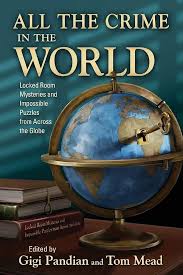

Gigi Pandian and Tom Mead
Gigi Pandian is a USA Today bestselling mystery author, locked-room mystery enthusiast, and fan of exploring ruined castles in the rain. She’s been awarded Agatha, Anthony, Lefty, and Derringer awards, and been a finalist for the Edgar. She writes the Accidental Alchemist mysteries (humorous cozy fantasy mysteries), the Secret Staircase mysteries (locked-room mysteries called “wildly entertaining” by the New York Times), and the Jaya Jones Treasure Hunt mysteries (lighthearted adventures steeped in history). Gigi lives in the San Francisco Bay Area with her husband and a gargoyle who watches over the backyard garden. www.gigipandian.com Tom Mead is a mystery writer and aficionado of Golden Age Crime Fiction. His novels in the award-winning Joseph Spector series include Death and the Conjuror, The Murder Wheel, Cabaret Macabre and The House at Devil’s Neck. He also recently published a collection of mystery stories, The Indian Rope Trick (and Other Violent Entertainments). His books have been translated into twelve languages (and counting), nominated for various awards and named books of the year by The Guardian, The Telegraph, Publishers Weekly, CrimeFictionLover, and Crimereads. @tommeadauthor