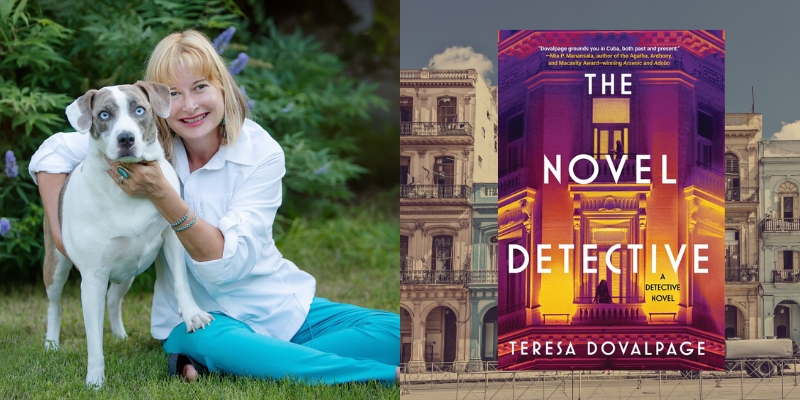
Teresa Dovalpage on Writing Herself into Her New Novel
The author of The Novel Detective returns to the Cuba of her youth as scribe, narrator, and character
Long before I wrote crime novels, I studied in the perfect setting for one. My Havana middle school was a labyrinth of granite floors, dusty halls, cobweb-filled classrooms and hidden nooks. It even had its own ghost: Andrés Gómez Mena. The millionaire owner of the entire block, known as La Manzana de Gómez, built Havana’s first indoor shopping arcade on the site. In 1917, shortly after its completion, he was murdered nearby.
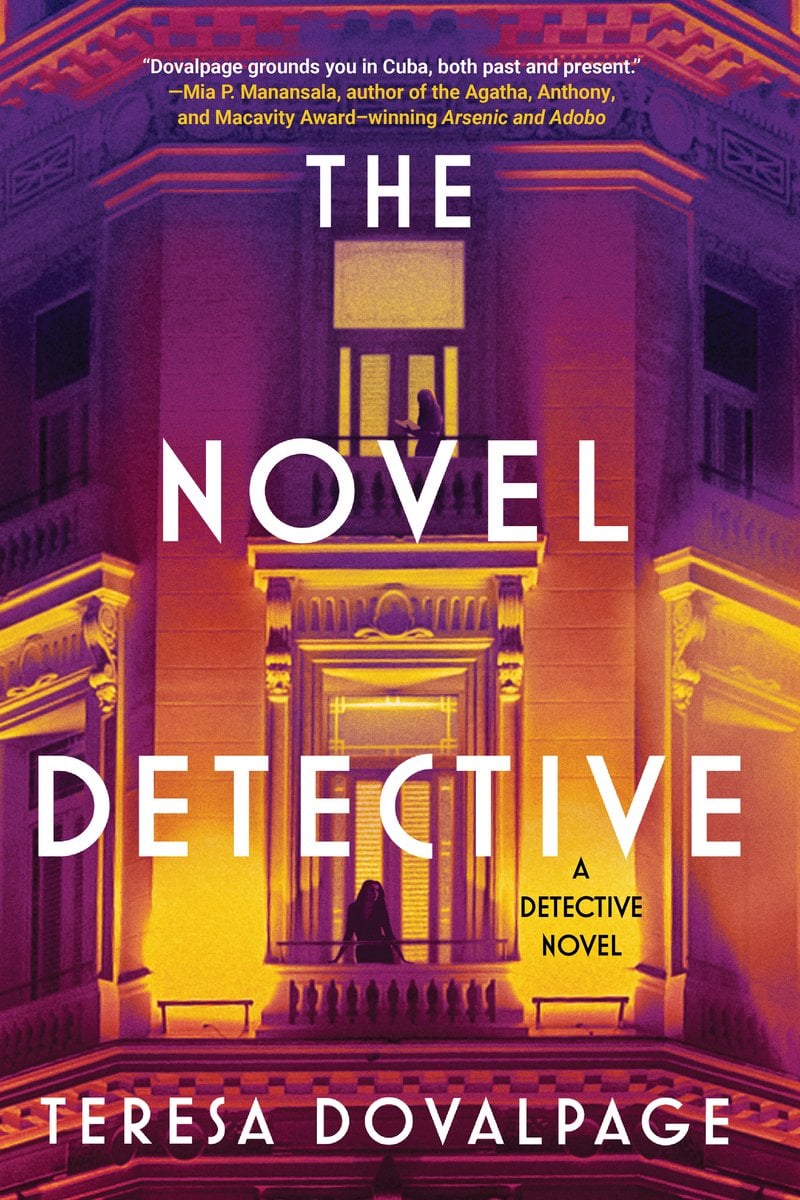
But the grand building, once home to shops, offices, consulates and even a theater, had fallen into disrepair. By the time I attended school there, from 1977 to 1980, it sat half empty. The fifth floor, where the school was located, had rows of locked rooms and narrow, boarded-up staircases nicknamed “tunnels of love.” It looked like a horror movie set…and became the inspiration for a book that a nerdy fourteen-year-old avid reader dreamed of writing. That book is The Novel Detective.
For many years, I toyed with the idea of setting a novel in La Manzana, but the story refused to take shape until I realized that, for it to feel really authentic, I needed to step inside. I would have to be not only the author, but also the narrator and a character. So I, Teresa, ended up becoming the eye—or the “I”—the one who witnesses and reveals. That is how Teresa and Teresita came into being.
Teresa, much like me, is a novelist in her fifties living in Hobbs, New Mexico, but unlike me, is haunted by the memory of a crime she (sort of) witnessed alongside her best friend, Estrella when they were fourteen years old. At Estrella’s urging, they both return to Cuba in 2020 to unravel the mystery and identify the culprit…if there is one.
In 1980, a tragedy had shaken La Manzana: The school’s prettiest girl and their English teacher died under unclear circumstances. Her life was cut short by poison; his ended when he plummeted from his office window. The official story claimed it was a suicide pact. But Teresa and Estrella, who happened to be in the building at the time, know that cannot be true.
Narrated in the first person, Teresa’s chapters unfold just before the pandemic. She and Estrella check into what is now the ultra-luxury Gran Hotel Manzana Kempinski as, playing the role of detectives, they revisit the crime scene and attempt to piece together the past.
As an avid Agatha Christie fan, Teresa tries to emulate Hercule Poirot and Miss Marple. While she lacks Poirot’s supreme confidence in his “little grey cells,” she marches ahead with her own investigative efforts.
Writing these chapters was easy. In many ways, Teresa is me. My frequent trips to Cuba, where my mother still lives, gave the story its most realistic touches.
Sadly, I never checked into the Kempinski. Its $350-a-night price tag cured my nostalgia, and I doubted my accountant would approve it as a “research expense.” Besides, my mother’s apartment offers a more comfortable, cost-effective base camp. But I dined at the rooftop San Cristóbal restaurant, hung out in the lobby and mirrored my character’s footsteps minus, of course, the actual detective work.
Now, the chapters focused on Teresita, the teenage version of Teresa, were the most fun to write. They helped me reconnect with the girl I used to be: nosy, sly and a bit naïve, still sheltered from the workings of the adult world, which we called La Verdad de La Vida (the Truth of Life). Much like my teenage self, Teresita is an only child and the recipient of her family’s overprotection:
Those who called Teresita “nerdy,” “spoiled,” “mama’s girl” and worse were not far from the truth. Jimena would heat water for her granddaughter’s bath, bring her coffee (with milk and lots of sugar) to bed in the mornings, and refused to let her go out in the rain or, God forbid, walk barefoot in the backyard, fearing she might catch pneumonia. Permission to go out alone or even with a friend was seldom granted.
All of the above is absolutely true. Like Teresita, my family kept calling me “la niña” (the little girl) well past my teenage years.
As the Spanish saying goes, recordar es volver a vivir—to remember is to relive. By that logic, resurrecting these memories meant living twice. I relived the past, reshaped it and created a novel with one foot in reality and the other in imagination. In the end, this process also allowed me to understand myself better and figure out where my compulsion to write comes from.
Beyond the fictional anecdote, The Novel Detective is a love letter to the nerdy girl I once was, to the woman she eventually became and, by extension, to all the nerdy girls in the world who dream of becoming novelists. It is to them that I dedicate this book, with the hope that it might encourage them, someday, to write their own.
***

Teresa Dovalpage
Teresa Dovalpage was born in Havana, Cuba. She earned her BA in English literature and an MA in Spanish literature at the University of Havana, and her PhD in Latin American literature at the University of New Mexico. She is the author of thirteen other works of fiction and three plays, and is the winner of the Rincón de la Victoria Award and a finalist for the Herralde Award. She lives in New Mexico. Her new novel, Last Seen in Havana, is now available.