

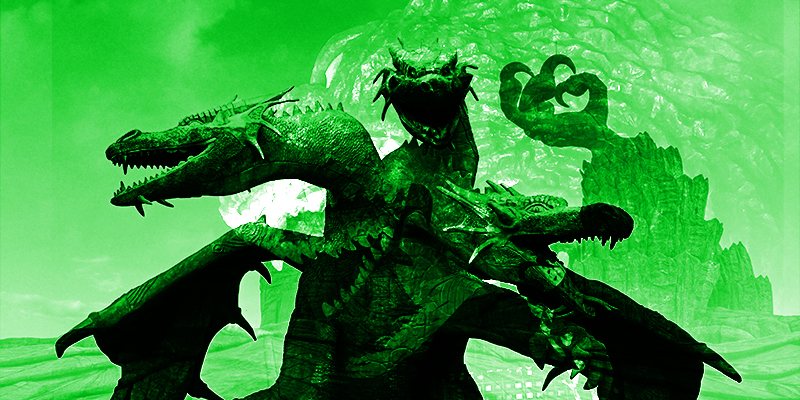
The Demystification of the Giant Monster: A Brief History of Giant Fictional Behemoths
"[A] creature, maybe out of time or space but certainly out of place, stumbles upon human civilization. And a monster is a fantastic thing, so of course some people want to own it once they see it in all its glory."
We’ve always dreamed of titans. From old epic poems to ancient creation myth, humanity has written about terrifying beasts and ineffable creatures which govern the world around us and are governed by stranger forces still. The monsters of yore were no less than demigods, nature made sentient. Faces given to time and entropy. Odysseus could not have slayed Scylla and Charybdis any more than he could have vanquished an ocean or mountain. The Earth itself.
But somewhere along the way, humankind did rise up to conquer nature. We circumnavigated the globe. Bored tunnels through cliffs and underneath harbors. Took to the skies, higher and higher, until our grasp exceeded our own atmosphere. We built skyscrapers that dwarfed King Kong and photographed the afterimages of stars dozens of light years away. Whatever riddles our ancestors once used leviathans and sphinxes to explain have since been solved. Not by titans or gods, but mere human intelligence.
And though we still tell stories about massive organisms run amok, the mediums available to us have vastly expanded. The first motion picture in the giant monster subgenre is often cited as The Pet, a 1921 silent film animated by American cartoonist Winsor McCay. The plot follows a suburban couple who adopt an odd animal that stumbles onto their lawn. The wife names it “Cutey,” and Cutey has quite the appetite. The more the creature eats, the bigger it gets, until Cutey’s large enough to eat a whole dinner for two in mere seconds. While the wife dotes on Cutey, her husband attempts to do away with the exponentially growing pet with rat poison.
The poison doesn’t take, and only enlarges Cutey further, now big enough to snack on cars and buses. In the movie’s less than nine minutes of runtime, Cutey grows from the size of a furry puppy to a massive creature capable of devouring a police station and school with just a handful of hungry bites.
At the climax of McCay’s film, the Air Force arrives. Squadrons of planes and blimps bombard the now gigantic Cutey. The indistinct beast—no more than a pair of eyes drilled into a silhouette which sometimes resembles a dog, bear, moose, cow, or even mouse—chomps at zeppelins without malice or fear. Only hunger. And maybe even curiosity. It’s not clear if Cutey is at all aware of the imminent danger or even feels any pain. It simply moves forward and consumes.
Then, having swallowed a blimp’s worth of explosive ordinance, Cutey finally erupts into a geyser of guts and debris. The Pet comes to an abrupt and bloody end, the city in ruins.
One hundred and five years later, McCay’s dark industrial fairy tale remains a remarkably familiar story within the modern medium. Countless fictional behemoths share Cutey’s origin: a creature, maybe out of time or space but certainly out of place, stumbles upon human civilization. And a monster is a fantastic thing, so of course some people want to own it once they see it in all its glory. To domesticate it. Study it. Profit from it.
Others, perhaps crueler but certainly wiser, see the danger for what it is: a lifeform with no understanding of society and its rules. A gluttonous fiend that will not pay for the cows it consumes or the buildings it obliterates. A bottomless pit of food and weapons and sacrifices that threatens to upend all the neat streets and urban promenades our species has spent millennia building.
And how does the movie always end? With a BOOM! The monster is inevitably eliminated after its customary rampage. It may be by any means necessary and at great cost to all involved, but the good guys always get the job done by the time the credits begin rolling. A few characters, along with us, the audience, may feel some grief. Even guilt. Because it was an animal, after all. Cutey didn’t know any better. Very few destructive behemoths of the past century do.
King Kong only rules on Skull Island. In Manhattan, he is little more than a confused and frightened ape (I can relate). Contrast him with another oversized creature: Moby Dick. Where Kong acts very much like a gorilla in his silver screen debut, the great white whale of Melville’s 1851 novel resembles something closer to an ocean deity. A conscious force of cruelty disguised as a sea mammal. The ravenous hunger of the winds and waves given breath and blood. Ahab wastes his life trying to kill Death itself. Compared to Moby Dick, King Kong is an innocent child stolen from its crib.
Yet both are equally unobtainable. Even as the giant monster movie has stripped the supernatural elements present in mythological and literary colossi, humans are still not allowed to tame them. To quote Jurassic Park: “Life, uh, finds a way.” The dinosaurs will circumvent our genetic sorcery one way or another, just as Cutey will find its next meal, but civilization is no longer at their mercy. If the raptors won’t sit and stay and roll over when asked, if we can’t “keep” them, then we no longer have to tolerate them. We can just kill them.
After all, what else are people supposed to do? Haven’t you seen Tremors? Witnessed what a single Graboid can do? The franchise’s iconic subterranean worms are older than horseshoe crabs, unchanged for hundreds of millions of years. Their eggs remain dormant for centuries, deep in the earth like cicada nymphs. From the Graboids’ perspective, humanity’s time on Earth is a rounding error. An insignificant geological blip. Yet these apex predators find themselves outmatched by a young Kevin Bacon and the meager population of the desert town of Perfection, Nevada. All it takes to vanquish the most evolved carnivore in the planet’s history is an abundance of explosives and some clever improvisation.
Ultimately, the Graboids’ corpses are sold off to the highest bidder. The grand reward for our heroes’ survival is a financial second wind. A chance to get back on their feet in a nicer town. Even the sandworms of Arrakis in Frank Herbert’s Dune, which dwarf the Graboids in both size and lifespan, aren’t so different. They may be worshipped as divine messengers by some, but the Shai-Hulud’s primary purpose is to produce the spice melange, which fuels interplanetary travel. Without that crucial caveat, there would be no reason for humanity to coexist alongside the sandworms. No point in struggling on Arrakis. The worm’s holiness is a function of its economic usefulness, which in turn is a biological byproduct of their larval stage.
The monster and the natural systems which it represents are no longer omnipotent. We can imprison King Kong in a zoo and make him dance for our entertainment. The only thing stopping us from harpooning Moby Dick is environmental regulations. The foreboding frontiers of Scylla and Charybdis have been probed, now little more than waiting pools of resources, their watery vortices and cragged cliffs vessels for cobalt and coal. Our oil comes from old fossils, and the new bones are put on display for an entry fee. The wolves which once tormented our cave-dwelling ancestors now trot alongside us as dogs. Pets. Tamed.
The monster is dead, and we’ve dissected it. Broken it down to the fundamental, biological, psychological pieces. What was once an object of awe and worship has become more and more grounded with the transition into the cinematic age. Why?
Prior to Cutey and The Pet, Winsor McCay spent two years of his life working on The Sinking of the Lusitania, a painstakingly hand drawn rendition of the U-boat attack on the RMS merchant and passenger vessel of the same name. Of the 1,960 souls on board, only 763 survived. The tragedy catalyzed American support for entry into the Great War, and inspired McCay to personally memorialize the lives lost.
This is all to say that the first giant monster’s creator was keenly aware of that modern beast: war. The last bastion of unpredictability.
In the Old English poem Beowulf, the titular hero engages in a multitude of battles with the forces of evil, culminating in a final showdown with the dragon. The fire-breathing serpent is itself a shadow of war, hoarding wealth and riches and death in its lair. The dragon is no less than a rival to Beowulf’s God, the devil scaled and horned. Relishing the countless youth it has stolen. Greedily presiding over its spoils. There is no sympathy for the dragon; it is a loathsome, condemnable creature.
Yet a titan like Godzilla manages to earn our empathy despite dwarfing the dragon’s body count in any number of films. Even in his first and simplest incarnation, the king of monsters, the daikaiju of all kaiju, is a sympathetic figure. He only attacks Japan after subaquatic hydrogen bomb tests awaken him from his slumber and cause radioactive mutations. Whereas Beowulf’s dragon was a purveyor of war, Godzilla is subject to it. The unsuspecting victim of a manmade weapon. Just like Cutey. Just like hundreds of real human beings every single day.
The monster from 2008’s Cloverfield is perhaps the most pertinent example, given that the Cloverfield Monster is implicitly a child. The 25-story-tall juvenile demonstrates the wits of a kitten as it desperately looks for safety among the waters of New York City, thrashing and lashing out while being relentlessly attacked by rockets and tanks and helicopters and supersonic stealth bombers. Eyes wide and frightened. Scream shrill and yearning.
In the end, only a nuke can kill Clover, along with over a million New Yorkers that are unable to evacuate in time. That is the monster’s modern fate: to be destroyed. Over and over and over again, so long as they have the guts to get back up then humanity will keep trying to blow them back down. Kill or be killed. There is no other way.
But in the real world of non-fiction, the most likely candidate to usher in total cataclysm is a human. We have dominated the natural order which once so frightened us. Bent it to our whim. The leviathans that once controlled the currents and winds can now be expressed in equations. The temperamental spirits who blessed our fields with rain have been reduced to Rorschach blobs inching across radar screens. The wildfires started by dragons’ breath pale in light of that great fire, the oh so holy bomb.
Humanity has nothing left to fear but humanity itself, and so our monsters have evolved in reflection. No longer are we the ones lost and confused, bargaining with the beast for a glimmer of hope. Instead, we have become the operators of this world, its self-manifested prophets. Humankind is the lone giant and we tremble in our own shadow as enormous fingers reach down to pluck eye for eye for eye for eye.
I’d like to think there is another way. Something more productive than mutually assured destruction. While writing my first novel, an apocalyptic sci-fi horror entitled THEM, I often found myself feeling far more optimistic than expected. It’s a fairly dark story: Homo sapiens are driven to near extinction by a rapidly reproducing swarm of six-eyed, three-legged, armor-plated, man-eating monsters. Yet there’s a stubborn thread of hope throughout, a suggestion that no, it didn’t have to go down this way. It didn’t have to end like this.
Maybe we could’ve figured out how to get along with Cutey after all.
***

W.H. Chizmar
W.H. Chizmar is the New York Times bestselling coauthor (with Richard Chizmar) of Widow’s Point: The Complete Haunting, as well as numerous short stories and essays. He lives in Maryland with his Bernese Mountain Dog, J.J. (short for James Joyce). Them, his debut novel, is now available.