The Great Lost Gothic Novel of Italian Romanticism
Translator Idara Crespi on bringing the work of Francesco Mastriani to a new world of readers.
I found Francesco Mastriani in a footnote.
This is how it usually goes with the writers who deserve better. I was reading through a survey of the European sensation novel—one of those dense academic accounts that traces the movement from Collins through Dickens through the French serialists—when his name appeared in a subordinate clause, almost apologetically: Mastriani, the Neapolitan novelist, who reached a readership of extraordinary breadth in the 1850s and 1860s, has never been translated into English. Full stop. The survey moved on. I did not.
What I found, when I started looking, was staggering—and, if I’m honest, a little infuriating. Francesco Mastriani (1819–1891) had written more than a hundred novels, nearly all of them published first in the newspapers and periodicals of Naples, installment by installment, as the city devoured each new episode.
He was compared, in his own lifetime, to Wilkie Collins and Eugène Sue. His readers were enormous in number and cross-class in composition—exactly the popular literary phenomenon that Victorian England was producing at the same moment with sensation fiction, and that France was producing with Les Mystères de Paris.
Mastriani was doing the same thing in Italian, for Naples, with a Neapolitan setting and a Neapolitan moral universe, and the English-speaking world had simply never noticed.
*
There are obvious explanations for why the Italian Romantic Gothic fell out of the English-language conversation while Collins survived and Sue is still in print. The translation gap is part of it—and I will admit I fell into a rabbit hole on this question for longer than was strictly professional.
Victorian translators worked primarily from French, and the French literary tradition had an institutional weight—Balzac, Flaubert, Zola—that drew continuous attention. Italian nineteenth-century literature, except for opera libretti and Dante, was simply not a priority. There were no Italian equivalents of the Tauchnitz editions, no British publishers with scouts in Milan and Naples.
The critical gap runs deeper. “Sensation fiction” as a literary-historical category was built almost entirely around English examples—Collins, Le Fanu, Braddon, Reade—with French adjacencies acknowledged but rarely examined closely. The question of whether there was an Italian sensation tradition was never seriously asked. If it had been, the answer would have been loud.
But I don’t think the disappearance was really about translation logistics or critical fashion. It was about the specificity of Naples. The sensation novel, as practiced by Collins, works in a world of English drawing rooms, provincial solicitors, and Gothic country houses—a setting that translated effortlessly across the Anglo-American world.
Mastriani’s Naples is volcanic, stratified, gorgeous and dangerous in ways that don’t map onto London. The city itself is a character, and it’s a character that English readers were never given the chance to meet.
*
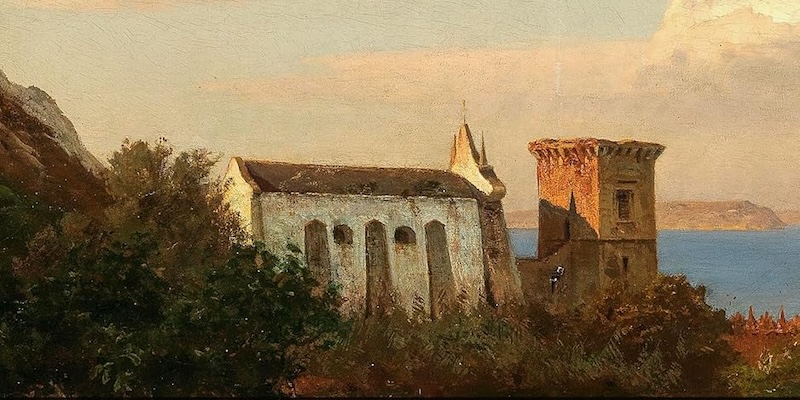
La Cieca di Sorrento—The Blind Woman of Sorrento—was first serialized in L’Omnibus in 1851–1852. Its protagonist is Beatrice, a noblewoman who has been blind since early childhood, who lives in a villa above the Bay of Naples with a devoted household and a history that is not what it seems.
She is not what you expect from a Gothic heroine. She is not frail or passive or victimized by her condition. She is observant in a way that sighted characters are not—alive to sound and temperature and the weight of silence in a room, and accordingly harder to deceive than anyone around her suspects. When the plot’s machinery of hidden identities and forged documents and old crimes begins to engage, Beatrice is often the sharpest intelligence in the room, precisely because she has never been able to rely on appearances.
There is a moment early in the novel that stopped me cold when I first translated it. Beatrice is sitting in her garden as a visitor she has never met arrives. She listens to the footstep on the gravel—its rhythm, its hesitation, its weight. She registers the particular quality of the stranger’s silence before he speaks.
By the time the man introduces himself, Beatrice has already formed a complete impression of him—and she is exactly right. Mastriani does not make a fuss about this. He simply shows you how she sees.
That restraint is what makes the book remarkable—and, I’ll admit, what took me the longest to learn how to translate. The plotting is genuinely intricate in the Collins tradition, with revelations that are earned rather than manufactured, and with a villain whose menace comes from calculation rather than melodrama.
But the emotional register is something Collins rarely attempted—warm, even operatic in its feeling, unashamed of sentiment in the way that Italian Romanticism is unashamed of it. You are invited to care about these people. The Gothic machinery is in service of the feeling, not the other way around.
*
Readers who have exhausted Collins often describe the same problem: they want more of the particular pleasure he gives—the hidden rooms, the compromised witnesses, the slow revelation—but they want it somewhere new. They want a different geography, a different moral atmosphere, a different kind of darkness. I’ve been one of those readers, more than once. I recognize the feeling.
Mastriani offers all of that. He writes from a city that was, in the 1850s, one of the great capitals of Europe—the largest city in Italy, in the shadow of Vesuvius, at the intersection of every Mediterranean current.
His Gothic is not English Gothic: it is warmer, louder, more overtly emotional, and rooted in a social world that English readers have almost never encountered in fiction. The blindness at the center of The Blind Woman of Sorrento is not a metaphor, and it is not a limitation. It is a way of seeing.
He wrote more than a hundred novels. We are, improbably, only at the beginning.
***


Idara Crespi
Idara Crespi is a literary translator and the publisher of Espresso Publishing House. Her translation of Francesco Mastriani’s The Blind Woman of Sorrento is available now.