The Man Who Became Electricity's First Human Test Subject
Meet George Forster... and the man who tried to bring him back to life, Giovanni Aldini
Spectacle was an essential component of Victorian scientific promotion—perhaps most famously enacted by (eventual) Royal Society president Sir Humphry Davy, who would demonstrate chemical and physical experiments (sometimes of a dangerous nature) to packed lecture halls for most of his career. Although Davy died at the very beginning of the Victorian era (and his scientific accomplishments are more closely associated with post-Enlightenment discoveries than Victorian ones), he and his equally performative contemporary, the astronomer William Hershel, are credited with stoking the nineteenth-century interest in the visuality of scientific discovery.
Early nineteenth-century scientists, especially Davy’s protégé Michael Faraday, would conduct demonstrations of electromagnetism and electrochemistry in similar academic (and yet dazzling) manners. But there was one man who took the trend of flamboyant scientific performance to an entirely new, and very dark place: Giovanni Aldini.
Aldini was Italian, born in Bologna in 1762, and devoted his life to the study of science. Both a medical doctor and a trained physicist, became a professor of experimental physics at the University of Bologna in 1878. What was the research interest for which he would become famous? Electricity.
Aldini was the scion of a wealthy and influential family; his brother, Count Antonio Aldini, was at one point the Secretary of State for the Kingdom of Italy. And they were both the nephews of Luigi Galvani, the renowned scientist who pioneered the concept of “medical electricity.” Galvani became interested in the effects of electricity on the body, as chronicled in the late eighteenth-century experiments of the scientists Bertrand Bajon, Ramón María Termeyer, John Walsh, and Hugh Williamson. In 1791, Galvani published his magnum opus, the scientific treatise De Viribus Electricitatis in Motu Musculari Commentarius, which summarizes the research of electricity on animal matter, arguing that the ability of electric currents to generate movement in dead animal subjects (frogs) suggests that the animals themselves possess an inherent conductivity. He referred to this as “animal electricity. He theorized that an electrical fluid was generated in the brain of living things, and spread through the body to power the muscles.
This rocked the scientific community. One scientist, Alessandro Volta, grew interested in Galvani’s claims. He initially embraced them, but later grew skeptical that animal matter had inherent conductive properties, theorizing instead that the electric currents were instead responding to the metal on the wires Galvani used to hold and connect various body parts of his dead animal subjects. Volta believed that Galvani’s experiments would produce similar results with other matter and Galvani believed that there must be a conductive electric fluid inside animal beings. The two were engaged in a longstanding public debate on he subject (though they respected each other personally). Volta coined the word “galvanism” to refer to the theory of electric current generation by chemical means (particularly in reference to animation of dead tissue). Since he invented the world’s first electrical battery, Volta’s own name was the basis for the scientific unit of electric potential.
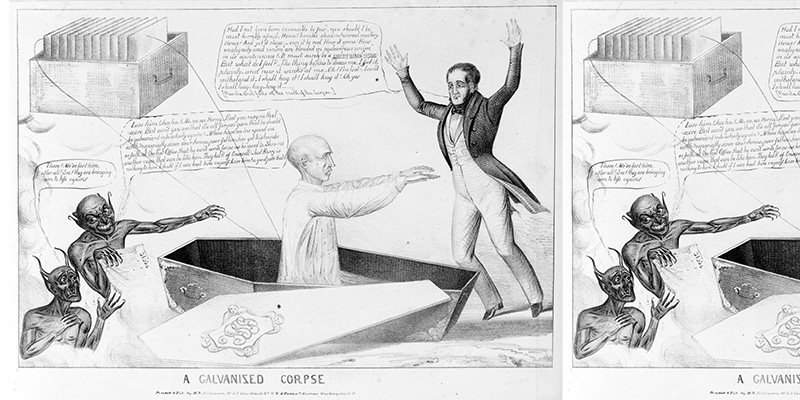
Anyway, Giovanni Aldini committed to his uncle’s cause, conducting electrical experiments on dead animals. And, in 1803, he arranged a public demonstration of the effects of galvanism on a human body.
This was part of the allure of the demonstration… but the other part was more sensational. Aldini chose for his corpse the body of George Forster (sometimes spelled Foster), a murderer who had been executed by hanging for killing his wife and child, by drowning them in London’s Paddington canal.
On January 14th, Forster was tried. He plead not guilty but later confessed to it. The account of the proceedings in the Newgate Calendar (the record of executions at Newgate prison) said of his confession.
“Previous to his decease, he fully confessed his having perpetrated the horrible crime for which he suffered: confessed that he had unhappily conceived a most inveterate hatred for his wife, that nothing could conquer, and determined to rid himself and the world of a being he loathed: acknowledged also, that he had taken her twice before to the Paddington canal, with the wicked intent of drowning her, but that his resolution had failed him, and she had returned unhurt; and even at the awful moment of his confession, and the assurance of his approaching dissolution, he seemed to regret more the loss of his infant, than the destruction of the woman he had sworn to cherish and protect.
Forster was then convicted of the crime, and was sentenced to execution by hanging as well as for “his body be delivered to be anatomized, according to the law in that case made and provided.” That means his body would be donated to science after death—not buried, but mutilated by dissection or whatever else, and so therefore prevented from being taken up into Heaven at the end of the world.
This was a fairly common punishment, for a horrible crime. In fact, the Murder Act of 1751/1752 required that only the corpses of executed criminals could be used for dissection and scientific experimentation. A primer on anatomization by The University of Leeds, outlines this history:
Part of the patronage given by James IV of Scotland was the bodies of certain executed criminals for dissection. In England Henry VIII granted the annual right to the bodies of four hanged felons. Charles II later increased this to six . Now bodies had to come from somewhere, but the conjoining of anatomy and hanging offences was very bad news, and the basis of an association which lasted until the first Anatomy act in 1832. Dissection was now a recognised punishment, a fate worse than death to be added to hanging for the worst offenders.
The dissections performed on hanged felons were public: indeed part of the punishment was the delivery from hangman to surgeons at the gallows following public execution, and later public exhibition of the open body itself. The punishment replaced the earlier hanging drawing and quartering, in which the four quarters were exhibited on spikes in various parts of the city, and differed only in that it was performed by medical men, and, incidentally that anatomical knowledge was obtained. This state of affairs was accepted by surgeons because it was, oddly, good for their image to achieve royal patronage and to be linked with the law.
Dissection was an alternative to the former practice of handling prisoners’ bodies, which was to hang them in chains until they fell apart. “This was a grisly fate, the tarred body being suspended in a cage until it fell to pieces. The object of this and dissection was to deny a grave.”
Forster was executed on January 18th of that year, and his body given to science immediately after. Aldini had Forster’s body sent from the gallows at Newgate to the demonstration hall at the Royal College of Surgeons. The Newgate account notes, “M. Aldini, who is the nephew of the discoverer of this most interesting science, showed the eminent and superior powers of galvanism to be far beyond any other stimulant in nature. On the first application of the process to the face, the jaws of the deceased criminal began to quiver, and the adjoining muscles were horribly contorted, and one eye was actually opened. In the subsequent part of the process the right hand was raised and clenched, and the legs and thighs were set in motion.” A retrospective on the spectacle in The Guardian notes, “The climax of the performance came as Aldini probed Forster’s rectum, causing his clenched fist to punch the air, as if in fury, his legs to kick and his back to arch violently.”
The Newgate account reads, “Some of the uninformed bystanders thought that the wretched man was on the eve of being restored to life… Mr. Pass, the beadle of the Surgeons’ Company, who was officially present during this experiment, was so alarmed that he died of fright soon after his return home.”
Humphrey Davy learned of Aldini’s experiment, and called it “rather disgusting than instructive.”
Although Aldini’s work did move Forster’s body, even he had to admit it didn’t wake him back up.

Olivia Rutigliano
Olivia Rutigliano is an Editor at Lit Hub and CrimeReads. Her other work appears in Vanity Fair, Vulture, Lapham's Quarterly, AirMail, the Los Angeles Review of Books, Public Books, The Baffler, Bright Wall/Dark Room, Politics/Letters, The Toast, Truly Adventurous, and elsewhere. She has a PhD from the departments of English/comparative literature and theatre at Columbia University, where she was the Marion E. Ponsford fellow. She hosts the podcasst "Culture Schlock" at Lit Hub Radio. She is on instagram at @oldebean, twitter at @oldrutigliano, and bluesky at @oliviarutigliano.bsky.social.