
The Most Powerful Question in Any Mystery
The author of Storm Damage ponders the narrative power of moral dilemmas
Mysteries and thrillers pose a familiar set of questions: What happened? Who did it? Who was the victim? Can the criminal be stopped? What will happen next?
These questions are indispensable. They create curiosity, suspense, and momentum. They keep readers turning pages long after they should have turned off the light.
But they are not always the questions that give a mystery its lasting power.
The most memorable mysteries eventually ask something more difficult: Why did the villain do it? What will uncovering the truth cost the protagonist? And once the mystery is solved, what must the protagonist do?
Writers can devise ingenious puzzles and mislead us with red herrings, MacGuffins, lying witnesses, false confessions, secret passageways, and other tricks of the trade. A clever solution can be enormously satisfying. But if the puzzle is all there is, the story may have no more resonance than a sliding-tile game. Once the pieces fall into place, the pleasure is over.
The mysteries that endure usually carry more moral weight.
Consider Dashiell Hammett’s The Maltese Falcon. On the surface, the novel is packed with conventional mystery questions. Who killed Miles Archer? Who can be trusted? Where is the falcon? Is the supposedly priceless statue even real?
These questions pull us through the story, but none provides its deepest tension. That arrives after Sam Spade discovers that Brigid O’Shaughnessy killed Archer.
At that point, the mystery has been solved. The more difficult problem has just begun.
Spade is attracted to Brigid. He may even love her. He also knows she is manipulative, deceptive, and dangerous. He must decide whether to protect her or turn her over to the police for killing his partner—a man Spade did not particularly like and whose wife Spade had been seeing.
That is not merely a choice between romance and justice. It is a choice between desire and identity. Spade must decide whether he truly possesses the professional code he claims to live by or whether that code disappears the moment it becomes inconvenient.
If he protects Brigid, he betrays his partner and makes himself complicit in murder. If he turns her in, he sacrifices a woman he desires in the name of loyalty to a man he barely respected.
There is no clean choice, which is precisely why the choice matters.
Spade’s dilemma elevates The Maltese Falcon beyond a clever gumshoe whodunit. It forces readers to ask what they would do in his place—and whether their own principles would survive the same pressure.
In a broad sense, nearly every story becomes a morality play, even when it refuses to announce itself as one. Stories enlist us as judges before we have agreed to serve. We root for one person, distrust another, excuse one betrayal but condemn another, and feel relief or dread when someone escapes punishment. That is us rendering a verdict in real time.
The protagonist becomes our point of moral entry. We may identify with that character, judge the character, or recoil from the character, but we experience the story’s hardest questions through the choices placed before them.
Gillian Flynn’s Gone Girl provides a more modern and psychologically tangled example. Amy Dunne disappears and constructs an elaborate scheme to frame her husband, Nick, for her apparent murder. The plot is filled with reversals, revelations, and shifting sympathies. But the most disturbing question arrives after Amy returns.
She traps Nick into remaining in their marriage by revealing that she is pregnant with his child, conceived using sperm he had stored at a fertility clinic. Nick must decide whether to expose Amy and risk public ruin, abandon the unborn child to her influence, or remain in a grotesquely toxic marriage.
Yet Nick is not simply an innocent victim trapped by a monster. He is dishonest, unfaithful, vain, and emotionally passive. Amy’s crimes are vastly more extreme, but Nick’s flaws prevent the story from settling into a comfortable battle between good and evil.
His final decision is correspondingly murky. He stays partly because he wants to protect the child, partly because Amy has cornered him, partly because he is fascinated by her, and partly because their psychological warfare gives him a sense of purpose. The decision is coerced, protective, narcissistic, and perversely romantic all at once.
That is what makes the ending linger. The mystery does not merely ask what Amy did. It asks what Nick will become now that he knows.
For writers, this distinction is important. A moral dilemma is not simply a difficult decision. Choosing whether to pursue a suspect through the front door or the alley may be tactically difficult, but it is not necessarily morally meaningful.
A true dilemma places two legitimate values in conflict.
Justice may conflict with loyalty. Truth may conflict with mercy. Protecting the public may require betraying a friend. Solving a murder may expose a secret that destroys an innocent family. Catching the villain may require the protagonist to violate the very principles that distinguish hero from villain.
The strongest dilemmas also impose a cost no matter what the protagonist decides. If one option is clearly correct and painless, the scene may contain suspense, but it does not contain much moral tension.
Writers can strengthen a mystery or thriller by asking three questions.
First, does solving the mystery create a new problem? The revelation of the villain should not merely close the case. Ideally, it should force the protagonist to make a consequential choice.
Second, is that choice personal? A detective may want to solve a crime because it is the job, but the story becomes more powerful when the solution threatens a relationship, a belief, a reputation, or the protagonist’s sense of self.
Third, does every available choice carry a price? The protagonist should not emerge morally untouched. Even the right decision may involve betrayal, grief, guilt, or lasting doubt.
Plot twists and moral dilemmas perform different functions. A plot twist changes what readers know. A moral dilemma changes what the protagonist will do.
The twist surprises us and may make us gasp. The moral dilemma implicates us in the protagonist’s decisions.
And that is often what separates a mystery we enjoy from one we remember.
***

Terry R. Bacon
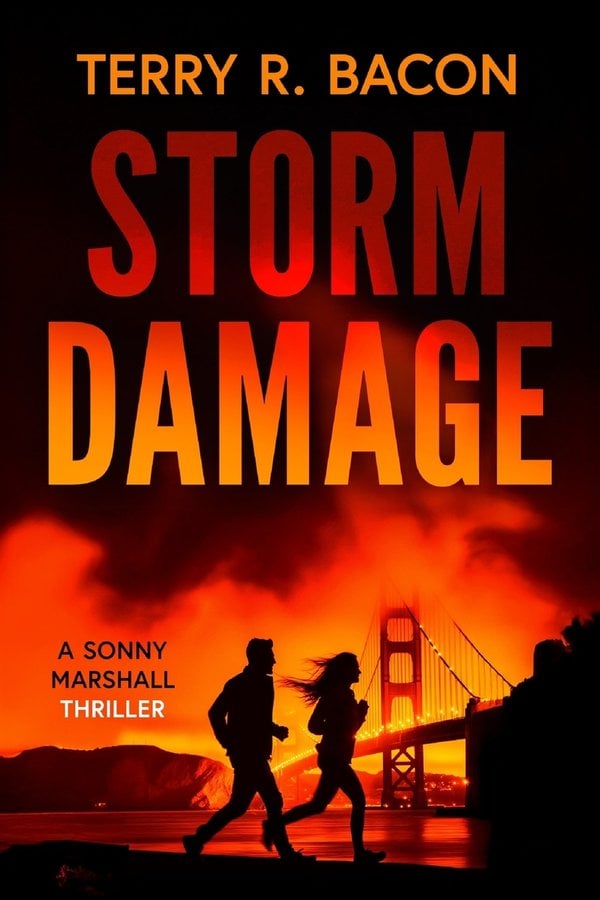
Terry R. Bacon is a poet, playwright, and award-winning author of more than a dozen books, including The Elements of Power, Elements of Influence, What People Want, Selling to Major Accounts, and Effective People Skills. Storm Damage is his first novel and the first in a series of Sonny Marshall thrillers.