The Other Woman’s Name: The Triangular Love Saga of Dorothy L. Sayers, John Cournos and Helen Kestner
Sayers was once madly in love with the high-brow Cournos, who treated her callously and later married another writer. All three wrote detective novels.
Part One:
Mrs. H. Attwood, formerly Mary Stokes
—“I suppose,” thought Harriet, “she had one of those small, summery brains, that flower early and run to seed.
“I always thought she had a head like a day-old chick [said the Dean to Harriet]. Very precocious, but no staying power.”
—characters discuss poor, pathetic Mary Stokes (Mrs. H. Atwood) in Gaudy Night
*
In 1935 Dorothy L. Sayers published Gaudy Night, her tenth Lord Peter Wimsey detective novel in a dozen years. Today the book is widely deemed the greatest of the author’s brace of Wimsey mysteries, although over the decades it has as well, it must be allowed, attracted some passionate and vocal detractors (usually, it would seem, men, including, among more notable names, George Orwell, Raymond Chandler and J. R. R. Tolkien). Gaudy Night was that rarest of things back in its day, a bestselling mystery that attracted serious attention, both positive and negative, from literary reviewers. By 1937, the year she published Busman’s Honeymoon, her final completed Lord Peter Wimsey detective novel, one prominent crime fiction reviewer, Maurice Richardson, had crowned Sayers—along with Agatha Christie and, amusingly enough, the decidedly male Ellery Queen (cousins Fred Dannay and Manfred Lee)—one of the three “Queens of Crime.”
Intriguingly for the biographer, Gaudy Night is not only an important and indeed pathbreaking mystery, in its merging of the forms of the detective and mainstream novels, but also a highly personal one—essentially an apologia by Sayers on behalf of herself and the independent life she had chosen to lead as an intellectual woman. In the novel, her avatar of the two prior books in the series, Harriet Vane, the brilliant writer of popular detective novels (you know, the good ones), returns to her women’s college at Oxford (Shrewsbury College, i.e. Somerville College) to attend its annual Gaudy—what Americans would term a college reunion—at the “urgent entreaty” of her old school friend Mary Stokes. Although but a minor character, Mary provides the impetus for the long novel’s action. Harriet Vane’s attitude toward her former friend is reflective of the novel’s thematic concerns, as well as highly suggestive of Sayers’ own personal and professional history.
Gaudy Night is not only an important and indeed pathbreaking mystery…but also a highly personal one—essentially an apologia by Sayers on behalf of herself and the independent life she had chosen to lead as an intellectual woman.
Long ago Mary Stokes had seemed destined to blossom into the hardy star student of Shrewsbury College, but in the event she proved in fact nothing more than a lovely, decorative summer flower, fragile and all too fated with the passing of time to pale and fade. Sayers vigorously casts poor wan Mary into the ignominious shade with this impressively comprehensive negative assessment of her personality traits on pages two and three of my 1976 hardcover Gollancz edition of the novel (Volume 13 in The Collected Edition of Novels and Stories by Dorothy L. Sayers):
Mary Stokes, so pretty and dainty as Miss Patty in the Second-Year play; so charming and finished in manner; so much the social centre of her year. It had seemed strange that she should take such a fancy to Harriet Vane, rough and gawky and anything but generally popular. Mary had led and Harriet had followed….it was always Mary who took the lead in all the long discussions about love and art, religion and citizenship. Mary, said all her friends, was marked for a First; only the dim, inscrutable dons had not been surprised when the lists came out with Harriet’s name in the First Class and Mary’s in the Second. And since then, Mary had married and scarcely been heard of; except that she haunted the College with a sick persistence, never missing an Old Students’ Meeting or a Gaudy. But Harriet had broken all her old ties and half the commandments, dragged her reputation in the dust and made money, had the rich and amusing Lord Peter Wimsey at her feet, to marry him if she chose, and was full of energy and bitterness and the uncertain rewards of fame.
Clearly Sayers, approaching the age of forty and nearing the end of what proved a tremendously successful and influential crime writing career, is describing herself in Harriet, except that Sayers’ great love affair had hardly resulted in such pleasing self-validation. With misgivings Harriet decides to attend the Gaudy and, sure enough, after meeting Mary in the flesh she reflects with patronizing, if doubtlessly acutely observed, condescension: “It’s a mistake…. Mary is a dear, as she always was, and she’s pathetically pleased to see me, but we have nothing to say to one another. And I shall always remember her, now, as she is to-day, with that haggard face and look of defeat. And she will remember me as I am—hardened. She told me I looked successful. I know what that means.”
Reflecting further Harriet thinks of her old school friend:
Mary Stokes (now Mary Attwood) seemed cut off from [Harriet and her interesting former schoolmates], by—it was no use to blink the truth—by a kind of mental stagnation that had nothing to do with either illness or marriage. “I suppose,” thought Harriet, “she had one of those small, summery brains, that flower early and run to seed. Here she is—my intimate friend—talking to me with a painful kind of admiring politeness about my books. And I am talking with a painful kind of admiring politeness about her children. We ought not to have met again. It’s awful.”
Harriet stops to speak with the admiring Dean of Shrewsbury, who confides to the detective novelist of her latest celebrated crime opus: “The Warden is longing to see you. She simply loved The Sands of Crime.” That pleasantry out of the way, the seemingly irresistible belittling of unsatisfactory Mary Stokes continues:
“How did you think Stokes was looking—Attwood, I mean? I never can remember all their married names.”
“Pretty rotten, I’m afraid,” said Harriet. “I came here to see her, really, you know—but I’m afraid it’s not going to be much of a success.”
“Ah!” said the Dean. “She’s stopped growing, I expect. She was a friend of yours—but I always thought she had a head like a day-old chick. Very precocious, but no staying power.”
“[O]ne of those small, summery brains”; “a head like a day-old chick”—Sayers had quite the touch for dismissive personal invective! In reading Gaudy Night Sarah Harrison, host of the Tea, Tonic & Toxin podcast, found Harriet’s “treatment of her old friend, Mary Stokes” both perplexing and appalling:
“They were best friends in college, and now Mary’s sick, possibly dying. Would love to see [Harriet] again. And [Harriet] gives Mary about five minutes before she just insults her and avoids her for the rest of the party. It was, is, to me, so cruel…. [Harriet is] like, well, I can’t, I can’t pretend to like someone just because they’re sick. But how about you just be a decent human being, right?… I was just like, are you a human person? Like, what’s going on with you that you can just be so mean?”
What, indeed, was going on with Harriet–and more to the point her creator, Dorothy L. Sayers—that she could pen this portrayal of Mary Stokes?
Could pathetic summer-brained, hatchling-like Mary Stokes have been based upon a real person who somehow had engendered Sayers’ wrath? The author of Gaudy Night assures readers in the novel’s Author’s Note that “none of the characters which I have placed upon this public stage has any counterpart in real life,” a claim which, while doubtlessly legally needful, many analysts of the detective novel have found, shall we say, something less than truthful. Indeed, Sayers’ most authoritative biographer, Barbara Reynolds, rightly calls the author’s claim “disingenuous, to say the least.”
Reynolds lists a couple of the novel’s fictional dons as examples of Sayers’ drawing upon real-life models for her characters, then adds of Harriet Vane herself: “Throughout the novel, Dorothy’s own life, her experience as a writer of detective fiction, her personality, her thoughts and feelings, her very way of talking, even her appearance, run parallel with Harriet’s, lending solidity and resonance.” In contradiction of her Author’s Note, Sayers herself once admitted: “Most fictitious characters are patchwork—a trait here and a trait there.” The minor though significant character of Mary Stokes, a feeble foil to Harriet Vane, battle-scarred by love but ultimately triumphant (in the novel she not only enjoys, like Sayers, material “brainy” success but additionally, unlike Sayers, secures the perfect man, Lord Peter Wimsey, as a mate), appears to have been such a patchwork piece as Sayers described.
Part Two
Love Is a Battlefield: Dorothy L. Sayers, John Cournos and a Certain Mrs. Atwood
AMERICAN BRIDE FOR JOHN COURNOS
Mr. John Cournos, novelist and poet, has given notice of his intended marriage with Mrs. Helen Atwood, student, aged thirty, at the St. Martin’s register office, Strand. The bride to be was formerly the wife of Harry Nelson Atwood, from whom she obtained a divorce in America.
–London Evening Standard, 31 December 1923
“I’ve heard you’re married—I hope you are very very happy, with someone who you really can love.”
—Dorothy L. Sayers to John Cournos, 22 August 1924
*
One of the most significant of the real-life “patches” which when stitched together comprised the fictional Mary Stokes, by my conjecture was detective novelist Helen Sybil Norton Kestner Satterthwaite Atwood Cournos (!), who married Dorothy L. Sayers’ ex-lover John Cournos. At one point in Sayers’ Gaudy Night, Harriet, returning from her bath to her room at Shrewsbury College, espies “the name ‘Mrs. H. Attwood’ [i.e., Mary Stokes] on the door next but one to hers. The door was shut, and she was grateful.” Poor Mary, snubbed yet again! Intriguingly, the identification of a real-life “Mrs. H. Atwood” (one “t” only) connected to Dorothy L. Sayers is possible. Although it is unlikely that Sayers ever met the real Mrs. H. Atwood, Sayers had certainly heard of her, both from a friend and from John Cournos himself, and she played, perhaps without ever realizing it, a not inconsequential role in Sayers’ life.
American Helen Kestner wed three times: first in 1914 to Reading, Pennsylvania life insurance agent Alfred Warner Satterthwaite, who gave her two children, a boy, Alfred, Jr., and a girl, Marcia, before expiring four years later at age twenty-eight in the great flu pandemic of 1918-20; second in 1922 to dashing, much-married American aviator Harry Nelson Atwood, whom she divorced after only ninety days; and third in 1924 in London to Russian-American Jewish journalist and author John Cournos, to whom she remained wed for thirty-five years, until her death in 1959. John Cournos had left London for the United States in October 1922, returning in April 1923 to promote his lauded novel Babel, the third book in a trilogy about the doings of autobiographical character John Gombarov, while Helen, a social worker, divorced from Harry Atwood since September 1922, had left the United States with her two children (Alfred, 8, and Marcia, 7) in May 1923 in order to do Red Cross work in London. Sometime later in 1923 Helen met John Cournos and by the end of the year she and John had decided to marry. According to a report in the London Evening Standard, on Dec. 31, 1923 John Cournos filed notice of his intent to wed “Mrs. Helen Atwood, student,” who was “formerly the wife of Mr. Harry Nelson Atwood, from whom she obtained a divorce in America.” John and Helen, both Americans (Cournos naturalized), were married by registrar the next day before the American Vice Consul at 15 Henrietta Street, Covent Garden, on New Year’s Day 1924.
A once much-heralded “modern” highbrow novelist—the dust jacket of Babel carried blurbs from up-and-coming American Jazz Age chronicler F. Scott Fitzgerald, along with respected British authors Shelia Kaye-Smith and Rose Macaulay—John Cournos today is remembered almost entirely, one might venture to say, for his affair with Dorothy L. Sayers, which lasted for over a year, roughly between the summer of 1921 and the early fall of 1922. Sayers, a virgin at twenty-eight, herself trying to find a footing in London and in life commensurate with her immense mental talents, understandably fell for the striking and highly opinionated rising author, “with consequences,” writes Sayers’ biographer Barbara Reynolds, “that were almost to destroy her.” Her early letters about Cournos to her parents, composed before their bitter (primarily on her side) falling-out, evince the shy love of the newly-besotted, but are bittersweet to anyone who knows what is coming and has similarly been, like Sayers, on the miserable losing side of love. Is it truly, as the poet avowed, better to have loved and lost than never to have loved at all?
Financially supported by her parents, Sayers was living a life of striving and uncertainty in London. In the 1921 census she lists her occupation as “translator.” She was looking for a what she deemed a “reasonable job” and writing her first Lord Peter Wimsey detective novel, and she was falling in love with a distinguished older man (forty years old, to be precise). Here on July 1 is Sayers’ purposefully vague description to her parents of the giddiness of love, “the dizzy, dancing way you feel” as the song “Both Sides Now” puts it: “Things have been very up-and-down and tiresome and pleasant, and I’ve never known from one minute to another whether I was in high spirits or the depth of gloom.” Then frustratedly fifteen days later she writes to her mother: “I can’t get the work I want, nor the money I want, nor (consequently) the clothes I want, nor the holiday I want, nor the man I want!!” She did not divulge the name of the man she had in mind in this, what might be termed Dorothy’s summer of love.
A once much-heralded “modern” highbrow novelist…John Cournos today is remembered almost entirely, one might venture to say, for his affair with Dorothy L. Sayers.
Eleven days later Sayers has boldly invited Cournos home to meet her parents at their country rectory in September, but she is dubious that the Great Man will actually accept: “I’m inviting a friend for the end of September, but ten to one he won’t be able to come.” He indeed was not able to come, and in October he is still putting off a visit. Sayers informs her mother: “John writes, ‘Your mother and dad appear to be quite charming people from your accounts and I shall certainly have to contrive to meet them some day. But perhaps they won’t like The Wall [his just published second novel, preceding Babel] as well, or the handwriting on it may prove a little terrifying.” Adds Sayers indulgently of her beloved: “You must tell me what you think. Personally, I think The Wall is not nearly so alarming as John thinks it is. Why do all men make themselves out such wonderful devils when they aren’t anything of the sort? John imagines he’s a terrible person….”
But was it all in John’s imagination? There is evidence of egotism and actual unkindness, or lack of empathy, discernible in John, as concerns his relationship with Dorothy. “I fear he has no sympathy with Lord Peter, being the kind of man who takes his writing seriously and spells Art with a capital A.,” Sayers reports to her mother brightly but disappointedly in November, after she has completed the manuscript of Whose Body? She took ironic solace, she noted, in the delightful “dictum of Philip Guedalla’s in the Daily News: ‘The detective story is the normal recreation of noble minds.’ It makes me feel ever so noble!” One expects more sympathy and understanding from one’s lover, but how often one is disappointed in this regard.
Sometimes Sayers’ life seems tantalizingly close to coming together, while sometimes it seems on the verge of falling apart. She begs her parents in December to “help me to keep it going till next summer, then, if Lord Peter is still unsold, I will chuck the whole thing, confess myself beaten, and take a permanent teaching job,” though she poignantly adds: “One reason why I am so keen about Lord Peter is that writing him keeps my mind thoroughly occupied, and prevents me wanting too badly the kind of life I do want, and see no chance of getting….”
One of those elusive desired things was John. We know, from Sayers’ later letters to Cournos, written in 1924 and 1925, that in 1921 and 1922 she was madly in love with the writer and wanted desperately to marry him and bear him children (particularly sons; Sayers had little use for girls), but that he, most vexingly, had pronounced himself a believer in free love who shunned marriage and had no desire even to bring children into the world. Cournos wanted full sexual intercourse with Sayers and she with him, but he demanded of her that she use contraception and this she refused to do.
For Cournos, evidently, Sayers was needlessly making a great fuss over what to him was merely a potentially mutually gratifying sexual relationship. In his 1935 Autobiography he reflects: “Sanity in sex is a rare thing in Anglo-Saxon countries… the Frenchman takes his sex for granted, just as he does his food and his wine…. I could never be happy in sex except on my own terms.” Sayers provokingly had to go and makes things complicated for them both with her Anglo-Saxon scruples about love and contraception. She herself referred obliquely to this matter in a letter to her mother in January 1922: “John turned up the other day and was all right, though deeply buried in Babel. He and I have had a difference, though, on a point of practical Christianity (to which he strongly objects) and I may hear no more of him.”
In the event the two kept up their relationship, which included considerable physical intimacy (they slept together naked, without performing intercourse) at least until July and possibly a few months later, with Sayers even letting Cournos stay at her flat when she was absent from it. As she reported in happy domestic chitchat over several letters to her parents: “I’ve got a pair of sheets for John, and pillow-cases….”; “I’ve got a charwoman, who is perfectly reliable, to do for John while he’s here….”; “John is established in No. 24, and enjoying himself, I hope. I’m glad to have him there, as he is a nice, decent responsible body, and will keep things nice….”
To her mother Sayers commiserates about John’s professional troubles, empathetically echoing his laments to her about himself in the manner of the truly smitten lover: “his American sales of The Wall have turned out badly…and he is short of the money he had counted on, and has to go on working…. He has no kind parents to fall back on, you see—in fact, all his people do is clamour for money. And he has worked so hard, and suffered so much—he deserves something better of life.” When in London she makes him dinners in her flat, one in July a five-course feast, none of the courses, she assures her mother, coming “out of tins.”
Things were very much looking up professionally for Sayers, who had found a good position as a copywriter with an advertising firm and seen her blithe and charmingly insouciant Lord Peter detective novel, Whose Body?, accepted by publishers in England and America. Yet a few months later in October Cournos left England for the United States, where his massive tome Babel (130,000 words) was being published, leaving Sayers very much alone. In November she complained that he had failed so much as to send her even a post-card. It was, quite clearly, all over between them.
Heartbroken, Sayers launched into a classic rebound affair with a sexually virile, unintellectual man as far removed from Cournos as possible: Bill White, a down-on-his-luck car salesman—a man in the motor trade, one might say—who was staying with the tenants of the flat above hers. “Don’t faint,” she wrote her mother in December 1922, “I am coming home for Xmas on Saturday with a man and a motor-cycle.” (She rode pillion.) Sayers had fun with her earthy, unpretentious Bill, though she did not love him, and the couple had intercourse, Sayers using contraception. She did not love nor desire to marry Bill, so she reasoned, so she did not want to leave open the possibility of bearing children. Ironically, by April she had become pregnant by Bill.
With Bill lacking the financial wherewithal to assist her and most unchivalrously wanting no part of fatherhood, Sayers determined to bear her child, a boy, alone in January 1924, farming him out to relatives and never acknowledging him as her own. (The boy, whom she tellingly named John Anthony, would know her as Cousin Dorothy.) For his part Bill, whom Dorothy now nicknamed “the Beast,” never in his life laid eyes on his son and moved on to another woman, whom Sayers later in one of her letters to John Cournos (see below) dismissed as “dreadfully common, with a voice like a rasp and a hard little mouth….” “She suits him perfectly,” Sayers added, lashing out at both her lovers, “what you once said you wanted yourself—the superior chorus girl type—but I don’t suppose you want to be reminded of that, under the circumstances [presumably meaning his marriage to Mrs. Helen Atwood.]
Bill was out, but in the manner of lost lovers, John Cournos showed up again in Sayers’ life. It was Dorothy who reached out to John, writing him on August 22, 1924, when her son was nine months old, upon learning that he had remarried. As Barbara Reynolds puts it, Sayers, like many another brokenhearted, castoff lover before her, “yielded to an impulse to renew contact with him.” The hurt in her still ran very deep; she had, it appears, never stopped loving the man who had treated her, she felt, so callously. She would correspond with him, on and off, for the next fourteen months, until October 1925, but ultimately it all came to nothing.
Six months later Sayers married Atherton “Mac” Fleming, a divorced Scottish journalist neither as brainy as John nor as studly as Bill, but something rather more middling in between. As with Cournos and Helen Atwood, the marriage was concluded at a registrar’s office, since Fleming’s status as a divorcee made marriage within the Church of England impossible for them. Mac’s and Dorothy’s union, which lasted until Mac’s death in 1950, over the years proved something less than satisfactory for the detective novelist, but the union was, at a time when Sayers very badly needed it, an emotional consolation, a mature companionate marriage. “Mac is perfectly get-on-able-with,” she wrote reasonably if not passionately to her cousin Ivy Shrimpton, who had sheltered her son.
What did Sayers expect out of writing Cournos again in August 1924, when he was married and a stepfather and she a single unwed mother of a nine-month-old boy? Probably she did not know herself. It seems doubtful that Sayers consciously would have been seeking to renew an affair with her former lover, given his marriage and her morals, yet frequently in such cases the urge to reach out again for some contact, any contact, with the lost loved one proves irresistible. It did so for Dorothy. Probably the very fact of John’s marriage, when he had proclaimed so dogmatically to Dorothy that he opposed the sacred institution, proved maddening to her, like a red cape waved at a too-much-tormented bull. Perhaps she was seeking some form of emotional closure with John, though she likely would have loathed that word.[1]
It is a short letter. Sayers opens magnanimously: “Dear John, I’ve heard you’re married—I hope you are very very happy, with someone you really can love.” She then divulges her own betrayal of principle:
I went over the rocks. As you know, I was going there rapidly, but I preferred it shouldn’t be with you, but with somebody I didn’t really care twopence for. I couldn’t have stood a catastrophe with you. It was a worse catastrophe than I intended, because I went and had a young son (thank God, it wasn’t a daughter!) and the man’s affection couldn’t stand that strain and he chucked me and went off with someone else!…
Both of us did what we swore we’d never do, you see—I do hope your experiment turned out better than mine. You needn’t bother about answering this unless you like, but somehow I’ve always felt I should like you to know. I hope you’re ever so happy—
–Dorothy
Presumably Sayers never heard from John Cournos again, but still she did not forget him, quite evidently having thoughts and feelings which she needed to work through in her writing.
Not unexpectedly, to anyone who has experienced ex-lovers’ epistolary or electronic exchanges, John’s answer, which apparently took a month or more to come, proved unsatisfactory to Dorothy. She herself had to let several weeks go by before she dared reply to him. Cournos apparently wanted bemusedly to know why, if Sayers had been willing to have contraceptive sex with this “Beast,” she had not been willing to have it with him. Explained an impassioned Sayers: “the one thing worse than bearing the child of a man you hate would be being condemned to be childless by the man you loved…. God bless you, man, I didn’t want his son—that I’ve got one only goes to show that Nature refuses to be driven out, even with pitchforks—or other implements.”
Aside from his lack of understanding of the workings of her own passionate heart, Cournos infuriated Sayers by indicating that he was using contraception with his new wife, who was three months younger than Sayers and thus still very much of procreative age:
To be frank, I’m badly disappointed. I wrote because I understood from somebody (who said they’d seen it in the papers), that you had really been generous to somebody after all, and I was sorry I’d misjudged you. But you say that this is an error—and when I asked if you are happy, you reply with a shallow brutality about babies. Look here, John—when I see men callously and cheerfully denying woman the full use of their bodies, while insisting with sobs and howls on the satisfaction of their own, I simply can’t find it heroic, or kind, or anything buy pretty rotten and feeble.
“If I could have found a man to my measure,” Sayers with a show of bravado adds in a memorable vainglorious cri de couer, “I could have put a torch to the world.” She then provocatively teases: “Would you like to find me one, even now?” In responding to Cournos’ expressed desire to see her again, she uncorks a sour cask of scorn:
Now why in the world should you want to meet me? Last time we met, you told me with brutal frankness that you had no use for my conversation. Do you think my misfortunes will have added a new lustre to my wit? Or am I to provide you material for a new chapter of John Gombarov’s philosophy? [Sayers refers here to the noble autobiographical protagonist of Cournos’ massive—and arguably massively self-indulgent—Gombarov trilogy, The Wall, The Mask and Babel, which she had dutifully read when she and Cournos were lovers. Bill himself, no intellectual, had read—and enjoyed—Babel.] If I saw you, I should probably only cry—only I’ve been crying for about 3 years now and am heartily weary of the exercise. Or do you want to know “How did I do it?” [manage giving birth to a child without anyone catching on]-I can tell you that, without wallowing in sentimental misery in an atmosphere of toasted tea cake.”
Yet by December, nearly a year into Cournos’ marriage to Helen, she has agreed, however tentatively, to see the man whom she still loved against her considered judgment: “It’s going to hurt me like hell to see you, because Judah with all thy faults I love thee still [a play, alluding to Cournos’ Hebraic origins, on the declaration “England, with all they faults I love thee still”], and as you’ve no use for me I must be in a very stupid and false and painful position. And I won’t be made to cry in teashops. But if you like to come here (the old flat they had known together), I will see you.”
At their meeting Cournos apparently expressed the desire to be friends again and offered to help find Dorothy a lover or husband. Sayers pointedly responds in January 1925 that any lover of hers would have to be a true companion as well, “because, you see, it’s such a lonely, dreary job having a lover…. One can’t be ecstatic about something which involves telling lies to one’s charwoman. At least, I can’t.” (How many lies had Sayers told to hers?)
In this January letter Sayers still shrouds herself conspicuously in sadness. The new Lord Peter novel, to be called Clouds of Witness, she already deems a failure: “Well, my ‘bright creations’ [apparently Cornos’ references to her Lord Peter tales, which Sayers found dismissive and patronizing] are really done with for the moment. The cursed book, associated with every sort of humiliation and misery—is actually finished—and five short stories as well…. Nobody will like the book, though there are good things in it….” She is open to a having a lover, but pessimistic: “in some ways I loathe the idea of starting over again. It makes such a slave of one. And in a sense, I am learning to cope with loneliness. I’m used to it now, and it frets me less than in the days when you knew me. —Still a companion would be good.” She resents Cuornos having referred to her previous letter as long, “as though you found it tedium beyond words.” She closes by observing sarcastically: “This is another ‘long’ letter—all about myself. I am so interested in myself, you see. —Reply with a brief note about yourself.”
On the recriminations go in her letters. In February 1925 Sayers writes angrily concerning Cournos’ “sneer” at “Anthony’s name” being “just a bit below the belt.” In fact as Anthony’s full name was “John Anthony” it would seem that, as Cournos must have noted pointedly to her, she had named her son with Bill after her previous, much-lamented lover. Barbara Reynolds notes that to everyone but Cournos, Sayers referred to her son not as Anthony but as John. “I know I have said some bitter things to you,” Sayers allows, “but you have rather encouraged that dreary kind of wit than otherwise.” She pleads with Cournos: “I simply can’t pretend to be impervious to jabs. I know it’s very unattractive to be miserable and I’ve tried hard to be merry and bright and all that sort of thing, but words that sound all right when life is all right sound pretty harsh when you’re down…. Don’t make a jest of my love for you, because truly it isn’t fair.”
Sayers closes by reflecting of Cournos: “Silence is your strongest weapon. If you don’t answer, I won’t bother you with any more letters.” But she did, like so many lamenting ex-lovers before and after her, who simply cannot stop picking at their scabs. In March she writes to Cournos complaining of his “haughty silence.” But then he writes again and Sayers, unable to help herself, recriminates again, in August making the shocking confession that she would have broken her religious principles for Cournos: “then I still had some hope and some faith and the desire for better things. But I swear if you had offered me love—or even asked for love—you should have had everything [i.e., contraceptive intercourse]. Not easily, because I did not want to commit so bitter a sin—but you never asked me to love you—never said a word to me of anything but bodily desire.”
It would seem that there was nothing further productive to be said between the two ex-lovers at this point, but the correspondence has a surprising coda, a sort of pacific grace note. Barbara Reynolds notes that by the time Sayers wrote the last of her letters to Cournos on October 18, 1925, Mac Fleming likely had entered the mystery writer’s life, giving her a more positive outlook on love and companionship and allowing her to focus productively on work again. The occasion for her writing was Cournos’ posting Sayers a copy of the October 17, 1925 issue of G. K.’s Weekly, in which was published an article by G. K. Chesterton, “How to Write a Detective Story.” Having read it Sayers responded to Cournos enthusiastically with her own disquisition on the principles of detective story writing, agreeing with Chesterton that it was “not only a circus trick but a genuine artisan’s ‘craft’”:
It does give just that curious satisfaction which the exercise of cunning craftsmanship always gives to the worker…. It is rather like laying a mosaic—putting each piece apparently meaningly and detached—into its place, until suddenly one sees the thing as a consistent picture. Like mosaic, too, I believe it to be on the whole most effective when done in the flat and on rather broad lines….The story [Unnatural Death, published in 1927] I am preparing to start on at the moment shows signs of becoming “round,” and for that reason I am rather nervous of it; probably I shall try to keep it, at least, in no more than high relief.
Sayers clearly responded to Cournos’ rare act of thoughtfulness—such a small thing it was too, really—and added: “I am glad you appreciate the brilliance of that article. Oh, dear! I should like to annotate every paragraph of it with examples, awful and otherwise.” Finally, Cournos had shown her that he respected her work and, moreover, she had found a companion in Mac Fleming. It was time to let her ex-lover go.
Presumably Sayers never heard from John Cournos again, but still she did not forget him, quite evidently having thoughts and feelings which she needed to work through in her writing. Five years later in her detective novel Strong Poison (1930), she turned Cournos into the pompous free love prattler Philip Boyes, the highbrow writer whom his lover, Harriet Vane, is accused of murdering. Five years after that, she created in Gaudy Night a character in Mary Stokes who appears to be, in part, a scornful caricature of the woman Cournos had condescended to marry, a woman whom she had never actually met, a certain Mrs. Henry Atwood, as the newspapers had called her in the published marriage notice. It seems that even at the height of her success as a detective novelist Sayers could not quite cast Cournos out of her mind. Does such intense love ever really die? But what of Mrs. Henry Atwood, or Mrs. John Cournos as she became, or, to give the other woman the due of her full name: Helen Sybil Norton Kestner Satterthwaite Atwood Cournos? The rest of this piece is devoted to the other woman in John Cournos life, the one who won him and in doing so incurred Dorothy L. Sayers’ ire.
Part Three:
Helen Sybil Norton Kestner Satterthwaite Atwood Cournos (1893-1959), aka John Hawk and Sybil Norton
Sadly Dorothy L. Sayers evidently destroyed Cournos’ letters to her, so we have a one-sided correspondence in which any references to Cournos’ wife Helen are sporadic indeed. There is in fact only one such of any significance, from January 1925. Sayers simply could not abide the fact that Cournos had refused her “your love and your children and our own happy acknowledgment of each other to the world” and then bestowed all this blessed bounty upon this upstart other woman Mrs. H. Atwood, a once-widowed, once-divorced American (Sayers probably witheringly assumed she was twice-divorced), who already had two children of her own. “You now say you would have given me all those [love, children, marriage]—but at the time you went out of your way to insist that you would give me none of them,” she wrote Cournos bitterly. “Remember that I had some ideals left then—I hadn’t the advantage of being married or divorced or shop-soiled. I believed everything you said to me in those days and if words meant anything, yours meant that you would not love me, you would never marry or have children.” Sayers believed herself to have been most cruelly deceived by the man whom she loved more dearly than any other.
Here Sayers’ attention turned briefly to Cournos’ wife, to whom in the correspondence she never referred by name, not even “Mrs. Atwood.” Cournos also had told her, apparently at some length, about Helen’s two children, concerning whom Sayers admonished him for having the temerity to refer to them as his children. They were, to the contrary, stepchildren, and he was but a stepfather, Sayers chidingly reminded him: “No, no—it’s no use your trying to lay claim to them by proxy—not the slightest credit attaches to you in the matter—I may say ‘my son’ but you must not say ‘my daughter.’” Her solitary substantive reference to Cournos’ wife grouped Helen with her two children, childbearing being obsessively on Sayers’ mind in her letters to her former lover. In effect she morbidly warned Cournos not to tarry too long about having children with his wife (whose age she did not know), or he just might end up inadvertently killing her. How ironic if the woman Cournos had chosen to marry then died in childbirth:
“By the way, having ‘retired in contemplation’ of your wife’s previous matrimonial experience, I am led to ask: ‘Are the girl of 8 and the boy of 10 the fruits of the first or second marriage?’ and to add that the results of my contemplation are, don’t put off your own efforts in that direction too long, unless you want to add wife-murder to your pastimes. I had rather a hard job with Anthony, at 30 years of age, though of course that wouldn’t apply so strongly to a tripara [a woman who had given birth three times].
Would John ever have a child with this American divorcee, Sayers was wondering, the child, it might fancifully be imagined, he had denied to her? Would Sayers have been reassured to know that Helen, who despite her two marriages was actually slightly younger than she, had forgone college and made a love match at the age of twenty in 1914, then given birth in her early twenties to a son and daughter in 1915 and 1916, before her husband two years later died blamelessly from influenza at the age of twenty-eight? By the next year, 1926, Dorothy and Helen had more in common, however, than a birth year and a highbrow lover: They were, both of them, published mystery writers. Between 1926 and 1933 Helen Cournos, hidden under the masculine pseudonym John Hawk, would publish nine detective novels, eight of which are currently being reprinted by Coachwhip. Emphatically Helen had bested Dorothy on the field of love, whether or not she was even ever conscious that Cournos and Sayers had been lovers. How did she fare in the field of detective fiction? Before that question, let us look at the pre-Cournos life of Mrs. Helen Atwood.
Dorothy and Helen had more in common, however, than a birth year and a highbrow lover: They were, both of them, published mystery writers.
Helen Sybil Norton Kestner was born on September 7, 1893 in Torrington, Connecticut, the only child of Christian and Helen “Nellie” (McCarty) Kestner. An attorney and a son of a prominent Reading, Pennsylvania liquor merchant, Christian Kestner had a privileged upbringing which included education at Harvard and the University of Berlin. Two weeks after the birth of Helen, however, Christian on a trip to Denver was in a streetcar accident in which his body was pierced by an iron rod. He had not been expected to survive the grievous ordeal, yet he lived another thirteen years to expire at the age of forty from meningitis, a disease possibly related to the lingering effects of his streetcar accident. After Christian’s death Nellie Kestner removed from Reading with her twelve-year-old daughter to live with her parents at their home in the city of Meriden, Connecticut, located between New Haven and Hartford. (In 1893 she had gone home to her parents’ then residence of Torrington, Connecticut to give birth to Helen.)
Through her mother’s family, the McCartys, Helen claimed a long New England lineage that extended back to a youthful fifer in the American Revolution. Her two middle names were derived from an esteemed Connecticut great grandmother, Sybil Norton. Helen was educated at Meriden High School, then lodged in an impressive Richardsonian Romanesque structure. Whether she had any further education beyond high school is unclear, but in 1914 when she was twenty years old, Helen wed Alfred Warner Satterthwaite, a twenty-three-year Quaker, University of Pennsylvania business graduate, life insurance agent and son of the manager of the Woolworth’s Department Store in Reading, Helen’s old home town. As stated above the marriage endured only four years before Alfred expired in the influenza pandemic, ironically with no life insurance in his own name, leaving Helen alone to care for the couple’s two toddler children Alfred Warner, Jr. and Marcia, then aged three and two. Helen did what her mother had done before her when her husband died prematurely: she returned home to Connecticut to live with her well-off grandparents and her mother, who now resided at New Haven. (Her grandfather Adelbert McCarty was a prosperous hair merchant, a purveyor of wigs and toupees.)
In the 1920 census Helen listed her occupation as the supervisor of a mission house; she was affiliated with the progressive mental health organization known as the Connecticut Society for Mental Hygiene. She later described herself in this period simply as a “widow trying to support two children.” In 1922 she sought a way out for the three of them through a second marriage. A decade earlier her late husband’s late sister Ruth Satterthwaite had wed a flamboyant, dashingly handsome pioneering Boston aviator named Harry Nelson Atwood, who was renowned for his then record-breaking 576-mile flight from Boston to Washington, D. C. in 1911, at the conclusion of which he dramatically landed his plane on the White House lawn at the invitation of President Taft. Like her brother Alfred two years earlier, Ruth died tragically young in 1920, leaving behind three children. In July 1922, Helen and Harry decided to wed, thinking that, Brady Bunch like, they might better raise their combined brood of five children together. This plan proved an utter fiasco, however. Atwood’s biographer writes that the couple “married, fought and argued for ninety days, and divorced. Helen later said Harry was mean and crazy.” Yet Helen got the last laugh. According to her daughter Marcia, when she left Harry, “she made sure she left with the deed to the land and house, which was in her name.” After Harry had put her on a train and said goodbye, Helen hotfooted it down the length of the train, hopped off, got into her “flivver” which she had secreted nearby, drove down to the lawyer’s office and got the deed into her hands. The next year she transferred the deed over to Atwood in return for a generous settlement. Marcia drolly recalled that this was a tale Helen “sure liked to tell.”
Her settlement secured, Helen departed with young Alfred and Marcia to do Red Cross work in war-recovering Europe—and, one suspects, take in more than her share of sightseeing. Her travel itinerary was ambitious indeed, including England, Scotland, Holland, Belgium, France, Spain, Portugal, Italy and Switzerland. Sometime that year, as we know, she met John Cournos and married him on New Year’s Day, 1924. What was it about Helen which captured John’s heart when Dorothy, for all her intelligence, charisma and determination—what she called her “careless rage for life”—failed disastrously to do so? What first attracted Helen to John, apparently, was his novel Babel. In his 1935 Autobiography, which he dedicated to Helen, John writes that Babel “was to win me a wife.”
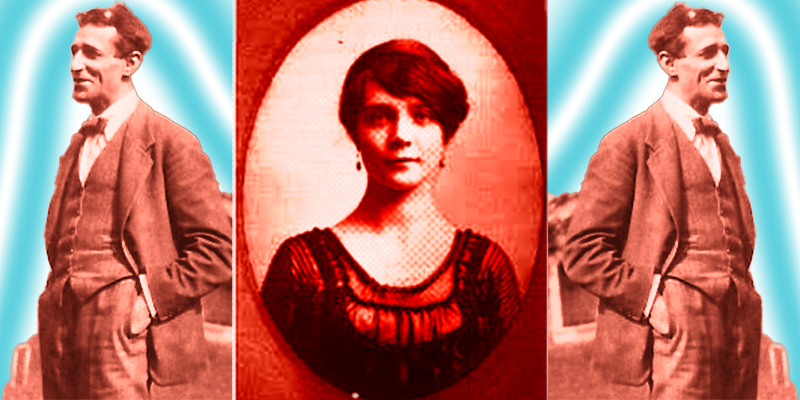
Helen’s passport describes her as 5’3”, with a high forehead and oval face and brown straight hair and eyes. Her passport photo shows rather a haggard-looking woman—her young children in their photos are rather comelier—yet a somewhat older studio likeness, (presumably from the 1910s when she was in her earlier twenties), which she would use as her author publicity picture, reveals a more attractive woman, petite with big soulful eyes and long hair pulled tightly down on either side of her face in Princess Leia like buns. She does appear rather like Sayers’ descriptions of a summer flower and a newborn chick—Had Cournos ever shown Sayers her photo? —yet as evidenced by her interactions with extroverted Harry Atwood, Helen was no shrinking violet or demure Victorian miss but rather someone capable of asserting herself. However, she lacked the singular literary talent and truly exceptional mind of Sayers, which perhaps to the egoistic Cournos came as something of a relief. Certainly Helen, with two children of her own already, was unlikely to clamor Cournos for yet more kinder.
Perhaps in Helen’s case it was Cournos who urged her to write detective fiction, having heard about the subject endlessly from Sayers and always desirous of adding money to his too-scantly-filled coffers, his literary career not having lived up to its early promise, despite his evident proficiency with wordage. Helen wrote in the trade journal The Editor in 1928 that she had long desired to write but was never able to find the time to make a determined job of it until the spring of 1926, which just happened to be around the time Sayers published her second Lord Peter Wimsey detective novel, Clouds of Witness. Helen’s first detective novel, written under the pen name John Hawk and published a few months after Clouds of Witness, was the rather conventionally named The Lone Lodge Mystery; appropriately, it is a highly traditional English country house murder affair. Helen wrote the book in three weeks, then within a fortnight had it placed serially in the London Daily Mail and with publishers in both London and New York—a much easier time than Sayers, or most other authors throughout history for that matter, have had of it with their first novels. Perhaps we can see the fine hand of Cournos here, given his connections in the publishing world. (Sayers enlisted his help as well in 1925; her first detective novel, Whose Body?, was published in the United States by Boni & Liveright, Cournos’ publisher.)
The first five of her detective novels…concern the investigative adventures of Mortimer Sark, a gentleman amateur detective who bears a certain resemblance to, you guessed it, Lord Peter Wimsey.
Thus launched, Helen published eight more detective novels between 1926 and 1933, all but the last of which were published in the U. S. and the U. K., though she never came remotely close to enjoying the success and prestige that Sayers did. Helen set most of her mysteries in England, telling an American newspaper that England was a far more law-abiding country than the United States and thus a better setting for stories where the criminals get “caught in the end.” The first five of her detective novels, all of them published between 1926 and 1929 (The Lone Lodge Mystery, The Serpent-Headed Stick, The Mid-Ocean Tragedy, The Titanic Hotel Mystery, The Murder of a Mystery Writer), concern the investigative adventures of Mortimer Sark, a gentleman amateur detective who bears a certain resemblance to, you guessed it, Lord Peter Wimsey. In contrast with Sayers, Helen never saw her detective novels as anything more than potboilers, taking far greater pride in her well-reviewed, serious mainstream psychological novel The Winthrops, which she published under the pseudonym Sybil Norton in 1927. In a 1928 article by Sybil Norton, Helen divulged that she was Mrs. John Cournos. While she allowed that she had published four mysteries under a pseudonym, she did not reveal the pen name for her mysteries. The Winthrops, she declared, “took about ten times as long to write [as her first mystery; about eight months], and is, I hope, a hundred times as good.”
In 1929, after the publication of six John Hawk mysteries, all of them set in England (the sixth of them The Locked Door, aka It Was Locked, went without Mortimer Sark), the couple and their two children, Alfred and Marcia Satterthwaite, who were now respectively fourteen and thirteen years old, left England to return to the United States, settling in once again with Helen’s widowed mother Nellie and her now octogenarian grandparents, Adelbert and Ellen McCarty. Of Helen’s remaining three published mysteries, two of them were set in the U. S, The Family Skeleton and The House of Sudden Sleep, while the remaining one, Murder at Arondale Farm, took place back in England, though without the ministrations of Mortimer Sark.
Over the 1930s Cournos continued to play the Great Man of Letters in New Haven, home of Yale University, though his career as a novelist largely ended in 1932 with The Devil Is an English Gentleman, a self-indulgent two-volume work of a staggering 170,000 words in which he fictionalized, as Sayers had scornfully predicted, the amorous relationship between himself and Dorothy, even going so far as to draw upon Sayers’ own letters to him. The novel was almost universally little panned—“Why is it that so many authors nowadays persist in writing when they have nothing to say,” bitingly complained one American reviewer—and little read. To be fair to Cournos, who has been accused with justification of caddish behavior toward Sayers over this matter, Sayers as mentioned above had made him, under the name Philip Boyes, her murder victim in the 1930 Lord Peter Wimsey detective novel Strong Poison, and placed her fictional avatar, Harriet Vane, on trial for his murder. However, Cournos may have made use of Sayers even earlier in the panned 1926 novel Miranda Masters, which one reviewer castigated as a “sometimes vulgar exercise in self-exhibitionism.” There is much in the novel about sex and contraception and the desperate need of the Cournos-like writer protagonist (John Gombarov again) to find “some fond soul, some dear girl” who will “release him [from his sexual frustration] through her sweet body’s surrender.” Further in 1930, the same year in which Sayers published Strong Poison, Cournos published his own mystery, Grandmother Martin Is Murdered, in which he quite evidently based one of the characters, most unflatteringly, on his crime writing ex-lover. More follows on these dueling mysteries below in part four.
When in 1933 the great Anglo-American modernist poet T. S. Eliot, who had accepted a one-year teaching position at Harvard, paid an overnight visit to New Haven, he stayed with the Cournoses. In a letter he observed with a characteristic touch of fashionable Thirties antisemitism that Cournos was “a Russian Jew by birth, not vulgarised and Americanised, but a good ghetto type—married to an incongruously Connecticut wife, formally a Mrs. Satterthwaite.” Two years later, when Cournos published his Autobiography (it appeared the same year as Sayers’ Gaudy Night), he omitted from it any mention whatsoever of Sayers, while dedicating to Helen “this self-portrait, done at her urging,” adding devotedly “if it pleaseth not her it pleaseth not me.”
Incongruous or not, the Russian ghetto Jew and the Connecticut smalltown Yankee remained together after their children Alfred and Marcia left the nest, though by 1940 the couple was living together, largely spent literary forces, in an apartment in Manhattan, John mostly earning money, as Sayers once had, through translation work. Following World War Two John and Helen edited Best World Short Stories 1947 and during the 1950s at the height of the Cold War they published patriotic biographies of historical figures aimed at the juvenile market, including books on founding father John Adams and American political folk hero Daniel Webster. John had come a long way from his radical free love days. In poor health during the later 1950s, Helen at sixty-five years of age was found dead in her bedroom from an overdose of barbiturates by John shortly before six in the evening on August 15, 1959. The woman who had won John Cournos survived by fewer than two years Dorothy L. Sayers, who herself had been found dead at the bottom of her stairs on December 17, 1957 after a tiring day of Christmas shopping in London. Both women’s untimely deaths are redolent of murders in detective novels.
John Cournos, who was said to have been devastated by the death of Helen, passed away in 1966 at the age of eighty-five. To the end of his life, he maintained good relations with his stepdaughter Marcia Sternbergh, at least, whom Dorothy imperiously once had told him he dare not call his daughter. Back in 1935 Marcia, then nineteen years old, had drawn the frontispiece of Cournos for his Autobiography. Marcia lived in York, Pennsylvania, her brother Alfred in Haverford, where at the college he was a popular professor of English. Less than a year before John’s death the old man traveled to York at Marcia’s invitation to read some of his poetry at the school where one of her daughters taught, surely a happy moment for a once much-discussed author, in literary circles at least, who now had been largely forgotten by all except his—Sayers’ opining on the matter notwithstanding—family.
John Cournos’ name resurfaced in a big way when biographer James Brabazon, who had access to many of the Cournos-Sayers letters due to the cooperation with his project of Dorothy’s son, Anthony Fleming, and Helen’s son, Alfred Satterthwaite, divulged in his 1981 authorized biography of Sayers that the modernist novelist and Sayers had had a passionate (on her part), unhappy (on both their parts) affair. Brabazon was decidedly unsympathetic to Cournos’ side of the emotional tangle—not to mention incredulous of Sayers’—and not infrequently he indulged himself in personal invective where Cournos is concerned. Above all he could not understand how Sayers had ever come to love, let alone like, someone like Cournos. In his biography he denigrates what he terms John’s “pretentious self-importance and self-pity of cosmic proportions.” At the end of the decade Brabazon contributed to the Daily Telegraph a full-page article, dramatically entitled “Crime Queen’s Fatal Attraction” (a nod of course to the Glenn Close film thriller), in which he declared with dripping disdain of Sayers’ mad infatuation with Cournos: “It’s a great wonder that Dorothy, who prided herself on being fastidious in intellectual and literary matters, should have fallen for such a pretentious man and such a bad writer.”
More measured by far was Barbara Reynolds, who had access to all of the Cournos-Sayers correspondence and had actually known Sayers. In her 1993 biography of Sayers, Reynolds notes Cournos’ striking looks, his sophistication, his “passionate beliefs about life, literature and love,” his seemingly major literary achievements (his autobiographical trilogy was “a vast would-be masterpiece in the tradition of Tolstoy”), and concludes of Sayers: “She was bound to find him attractive…. Dorothy’s horizons were widened; she had never met anyone like him.”
Reynolds provides the fullest details that we had, sparse as they are, until the publication of this piece, on Helen Cournos, but some of what she says about Helen is incomplete or flatly incorrect. Cournos’ wife, she declares, “had had two previous husbands and was the mother of two children. An American, named Helen Kestner Satterthwaite, she was the author of detective stories published under the pseudonym of Sybil Norton.” This account of course leaves out the surname Atwood—derived from her famed aviator second husband, Harry of the ninety days—whose name she still used at the time of her marriage to Cournos. She was, like Mary Stokes, Mrs. H. Atwood. Kestner, as we have seen, was her maiden name. But yet more inaccurate is Reynolds’ following sentence. Helen of course did not write detective fiction under the pseudonym “Sybil Norton,” which she employed for her mainstream writing, most importantly the novel The Winthrops, which Helen regarded as easily her finest writing achievement. She employed the masculine “John Hawk” as her detective fiction pen name.
By the time that Barbara Reynolds wrote her biography of Sayers, however, the John Hawk mysteries were so utterly forgotten as to make this an understandable error. It took a letter to the New York Times from Helen’s granddaughter Marcia Satterthwaite Wertime later in that year to rectify Reynolds’ mistake. Marcia’s issue was not with Reynolds, whom she found judiciously evenhanded in her treatment of Cournos and Sayers, but rather with the reviewer of Reynolds’ book, Barbara Gizzuti Harrison, who declared that in her affair with Cournos, Sayers “fell in love with a cad” and a “moral idiot who had put her on probation” (i.e., ostensibly demanding that she have contraceptive sex with him before he might consider marriage her). Marcia admitted that her own father Alfred had asserted to James Brabazon that Cournos had treated Sayers “scurvily,” but she thought her father’s judgment unfair to her step-grandfather. In fairness I must note that Marcia—who, having been born in 1949 would have remembered both her grandmother and step-grandfather—is the person who first pointed out the intriguing existence of a rather dim and pathetic woman named “Mrs. H. Atwood” in Sayers’ detective novel Gaudy Night.
Coda: When Ex-Lovers’ Thoughts Turn to Murder:
The Dueling 1930 Detective Novels of Dorothy L. Sayers and John Cournos
Remarkably 1930 saw the publication of detective novels by both Dorothy L. Sayers and her ex-lover John Cournos, respectively Sayers’ Strong Poison, a classic crime novel which featured her sleuth Lord Peter Wimsey and introduced to the world her avatar, mystery writer Harriet Vane, and Cournos’ sole, undistinguished effort in the crime genre, Grandmother Martin Is Murdered. In them the pair through their fiction worked through their lingering real-life animosities against each other.[2] Some three decades later, ex-lovers Patricia Highsmith and Marijane Meeker would revenge themselves upon one another by murdering each other in their fiction. In 1930 Sayers would do the same thing, murdering Cournos in Strong Poison, while for his vengeful part Cournos would make Sayers his murderer in Grandmother Martin Is Murdered.
Cournos actually struck first, publishing Martin at the beginning of the year in February, while Strong Poison appeared some six months later in September. One might be tempted to speculate that Sayers was responding to Cournos’ literary stab at her, yet she had already conceived the plot of Strong Poison, which she referred to as her arsenic book, in June of 1928 and completed it in April 1930. Moreover while in the United States Cournos published his mystery under his own name with his wife Helen’s publisher, Farrar & Rinehart, for the book’s publication in England he devised a pseudonym, John Courtney, possibly because he did not want Sayers to know that he had written it. Sayers may never even have been aware that Cournos had published a detective novel in which he portrayed her as a deranged murderess. Even had she actually felt this fictional slap in the face, it does not seem possible that she could have rewritten the book in less than a scant two months in order to make him the odious murder victim in her book. Apparently, it was all was just an unlikely coincidence.
Dorothy L. Sayers’ Strong Poison, the classic first installment in the Lord Peter Wimsey-Harriet Vane saga, has gone through numerous reprintings, especially since the Sayers revival of the 1980s, while John Cournos’ detective novel, which was indifferently reviewed in the States and ignored in England, languished out of print for nearly a century, until its reissue this year. The Cournos mystery concerns the put-upon relatives of the titular Grandmother Martin, a tyrannical and querulous octogenarian matriarch, sickly but determined to live on at all costs (to others), who through her constant demands is driving her devoted daughter, the widowed Mrs. Adams, to her own death. Mrs. Adams’ own daughter, Hetty, decides to return to the family home with her husband, “the well-known novelist, James Wilberforce,” and their young son, in order to rescue her self-sacrificing mother from her grandmother’s selfish exactions. When Grandmother Martin dies, her seemingly devoted nurse, Fanny Purcell, who just happens to have been James Wilberforce’s discarded ex-lover, cries murder (morphia poisoning), intimating that the culprit is none other than James’ wife Hetty. It turns out, however, that Nurse Purcell herself wickedly overdosed Grandmother Martin, in order to get Hetty arrested for murder and have James all for herself. Nurse Purcell has never gotten over her intimate relationship with James, who “took a long journey” and eventually married Hetty; and Fanny has never gotten over that rejection. She hates Hetty like poison and imagines miserably that in another, better life the son James had with Hetty might have been hers.
Grandmother Martin is Murdered is, like other of Cournos’ novels, an intensely self-centered and satisfied book, in which the protagonist clearly is the barely disguised author and meant to figure as its most sympathetic character (“a kind, humane man,” Cournos admiringly tells us of James); yet James seems in fact something of a selfish sexist pig. He thinks of Fanny, who has become demented with rage and grief over the loss of him to another woman:
Fanny…was no puritan, but a passionate woman…. She was no pure wanton either. What she might have been had he married her became a matter of speculation…. Probably a normal woman, devoted to him and his children. He acknowledged to himself that he was to blame there; yet it [loving and leaving her] was no more than many another man had done…. Nor was it any fault of his that he had met a woman whom he loved more than Fanny and whom he regarded as more his kind of woman.
Had only Sayers obligingly yielded her avid literary ambition (be it “only” detective fiction), she might have become a “normal” woman, devoted wholeheartedly to a “great” man of literature, Cournos. Instead, as Cournos apparently saw it, she became enraged with jealously over his marriage to Helen Atwood, sending him letter after recriminatory letter once she learned of his perfidious union. For his part James Wilberforce feels much better after he finally tells Hetty of his past dalliance with Fanny: “There was nothing more to hide. One secret burden off his heart, at any rate.” Hetty “was a good wife, a good disciple,” James thinks, something which willful Fanny could never have been to him. After the murderously maniacal nurse conveniently commits suicide, leaving behind a confession absolving Hetty, kindly Detective Inspector Forbes, a great fan of the Wilberforce fiction oeuvre, agreeably tells James: “You’d never have been happy with this woman [Nurse Purcell]. But even his wife Hetty, whom James claims dearly to love, he constantly terms hysterical. Women in general are deemed prey to their emotions, prone to hysterics, and at times rather tiresome in their irrational feminine ways.
Cournos, in his attempt to wring the money from his writing that his highbrow fiction had never come close to earning, had flatly failed in a genre in which she herself had flourished and which he had once contemptuously dismissed as non-literary.
One can imagine the disgust which Sayers would have felt after perusing Grandmother Martin Is Murdered, in the unlikely event that she had actually learned of its existence. Aside from Cournos’ unflattering portrayal of Lord Peter Wimsey’s creator as a sort of unhinged “Fatal Attraction” murderess, the book, as many disdainful contemporary critics rightly pointed out, is an abject failure as a detective novel, making little to no attempt to conceal the crime’s culprit and having no other interest aside from its dullish depiction of the stilted emotional drama of James Wilberforce’s travails at the hands of dementedly vindictive discarded woman. Complained the Sacramento Bee disgustedly, not even bothering to conceal the sex of the killer: “he must indeed be a dull reader of detective fiction who cannot spot the guilty person long before Cournos permits us to learn the guilty secret and motive of her deed.” The Cleveland Plain Dealer chimed in that “[t]he attempt of John Cournos to catch up with the fashion of the moment by writing a detective story is a flat failure. As soon as the murder takes place, the reader knows who did it.” Doubtless Sayers, a consummate craftswoman and keen critic of detective novel aesthetics, would have agreed with these reviewers’ estimates, while taking bitter satisfaction that Cournos, in his attempt to wring the money from his writing that his highbrow fiction had never come close to earning, had flatly failed in a genre in which she herself had flourished and which he had once contemptuously dismissed as non-literary.
While Sayers with Strong Poison produced an inestimably superior detective story, the novel bears resemblance to Grandmother Martin Is Murdered in that in it Sayers, like Cournos, is grinding an armory of axes concerning her near-decade-old affair. In Strong Poison brilliant detective novelist Harriet Vane, somewhat plain but withal desperately fascinating, is on trial for the murder—arsenic poisoning this time–of her late lover, highbrow novelist Philip Boyes. (“Perhaps not strictly good-looking but all the more interesting for that,” is how Peter’s wise albeit dithering mother, the Dowager Duchess puts it in appraisal of Harriet’s features, “because good-looking people are so often cows.”) Forty percent of the way though the novel we should all know who the killer is and, if we are reasonably clever, be able to take a good crack at how the murder was done, but the rest of the book is quite entertaining in a way Grandmother Martin Is Murdered decidedly is not, with Peter bringing all of his resources powerfully to bear in order to build a provable case against the killer and suspensefully not putting the final “how” pieces of the puzzle in place until very late in the tale.
Most fascinating to students of the Sayers-Cournos affair, however, is Sayers’ treatment of the Boyes-Vane relationship, which she modeled after her and Cournos’ own ill-fated one, with telling alterations. Through Harriet, to state it bluntly, Sayers puts Cournos in his place, something which she was never able to accomplish in real life, no matter how many embittered, admonishing letters she sent him. Harriet’s key speech comes when Lord Peter, interviewing her in jail, asks whether she and Boyes were friends and provokes this furious response:
“No.” The word broke out with a kind of repressed savagery that startled him. “Philip wasn’t the sort of a man to make a friend of a woman. He wanted devotion. I gave him that. I did, you know. But I couldn’t stand being made a fool of. I couldn’t stand being put on probation, like an office-boy, to see if I was good enough to be condescended to. I quite thought he was honest when he said he didn’t believe in marriage—and then it turned out it was a test, to see whether my devotion was abject enough. Well, it wasn’t. I didn’t like having matrimony offered as a bad-conduct prize…. I thought Philip had made both himself and me ridiculous, and the minute I saw that—well, the whole thing simply shut down—flop!”
Yet in real life Cournos never actually offered, in contrast with Philip Boyes and Harriet, to marry Sayers; Sayers learned of John’s faithlessness to his free love principles only when she heard, secondhand, of Cournos’ marriage to another woman, Helen Atwood. It is in the novel that Sayers enjoys the vicarious satisfaction of telling Cournos, aka Philip Boyes, just where he can get off—and murder him for good measure. Notably in Strong Poison there is no other woman like Cournos’ Helen Atwood in Boyes’ life, someone he marries in preference to Harriet, she being “more his kind of woman.” Before he is slain Boyes instead is left frustrated and vexed with Harriet’s principled determination not to marry him. In this sense Grandmother Martin Is Murdered is more of an accurate recollection of real life than Strong Poison, though Cournos highly exaggeratedly (and rather flatteringly to himself, as per usual) imagines Sayers as being so distraught by Cournos’ rejection of her that she despicably devises a murder and frame-up to try to get her old lover, James Wilberforce, back in her amorous clutches.
Sayers shafts Philip Boyes’ character throughout the novel, especially through the derisive comments of Lord Peter, who tells Harriet, for example, of Boyes’s treatment of her and his attitude to women generally: “It sounds to me as if the fellow was a prig—not to say a bit of a cad…. Such a Victorian attitude, too, for a man with advanced ideas. He for God only, she for God in him, and so on.” Boyes’ one defender, a pathetically worshipful hanger-on by the name of Vaughan (male, naturally) merely nauseates us through his abject obsequiousness when to Lord Peter he attempts to shield his slain hero and slash his perfidious lover: “Oh, she did it all right [poisoned Boyes]….Just because she couldn’t write anything but tripe herself….You’d think it would have been enough for her to help and look after a genius like Phil, wouldn’t you? Why, damn it, he used to ask her advice about his work, her advice, good lord!… Of course it was hopeless from the start for Philip to get entangled with that kind of woman. Genius must be served, not argued with.”
In John Cournos’ brief critical heyday, back when he had been Dorothy L. Sayers’ lover, some of his admirers might well have said the same thing of him and Dorothy. Sayers got the last laugh, however, at least in one respect. As Eiluned Price, one of Harriet’s lesbian friends (“She scorns everything in trousers, but she’s a good friend at a pinch.”), scornfully observes: “Women geniuses don’t get coddled.” Yet sometimes they persevere and triumph anyway.
Today in 2026, over a century after the publication of Sayers’ Whose Body? and Cournos’ Babel, virtually no one alive, unless it is in connection with Sayers, has heard of the now disfavored Twenties critical darling, while Sayers herself stands regally as one of that inestimable quartet of British Crime Queens (not to mention her accomplishments in theology and classical literature). In her real life, however, Dorothy L. Sayers never triumphed so decisively over John Cournos in the matter of their love lives, if she even triumphed over him at all. That satisfaction she could only enjoy vicariously in her fiction, by creating Harriet Vane and giving to her in holy wedded matrimony the perfect, albeit imaginary, man, Lord Peter Wimsey. In love, regrettably, Sayers was rather less like Harriet Vane and more like her minor character Miss Marjorie Phelps, who makes “figures in porcelain for a living” and is Lord Peter’s entrée to the bohemian arty crowd. In her heart matey Marjorie loves Peter and when the amateur sleuth unwittingly reveals to her his head-over-heels love for another woman, Harriet Vane, she suddenly feels “as though something inside her had been put through a wringer.” Sometimes, sadly, a wrung heart never quite straightens again.
Books by Mrs. Helen Cournos:
John Hawk detective novels
The Lone Lodge Mystery (1926) (Mortimer Sark)
The Serpent-Headed Stick (1926) (Sark)
The Mid-Ocean Tragedy (1927) (Sark)
The Transatlantic Hotel Mystery (1928) (Sark)
The Murder of a Mystery Writer (1929) (Sark)
The Locked Door (in the U. S., It Was Locked) (1929)
The House of Sudden Sleep (1930)
Murder at Arondale Farm (1931)
The Family Skeleton (1933) (not published in the U. S.)
Sybil Norton mainstream novel:
The Winthrops (1927)
Dueling Detective Novels:
John Cournos, Grandmother Martin Is Murdered (1930)
Dorothy L. Sayers, Strong Poison (1930)
[1] To me everything about Sayers’ letters to Cournos indicates that she was both the one in love and the one who had trouble moving on from the relationship, but her biographer Barbara Reynolds would have it that “it is clear that it was D.L.S. who brought the affair to an end.” Reynolds draws this conclusion from this comment from Sayers in her December 4, 1924 letter: “I wanted to have children, quite normally and ordinarily. I wanted to have yours, and as you repeatedly refused, I chucked the whole business.” Reynolds thinks that the phrase “chucked the whole business” means ended the sexual relationship with Cuornos, but to my mind Sayers here means chucked the whole business of having children. Hence she used contraception when having sex with her rebound lover, Bill White, though in the event these precautionary preventive measures that she had formerly decried ironically failed her. Her very next sentence in the letter begins: “I didn’t want the Beast’s [children]….” (referencing Bill White).
[2] With Robert Eustace Sayers also published an additional, nonseries detective novel in 1930, The Documents in the Case.

Curtis Evans
Curtis Evans is the author of Masters of the "Humdrum" Mystery and The Spectrum of English Murder and the editor of Clues and Corpses: The Detective Fiction and Mystery Criticism of Todd Downing, Mysteries Unlocked: Essays in Honor of Douglas G. Greene and the Edgar nominated Murder in the Closet: Queer Clues in Crime Fiction Before Stonewall. He blogs at The Passing Tramp.