The Secret Queer True Crime History Behind the Victorian Era's Other Sherlock Holmes
E.W. Hornung's Raffles stories —he was the original Gentleman thief, and for fifty years as popular as Sherlock — are almost entirely forgotten outside specialist circles, yet they contain one of Victorian literature's most compelling implicit queer relationships. I've revived this pairing in my new novel 'The Great Game' and here's why.
In June 1898, Ernest William “Willie” Hornung began publishing the short stories that would comprise the collection The Amateur Cracksman. Hornung was at that point a relatively minor literary figure, though a well-connected one, in part by his membership of the cricket club, the Allahakbarries, founded by J.M.Barrie and whose other members included Jerome K. Jerome (Three Men in a Boat) and Arthur Conan Doyle, whose beautiful sister Connie Hornung married in September 1893.
So when one notices that the dedication of The Amateur Cracksman read in full as follows:
To A.C.D.
This form of flattery
One has perhaps to sit up and pay attention.
ACD was, of course, Hornung’s brother-in-law, Arthur Conan Doyle, already internationally famous as the creator of Holmes and Watson, and the reason for the sideways compliment quickly becomes apparent when you read the short stories within.
Each of them contains not a case, but a caper. Not a mystery to be solved, but a crime to be executed. Our hero is a tall, aristocratic, physically and mentally exceptional, singular British individual, A.J. Raffles, amateur cracksman. The greatest gentleman thief of this or any other age and the narrator of our stories is his hapless, much put-upon, intellectually and socially inferior best friend, War veteran Harry “Bunny” Manders.
Sound familiar? Flattery, indeed.
Hornung had shamelessly stolen and inverted Conan Doyle’s framework, put Holmes and Watson through a dark mirror, and outputted Raffles and Bunny – and it worked! The book became a bestseller. The characters became notorious, and Hornung himself was elevated from minor literary figure to celebrity author.
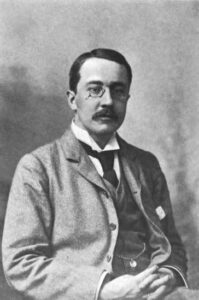 E.W. Hornung
Indeed, over the next half century, Raffles and Bunny became two of the most famous, most adapted, and most talked-about literary creations of the age, standing comfortably beside Dracula, Sherlock, Dorian Gray, Peter Pan and a little bear called Pooh.
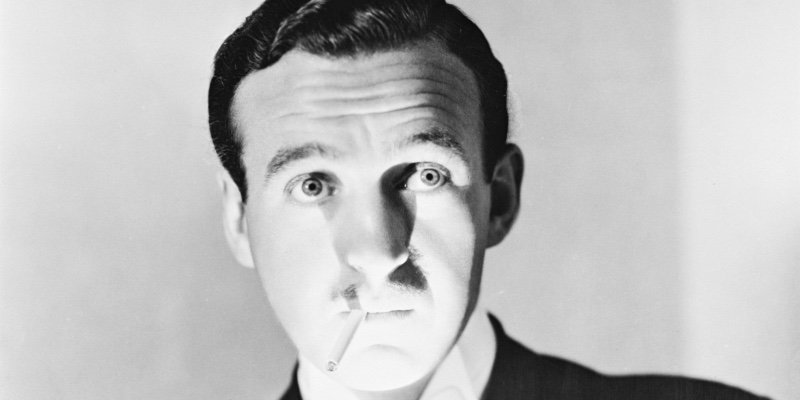
Hornung produced multiple volumes of short stories, a full-length novel, two long-running plays and then came the radio and movie adaptations, both during and after Hornung’s lifetime, culminating most memorably in David Niven’s 1939 portrayal of Raffles (pictured above), in a performance that unquestionably inspired Cary Grant in Hitchcock’s To Catch a Thief.
That today hardly anyone remembers Raffles and Bunny, and that the stories are either out of print or only available in cheap public domain editions is sad, but perhaps not in itself surprising. Most literature does not survive the test of time. Even stuff massively popular in its day fades into quick oblivion decades later.
If you doubt this, try and name one thing that A.A. Milne or J.M.Barrie wrote other than the children’s books for which they are remembered. Yet in their prime they were both titans of the stage and literary worlds, churning out highbrow adult entertainment and if you told either man that today they would only be remembered for a little bear and a boy who never grew up, they would be surprised and perhaps at least in Milne’s case horrified. As, of course, was Conan Doyle, as his detective hero eclipsed all his other achievements.
Most things don’t last. None of us get to choose if we will be remembered at all or if we are what we might be remembered for. Thinking otherwise is hubris.
So in a way, perhaps the more interesting question is, why did Raffles and Bunny last as long as they did and become as famous and notorious and loved and controversial?
It cannot simply be because they were coasting off the coattails of Sherlock and Watson. There has been plenty of fanfic over the years, but little of it sticks around. Yet Bunny and Raffles did. Part of the answer is Hornung’s unquestionable talent as a wordsmith. He writes in clear, understated yet elegant Edwardian prose. His plots are of the most elaborate and beautiful clockwork, each caper humming and spinning through complex twists and turns but always sticking the landing.
I don’t think that’s the whole of it, though. There’s something else going on.
In story after story, Bunny, our well-intentioned but hapless narrator, is bamboozled by his beautiful friend into being first an accomplice and eventually a full-on burglar himself. Despite being the one telling the story, Bunny – like Watson before him – is always several steps behind his own narrative. Whilst he always tries to resist the moral corruption that Raffles so enticingly offers, Bunny nevertheless inevitably succumbs. In one tale, he robs his own parents. In another, he betrays his beloved fiancée, thus ending their union, and his chance for wedded bliss, forever.
When this happens, Raffles comments:
“So you are out of Paradise after all! I was not sure, or I should have come round before. Well, Bunny, if they don’t want you there, there’s a little Inferno in the Albany where you will be as welcome as ever.”
The Albany being the exclusive all-male apartment building where Raffles resided, and in that little detail, “all-male”, I believe lies the secret. Bunny is thrown out of the heaven of female companionship and into homosexual hell.
Homosexual? Yes, because Holmes and Watson were not the only inspirations for Raffles and Bunny; Arthur Conan Doyle wasn’t Hornung’s most famous friend. He was one of two famous literary men who Willie Hornung counted as his closest. The evidence is the name of Willie and Connie’s only son: born in 1895, the boy was christened Arthur Oscar Hornung.
Yep, there he is, sneaking up to us like he does everywhere in the Victorian age. The omnipresent, essential man of culture, Oscar Fingal O’Flahertie Wills Wilde. Wilde was not just friends with Hornung, but close enough friends that Hornung would name his only son for him, and three years later, create a pair of characters that are as much indebted to Oscar and his lover Lord Alfred “Bosie” Douglas as they are to Sherlock and Watson.
When you read them closely, it becomes manifestly clear that Raffles and Bunny are coded homosexuals, that Raffles’ corruption of Bunny is not limited to the realm of property acquisition, and that his control over him is best understood as sexual, indeed, as sadomasochistic. All, of course, carefully concealed and discreetly folded beneath the surface of elegant Edwardian prose
(I am not making a new discovery here. This influence is long noticed and accepted by Hornung’s biographers and indeed by the literary world at large, both at the time and later. Famously, Graham Greene resurrected Raffles and Bunny in a celebrated 1974 comedy play entitled The Return of A.J. Raffles, where he pulled the subtext, squirming and wriggling, into the text, putting Bunny Manders and Lord Alfred Bosie Douglas into the same room at the Albany where they plotted a heist against Bosie’s father, the brutish Marquess of Queensberry, a form of revenge for what he had done to poor Oscar.)
I believe that it is this combination of text (the dashing gentleman criminal as hero) and subtext (the homosexual operating covertly at the highest levels of society, both celebrated and feared) that gave the stories their particular frisson and resonance in the first half of the 20th century. When Hornung made, against his brother-in-law’s wishes, his villain the hero, he was also making the gay man the hero.
When I chose to resurrect Raffles in my new novel, The Great Game, I decided to bring his sexuality a little closer to the surface, clear to any reader who is paying any attention. It is less clear to his new compatriot, my hero Balvinder Dev Singh, who takes the place of the poor dead Bunny as Raffles’s accomplice. Even though Balvinder, a veteran of the Boer War and a graduate of India’s most elite schools, is less a fool than his predecessor and less willing to follow Raffles to hell, he remains uncertain about his friend’s sexual proclivities. Ultimately, it’s as much disinterest as it is uncertainty. Balvinder doesn’t care who Raffles sleeps with, his own moral compass is more concerned with the sins of the empire than it is with the love that dare not speak its name. Indeed, it is the turn of the book that Balvinder ultimately asserts his own moral compass and is even able to turn Raffles, briefly, towards the cause of global justice.
I like to think that Hornung would approve of my inversion of his inversion. He was a man willing to hold moral complexity in one hand and artistic imitation in the other and mash them together into something wholly of his own. In that, he is a writer after my own heart.
He was also a loyal man, even when it was unpopular to be so. His friend Oscar Wilde fell dramatically from grace in 1895 with the series of trials that led to his condemnation and imprisonment. Wilde’s friends, once legion, abandoned him almost entirely, and he never saw his children again, dying in exile, agony and poverty in 1900. In such a climate, for Hornung to continue writing stories that so warmly paid tribute to his friend’s grace, style, genius, and contradictory nature is, in itself, a type of heroism.
A greater hero still was Hornung’s son, who chose not to use his given first name of Arthur but instead answered always to Oscar, even at a time when that moniker was synonymous with disgrace and depravity. Oscar Hornung wore his name proudly till the day he fell at Ypres on July 6, 1915— he was twenty-two. He died just a few miles from Aubers Ridge, where Wilde’s own eldest son, Cyril Holland, (Holland, because he had accepted his family’s dictum to renounce his disgraced father’s name) had been cut down by a sniper two months earlier.
Some stories you can’t make up, but once you know them, they stay with you forever.
***
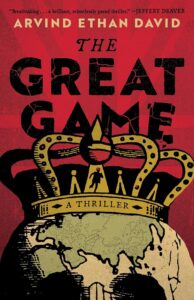

Arvind Ethan David
Arvind Ethan David is an Olivier nominated playwright, a Stoker nominated graphic novelist and a writer-producer of television including Dirk Gently's Holistic Detective Agency, Anansi Boys and the Asian Academy Award–winner The Garden of Evening Mists. The Great Game (Thomas & Mercer) is his debut prose novel and is available now.