The Undeniable Bisexuality of Gilda
Making the case for the 1946 noir classic as an iconic queer film
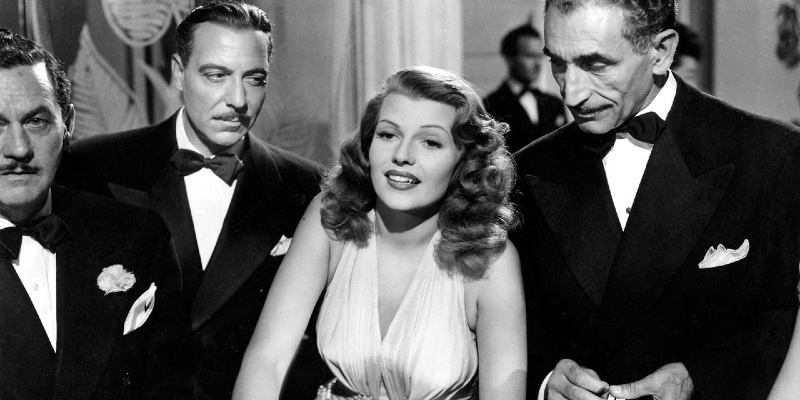
The movie Gilda, starring Rita Hayworth, is known for many things, including the lush cinematography, and for solidifying the stardom of Hayworth, previously known primarily for musicals and comedies. The film features the most iconic scene of Hayworth’s career, a gif-length meme (long before such things existed) of Hayworth tossing her auburn tresses and turning her head to greet the camera with a broad smile. Even if you’ve never seen the movie, you’ve likely seen that image.
It’s also a movie that only makes sense if the two male leads are bisexual.
For those who have never seen the film, or have forgotten, Gilda opens on the docks of Buenos Aires. (Or the Hollywood soundstage approximation). Johnny Farrell (played by Glenn Ford) is a vagabond who has won money at craps played with weighted dice and is about to be robbed when a man appears out of nowhere, disarming the thug. This is Ballin Munson (played by George Macready), a debonair figure dressed in evening wear, complete with top hat and white scarf, but the way he’s able to disarm the would-be mugger, shows he’s clearly more than a gentleman.
After saving Johnny, he tells him that at the casino, cheating isn’t allowed, but gives him a passkey. Johnny presses his luck, and at the casino gets caught counting cards and is escorted to the office of the casino manager and owner, who is none other than Ballin. Johnny goes to work for him, becoming his right hand man. Then Ballin takes a trip, and returns married. To a woman who happens to be Johnny’s ex. The titular Gilda, played by Hayworth.
What follows is a love triangle, deaths, a double crosses, exploding planes, musical numbers, and more. While Ballin is working, Hayworth is off playing around with seemingly every available man she meets. The heat between Johnny and Gilda is palpable, loving and hating each other. The charged energy between Johnny and Ballin – which has been a third character in every scene they appeared in, no matter who else was around – becomes a tension once Gilda arrives that is hard to quantify, but the threat of violence now seems to hang over them all in every scene.
This is a story of two men fighting over a woman. The age old story of two men who are like brothers, and a woman comes between them. Because, as Ballin said, “Gambling and women do not mix.”
There’s more to the plot, including a Tungsten Syndicate, which may bring to mind the contemporaneous Hitchcock movie Notorious whose plot was about uranium (and like this movie, really about the relationships between the characters, the “plot” practically a macguffin). I won’t spoil all the twists and turns.
Much has been written over the years about how queer old Hollywood films were, and how queer film noir was. It shouldn’t be a surprise that noir was queer. How often were LGBTQIA+ people pushed to the margins of society? Or stayed closeted due to the threat of being treated that way? Logically it makes sense that films depicting societal margins would have queer people and queer themes.
For Hollywood films, this often meant that characters who were written as queer in books were either made straight or became implicitly queer in ways that were sometimes subtle, and sometimes not. This is on account of the Hays Code, which was adopted in 1930 and banned “any inference of sex perversion.” (It also banned nudity, childbirth, interracial relationships, and ridicule of clergy, among other things).
“Queer coded” was coined to describe how LGBTQIA+ people were portrayed in spite of all that. Which often meant men or women who acted in an atypical or gender-nonconforming manner, which could mean something as simple as an effeminate man, or a woman with short hair who wore pants. Often they were supporting characters or villains. Think Joel Cairo, played by Peter Lorre, in The Maltese Falcon, or Waldo Lydecker, played by Clifton Webb, in Laura. Villains and decadent dislikable figures were allowed to be queer coded, because defeating them meant that proper, correct, heterosexual individuals triumphed. It might not have been explicitly stated in that manner, but that was often the subtext.
Other times the queer themes and characters were too subtle to be noticed. In one scene in the novel The Maltese Falcon, Sam Spade referred to a character as a “gunsel.” This was a revision. In Hammett’s original manuscript Spade referred to the character as a “catamite” – a derogatory term for gay. Hammett was told by his editor that word wasn’t allowed, and so he changed it to “gunsel” and left the scene as it was. Whether the editor knew that gunsel was a term for gay is unclear. The editor, and others, likely saw the word “gun” and thought that the term referred to a henchmen or hired gun. Raymond Chandler and others would use the term to mean just that. John Huston was able to use the word when he adapted the book into the 1941 film, likely for the same reason. The gatekeepers had no idea that the word meant gay.
This is a long-winded way of saying that noir was always a little queer, in ways that were both obvious and not, and it is in no way revisionist to make that claim. With this in mind, let’s look at the film Gilda once again in a less straight forward manner. (For the record, I agree that puns are the lowest form of wit, but liking puns is a bisexual trait).
***
The movie opens with a black screen, the camera appearing to rise up from the darkness below the floor to reveal a pair of dice in the foreground. A disheveled Johnny Farrell (played by Ford) is crouched low to the floor, with other men, watching for the roll. Ford gathers up his winnings without counting the bills, and grabs his worn hat, before scurrying off to count his winnings. In films noir, docks were a place of criminality, but for centuries docks have been a borderlands space where people were not bound by the rules of strict society. That was true of race and nationality, and it was true of sexuality as well. There was a reason why sailors were often queer coded. Farrell is about to be robbed when a well-dressed man appears and scares the thug off. Why is a wealthy man dressed in evening wear wandering around the docks at night? Today there are apps for this.
There’s also the dialogue in the scene.
“You must lead a gay life,” Johnny said.
“I lead the life I like to lead,” said Ballin.
“You’re a lucky man.”
“I make my own luck,” Ballin said, before saying of Johnny, “A man who makes his own luck, as I do, recognizes another’s.”
“Gay” was regularly used as “carefree” in this period, as in the 1934 film The Gay Divorcee, but it also meant homosexual. Also, in this era it often referred to a relationship between an older man and a younger one. Something that’s easy to be reminded of when the boyish looking Ford stands next to the poised, well-dressed Macready. Also, why would wandering around the docks in the middle of the night for no reason be “carefree?” It’s called a double entendre.
The two never exchange names in that first scene, though Ballin offers Johnny a cigarette, and Johnny lights his and Ballin’s as they maintain eye contact. They only introduce each other at the casino, after Farrell is escorted into the owner’s office. Two men who meet on the docks late at night would not necessarily exchange names.
Gambling is illegal in Buenos Aires, but the casino operates in the open with the knowledge of authorities. To enter the casino, a passkey is required that one shows to the doorman, but the frosted glass doors don’t hide anything. From his office, Ballin has windows that look out onto the floor with shades he can close, and microphones to listen in, or shut off. Open, but also not. Blatant but unspoken.
In the casino, the men exchange names for the first time, and there’s a strange energy and tension between them. Even rewatching the movie, I can’t quite put a name to it because they’re toying with each other, but that suggests lightness, and it is not. There is tension, but there’s not anger. Farrell is proposing that he be hired to work for the casino, but he’s not asking or even pleading. It’s this very delicate dance, and there’s a reason why this relationship has been read as gay since the movie was released.
Ballin seems uncertain about hiring Johnny, until he watches as Johnny calls the heavy who punched him earlier into the office. Johnny slugs the man and knocks him to the ground as Ballin’s cane goes from leaning against the floor to shooting to an upright angle. The scene ends, and in the next one, Johnny is Ballin’s right hand man.
Time passes and Johnny is now running the casino when Ballin announces that he has to go away for a short trip. When he gets the call that Ballin is back, Johnny goes to the house and while there are servants, Johnny has a key to the front door, and walks inside calling for Ballin. There Ballin announces that he’s gotten married, and Gilda is Johnny’s ex, but Johnny’s face falls when Ballin mentions he’s brought a woman back with him. Before Gilda appears, before he recognizes her, and that is different from his expression when he recognizes her.
When we meet Gilda, she rises into the frame, flipping her hair in that famous scene. It’s hard not to think of Johnny’s entrance, the camera meeting him from above in the dark. Of Ballin, emerging from the shadows from the side. And Gilda, rising up to meet the camera and the light.
This is also the first scene in which we really see who Ballin is. It’s in the way that Ballin greets Johnny, the way he introduces them. He enjoys this power play and the control he has over both of them. And over others, as we see in the following scenes, as he uses his power and influence to squeeze people in ways that get him into trouble.
Hayworth’s performance has such depth and feeling. She’s not a femme fatale, though she’s sometimes referred to as one because she’s the dame in a noir. In the scene where we first meet her, there’s a long shot as the camera stays on her smoking a cigarette as Johnny and Ballin converse off camera. You can see in her expression who is looking at her and what’s happening off camera. She’s aware of performing, for her husband, for Johnny. You can see on her face when they look at her as opposed to each other. When they leave the room and she’s no longer being seen, it’s as though we’re seeing her for the first time.
There’s a famous John Berger quotation from his book Ways of Seeing, and leaving aside the accuracy of it as a general statement about gender, I think it sums up the character of Gilda and her dynamic with men: “Men look at women. Women watch themselves being looked at. This determines not only most relations between men and women but also the relation of women to themselves.”
The two men leave Gilda and walk down the stairs to the front door in a beautifully staged scene. In a single camera shot the two walk down the stairs, lighting a cigarette, lingering on the stairwells before approaching the front door. Like the scene in the casino, there’s a strange energy between the two. They’re negotiating. In a way that reminds me of Paul Simon’s famous lyric “Negotiations and love songs / are often mistaken for one and the same.” Throughout the scene Johnny is often at the center, but sometimes his back is turned to the camera, making his expression inscrutable. The two men switching places and moving around as they make their way from the top of steps to the landing and then to the first floor like they’re dancing. Finally when they end in the foyer, Johnny digs into his pocket and gives Ballin his house key.
“What’s this?”
“Tact.”
***
This might be a good opportunity to mention some of the people who worked on the film. It was produced by Virginia Van Upp, who was not just a female producer in the Hollywood studio system, but an executive producer at Columbia Pictures. She and Hayworth were also good friends, working together over the course of two decades. The film was shot by Rudolph Mate, one of the great cinematographers in film history, who worked with Hitchcock and Lubitsch and Welles, shot That Hamilton Woman and The Pride of the Yankees, and became a legend during the silent era for his collaborations with Carl Theodore Dreyer on The Passion of Joan of Arc and Vampyr.
The film was written by men and women, including an uncredited Ben Hecht, and I think this plays into some of what makes this such a complex film. Like a lot of second-rate noir films, it has too much convoluted plot. This film knows that Hayworth has sex appeal and shows it off, it has good dialogue, but it’s a film that’s about the vibes. One that we remember for scenes, instead of the plot, which goes off the rails by the end.
The relationship between Johnny and Ballin has always been read as gay. Since the movie was released, essentially. Glenn Ford told Vito Russo in the The Celluloid Closet that he and Macready played the characters as gay. I would argue that is bisexual erasure. But almost everyone watching knows that something is off. Film historian Eddie Muller called Gilda “the most perverse movie made in the 1940s” for a reason.
Also it’s interesting that the film was able to have so much queer subtext edging into actual text, but once Hayworth arrives, her smile – and that black satin dress and her singing – distract everyone. I don’t just mean that the film is bisexual because there’s a relationship between two men and Hayworth at her most glamorous and seductive, and that Ballin seems to have a similar relationship with both Johnny and Gilda, both of whom he “married” very quickly. Gilda plays around with men, and Johnny covers up Gilda’s slutting around with men to protect Ballin more than out of concern for her.
This is a film about dual lives, about hiding in plain sight, about performance and playing multiple roles. All three of the main characters are doing that throughout in different ways. About the ways that sexuality and desire play out in different ways.
Then there’s also the dialogue:
Johnny: You married him for his money.
Gilda: That happened to come with it.
Johnny: Now, that’s a great way to make a living.
Gilda: That wouldn’t be the big pot calling the little kettle black now would it?
Johnny: I was down and out. He picked me up. Put me on my feet.
Gilda: Now isn’t that an amazing coincidence, Johnny. That’s practically the story of my life.
Or as Ballin puts it, “I bought her, Johnny. Just as I bought you.”
This is why I say that the film makes more sense if they’re bisexual. They met on the docks and had sex, and the next day in the casino, the men size each other up differently. Johnny knows what Ballin is, even as he’s almost begging for a job and asking to be let off the hook for cheating. Ballin likes him, wants him, but also sees how they can use each other. Their relationship is this complex mixture of the personal and professional, power and desire. If the camera lingered a little longer on each scene, the men might reveal themselves as versatile switches in ways that would make the Heated Rivalry characters blush.
Often people argue that claiming characters as queer is something that complicates things unnecessarily. That it adds a layer to characters and situations that isn’t in the text. Imagines possibilities that may or may not mean anything. Changes the dynamics and alters the meaning. Here it’s the opposite. The characters, their intentions, their actions, make more sense if the men are bisexual. It feels incredibly obvious. It shouldn’t really be a surprise. This is a story about people who have no respect for borders, legality, property, or tradition – unless it suits them. What could be more natural than to disregard compulsive heterosexuality?
Part of what makes bisexuality so mind boggling for many people is precisely what makes it so simple for other people. To like multiple people. To be open to the possibility. To not have a type. To be attracted to people and their energy and their personalities. Gilda is the story of two men, and a woman who comes between them. The two male characters being bisexual changes nothing about the plot, and it changes everything. That is what it means to be bisexual. That’s as true in 2026 as it was in 1946.

Alex Dueben
Alex Dueben has written for The Believer, Vulture, The Millions, The Los Angeles Review of Books, The Brooklyn Rail, and many other publications. He is the writer and editor of the artist monograph Hurricane Nancy, and his debut novel is forthcoming.