
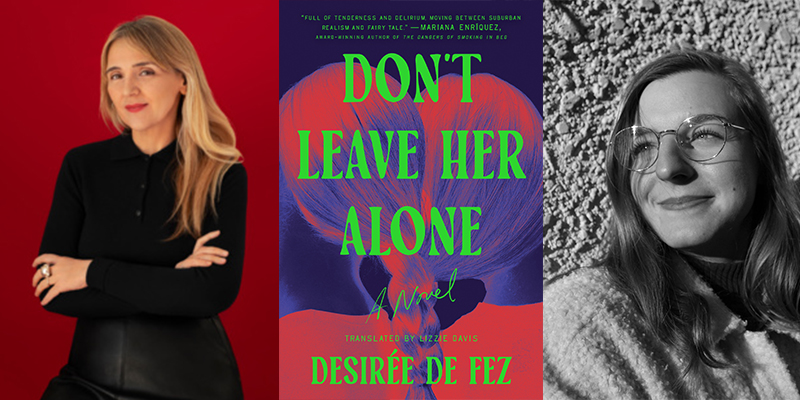
The Writer and her Translator: A Conversation Between Desirée de Fez & Lizzie Davis
"You could say that my mother and David Cronenberg are my muses"
The following is a conversation between translator Lizzie Davis and author Desirée de Fez, as the two discuss bringing de Fez’s particular brand of body horror to English-reading audiences, and appreciate the cathartic nature of grotesquerie.
Lizzie Davis: To start with, Desi, I would love to hear about what draws you to horror as a genre, and especially body horror. I wondered if you might chart your beginnings as a consumer of these kinds of films and books. What were some of your formative horror experiences?
Desirée de Fez: I’ve always been a very fearful person, and, paradoxically, from a very young age I found a refuge from those fears in horror books and films. Being able to recognize my fears on the pages of a book or on a screen, in places I could control and where I knew that, despite the fear, I was safe, helped me understand and analyze them. In a way, they also served as a form of catharsis for me.
My previous book, Reina del grito, was precisely a journey through my fears, using some of the horror films that have meant the most to me as a way of exploring and explaining them. Looking back, I think it was incredibly important for me to come across Carrie, both Stephen King’s novel and Brian De Palma’s film, as a gateway into horror literature and cinema. Both the book and the film are also enormously important to me on a personal level.
Lizzie: In a letter to readers, you described the book as—I forget the exact phrase, but I loved it!—something like if your mother had directed a David Cronenberg film? Can you talk more about that? I watched The Brood while translating and found it so compelling—there was so much in it that resonated with Don’t Leave Her Alone.
Desirée: Yes! The first time I told my publisher in Spain what I wanted the book to be like, I told him I wanted it to feel like the result of a conversation between my mother, who is a somewhat Almodóvar-esque Spanish woman, and David Cronenberg. You could say that my mother and David Cronenberg are my muses (haha). It was a way of explaining that I wanted to bring the things I love about horror—the monsters, the ghosts, the body horror—into my own reality, my own universe, my everyday life, the world I know.
I’ve always been interested in body horror, and that’s one of the reasons I adore David Cronenberg. I honestly think he’s my favorite director. The sheer amount of ideas, ingenuity, boldness, and visual power in his films blows me away. And yes, The Brood is a very clear influence on Don’t Leave Her Alone. Cronenberg is very much present throughout the book, but so are all the female directors and writers who, in recent years, have turned to body horror to explore very profound issues that, in most cases, have to do with us, with women: beauty standards, motherhood, anxiety, obstetric violence. The list is a long one: Mariana Enriquez, Elaine Vilar Madruga, Rachel Yoder, Julia Ducournau, Coralie Fargeat, Rose Glass…
For me, it has been incredibly inspiring to see how all these authors have used the body as a way of addressing all these issues with such force and impact, making sure that the message and the critique come through loud and clear. I wanted to follow that path, but bringing that body horror into the bodies, places, and situations I know.
Lizzie: Now, in your professional life as a writer and creator, what is it that continues to attract you to horror? What can it do that other genres can’t?
Desirée: I know it’s a cliché, but I think it’s a genre that allows for a degree of freedom, inventiveness, originality, risk-taking, and impact that can be incredibly enriching for stories. I genuinely believe that, from the more extreme end of genre fiction—horror, fantasy, and science fiction—you can talk about reality in a very direct and honest way. There’s also something playful, addictive, and, above all, cathartic about horror that I find very compelling and that I really enjoy.
“I genuinely believe that, from the more extreme end of genre fiction—horror, fantasy, and science fiction—you can talk about reality in a very direct and honest way.”
Lizzie: If this book were to be adapted into a film, what would your dream adaptation look like? Do you have a lead actor in mind? What about style?
Desirée: Absolutely! I also think that translation is an incredible form of adaptation! And working with you, having the good fortune that you translated No la dejes sola, has confirmed that for me more than ever. I think it’s incredibly difficult to preserve the essence of a book in translation while, at the same time, making the decisions necessary for the story to breathe and resonate in another language. I’m so grateful to you. As for a film adaptation, I’ve thought about it a lot! Especially because, since I’ve always worked in fields related to cinema (I’m a film critic and a film festival programmer), my way of thinking is very cinematic and visual.
I know I’m dreaming, but if the film were ever made, I’d love for it to be set in Barcelona and to retain its real-life locations. I’d want the first part to be a kind of slice-of-life thriller, very frenetic and anxiety-inducing, and for the more genre-driven part to be very free and spectacular (the settings, the body horror). I’d also love it to preserve the book’s sense of humor, which is essential to me. In my head, I know exactly who I’d like to direct it and who my ideal Carmen, Diana, and Alba would be. But I’d rather not say who, so I don’t jinx it! Haha.
Lizzie: Humor, yes, that’s such a crucial aspect of the tone you develop in Don’t Leave Her Alone, and I’m glad you mentioned it! There’s something very corporeal in humor as well—something that brings it into natural conversation with body horror, laughter as a kind of flip side of the coin of fear, both such primal human emotions. Can you tell me more about why it was so important to you that the book be humorous?
Desirée: For me, humor is essential, to the point that I find it difficult to connect with films and books that leave it out entirely. I don’t mean that I need all films and books to be funny, but rather that humor should be present in some way, just as it is in life, sometimes even in the hardest situations. I find it difficult to separate life from drama, but I also find it difficult to separate it from comedy. That’s precisely why, in Don’t Leave Her Alone, I tried the humor to emerge in such an organic and natural way. I liked the idea that these three women had the ability to laugh at themselves, that there was a place for humor in their conversations, and even that, at certain moments, humor and horror became impossible to separate. I love it when someone manages to achieve that in their films or books.
Lizzie: The body horror is such a striking part of the novel. What does body horror allow you to express in the novel?
Desirée: In this case, I wanted to use body horror in two different ways. In the first half of the book, which takes place in a more realistic territory, I wanted that horror to gradually creep in and manifest itself in a subtle, everyday way, as small manifestations of the stress, anxiety, and the feeling of discomfort in their own bodies experienced by the three main characters. For example, to me, it’s also body horror that one of them, Alba, develops eczema around her eyes as a result of the stress of motherhood, and that she can’t treat it precisely because she is breastfeeding her child.
In the second half of the book, I wanted all the stress and anxiety that the protagonists had been accumulating for years to explode, for the characters to experience a kind of catharsis. And they experience that explosion and catharsis through their own bodies—that’s where a more explosive form of body horror comes in.
In any case, in Don’t Leave Her Alone, body horror is an extreme expression of the characters’ psychology and distress.
Desirée: How did you Lizzie approach translating the novel’s body horror? Were there particular challenges involved in making those moments feel as visceral in English as they do in Spanish?
Lizzie: Ah, what a great question. It felt important to ensure that the more horrifying, visceral scenes in the novel read with force and immediacy—that the translation maintained the original’s strangeness and surprise without putting distance between the reader and the action. I wanted each image to be as clear as possible, and each sentence to feel honed. The impact needed to be there in English just as it was in Spanish, and I knew it would be lessened if there were superfluous language or vague images, since those things would give a reader pause.
Rhythm and pacing were also huge points of focus for me. Because of your background in film, Desi, you have an incredibly strong sense of when to linger on an image, when to cut away, when to let dread slowly build and when to shock. I wanted the English to follow those movements closely, whether that meant letting a sentence stretch on to hold the reader in its discomfort, or delivering a sudden sharp realization. So much of horror, whether in film or in writing, seems to be a matter of timing—how long we’re made to look and what we feel while we’re doing so, what we can’t see and what we suddenly do see.
Lizzie: Why do you think horror can travel so powerfully between languages and cultures?
Desirée: I’m not sure, but perhaps in the case of stories that use horror to address issues that matter to all of us—more socially engaged and political horror—it has to do with the fact that its conventions allow messages and images to be conveyed with greater power and impact than in other genres. And with more playful horror, perhaps precisely because it is playful and directly stirs the viewer’s emotions. The cathartic nature of many horror books and films could also be a reason. But I’m not sure.
Lizzie: Do you see Don’t Leave Her Alone as part of a broader conversation happening around horror in translation, especially in Spanish-language writing?
Desirée: I don’t think that’s something I can answer. But I certainly hope so! (haha).
Lizzie: I think—from the vantage point of literary publishing in the US, at least—that there’s absolutely a growing appetite for horror, and especially horror written by women, about subjects like bodily autonomy, motherhood, and the pressures of everyday life. Horror, as you say, can make literal and visceral the emotional experience of being a woman in today’s world. That’s where I see Don’t Leave Her Alone entering the conversation—the distress the women experience takes a physical form, the strictures of their relationships manifest as tentacles, one of them has a chilling and monstrous encounter with her childhood self. Psychological and emotional terrors materialize as real-world confrontations.
“Horror, as you say, can make literal and visceral the emotional experience of being a woman in today’s world.” –Lizzie Davis
Lizzie: What were your main concerns regarding the translation?
Desirée: Even though I knew the book was in the best possible hands, my main concern was whether the dialogue, which is very spare and musical, with hardly any narrative tag, would work in English in the same way. And related to that, I also wondered whether the way the three women speak to one another—with their own codes, shared expressions, and sometimes rather colloquial language—would make sense in another language. I was also worried about whether the book’s sense of humor would still be funny in English, especially because of that old saying that “humor doesn’t travel well”. ¿What have been your biggest challenges as a translator?
Lizzie: I’m so glad you bring this up! Translating the dialogue was one of the biggest challenges for me—dialogue is always difficult, I think, but in this case especially so, because of precisely the things you mention. The women do develop their own language—as in any close relationship, certain seemingly innocuous phrases can accrete much deeper meaning through repetition, and contained within every exchange is a history of previous exchanges, a lifetime of memories, narratives, dynamics. I found myself reading out loud often, performing the dialogues to ensure they retained their verve and humor, running jokes by friends. I tried to get to know the women you’d written and of course also relied on the women in my own life (my sister, my mother, my cousins and aunts) to “hear” their voices in a context that both honored Barcelona’s importance to the novel and ensured the nuances of each subtle comment were accessible to an English-language reader. Something like, “What would my own sister say, in English, if we’d been living in Barcelona for our entire lives?”
Lizzie: Why did you decide to include so many brand names and references to popular culture in the book?
Desirée: There were two reasons for this. The first is that I believe all these references form part of the characters’ aesthetic universe: they are the things that surround them, the things they live with and, in many cases, the things they like. The second is that this abundance of brand names, especially given that the story is set during the most consumerist time of the year, helped to develop one of the novel’s secondary themes: consumerism and the way we have integrated it into our lives. This is the reason why it was so important to me to retain it in the translation, except in those cases where they would genuinely make the text harder to understand, all those brand names and references to popular culture—place names, television programmes, songs…
Lizzie: Which reminds me of your determination when it came time to get permission to include the lyrics to the Camela song in the novel at all costs!
Desirée: Yes! For me, it was essential to have that song because it almost works as a thread running through the story. I automatically associate it with the characters and the story I wanted to tell. And it has a sentimental value for me because it’s the kind of song that, when I was young, I grew to dislike because my sister listened to it all the time. Years later, it came back to me in a different way, and I realised just how important it had been to my family story. Now I listen to it in a completely different way from when I was younger. But It wasn’t easy to secure the rights to Camela’s song, because we had to find out who held the rights, and it was a slow process. But we had the help of filmmaker J. A. Bayona, who had worked with the band early in his career. He directed some of their music videos. He put us directly in touch with the members of Camela.
Lizzie: I’d initially had an idea—which seems crazy to me now—to find an “equivalent” English-language song, one that came out in the same year and touched on similar themes but would be immediately audible to English-language readers. But in speaking with you about this, I realized it was not the way to go, especially given our desire to maintain Barcelona’s strong presence in the novel. Only Camela would do. My hope is that English-language readers will give it a listen!
Desirée: No! Your song suggestion was brilliant and made perfect sense. And, interestingly enough, there were certain parallels between the lyrics of the two songs. But it was more a matter of sentiment. Something told me that the story just wouldn’t work with another song. I feel very lucky to have been able to stay in touch with you, Lizzie, throughout the whole process. I had, of course, complete and absolute confidence in you. And the result is incredible. I never dreamed I would get to read my book in English, let alone translated with such dedication, wisdom and love. But I’ve really appreciated being able to read the translation as it progressed and share with you the very few doubts I had.
Lizzie: This is so moving to hear—It was an absolute honor to collaborate with you on the project: the first book I’ve translated in this genre, and certainly the most cinematic novel I’ve worked on! I loved having the chance to exercise those muscles, to think about suspense, comic timing, the physical impact of an image . . . Your trust gave me room to play, and our conversations gave me insight into what details held particular weight. It was a joy to collaborate with you to bring the book into a new language and context.
Last but not least, I wanted to ask you a slightly more personal question: How did it feel the first time you read the book in English?
Desirée: Maybe this sounds a little sentimental, but the first thing I thought when I read the translation was how amazing it was that three characters (Carmen, Alba and Diana) who, because of their fears and because life keeps dragging them along, never make time for themselves had somehow made time to learn English and travel together to other places, haha.
***
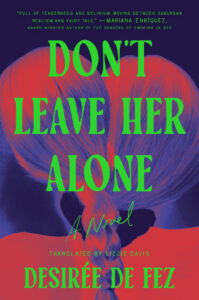
Desirée de Fez is one of Europe’s foremost experts in fantasy and horror literature and film. Over the past fifteen years, she has worked with some of the world’s most significant independent film production companies and has advised Spanish, Latin American, and American producers and directors. Desirée is also a film critic, specializing in fantasy and horror cinema, and works as a programmer for an international film festival. Don’t Leave Her Alone is her debut novel.
Lizzie Davis is a writer, an editor, and a translator from Spanish and Italian. Her recent translations include Juan Cárdenas’s The Devil of the Provinces (longlisted for the 2023 National Book Award for Translated Literature) and Ornamental (finalist for the 2021 PEN Translation Prize), as well as work by Valeria Luiselli, Daniela Tarazona, Begoña Gómez Urzaiz, and Elena Medel.