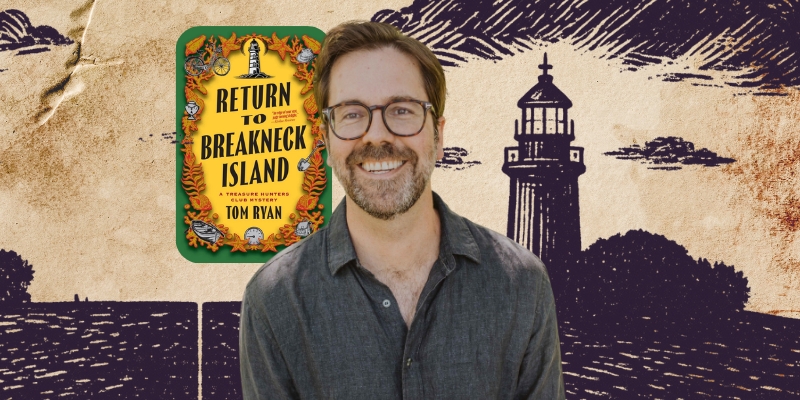
Tom Ryan on Nostalgia, Audiences, and Writing Coming-of-Age Crime Capers
John B. Valeri in conversation with the author of Return to Breakneck Island
If books have all the makings of a treasure (and of course they do!), the prospect of a new story from Tom Ryan is as good as X marks the spot….
This is an indisputable truth that readers young and old(er) know. Before making the transition to adult suspense with the USA Today bestselling The Treasure Hunters Club (2024), Ryan—also a screenwriter and producer—endeared himself to YA audiences with two queer-centric coming-of-age stories that doubled as crime capers. Keep This to Yourself won multiple accolades including the International Thriller Writers Award for Best YA Novel, the Arthur Ellis Award for Best YA Crime Book, and the Ann Connor Brimer Award while I Hope You’re Listening was the recipient of the 2021 Lambda Award for Best LGBTQ Mystery.
Having sharpened his skills by satisfying teen readers’ “finely tuned bullshit detectors,” Ryan then set his eyes on an older audience. The Treasure Hunters Club introduced a trio of protagonists—Peter Barnett, Cass Jones, and Danielle “Dandy” Feltzen—whose lives would intersect in the coastal town of Maple Bay, Nova Scotia, long rumored to be the site of buried pirate treasure.
The unsuspecting heir to a vast family fortune, Peter—whose estranged grandmother initiated their reconciliation before turning up dead at the bottom of the stairs—learned that legacy can be both life-affirming and lethal. Cass, a fledgling writer in need of a new story, discovered the makings of a bestseller. And young Dandy, heartbroken by her grandfather’s death, stepped forward in her new identity as a teen detective.
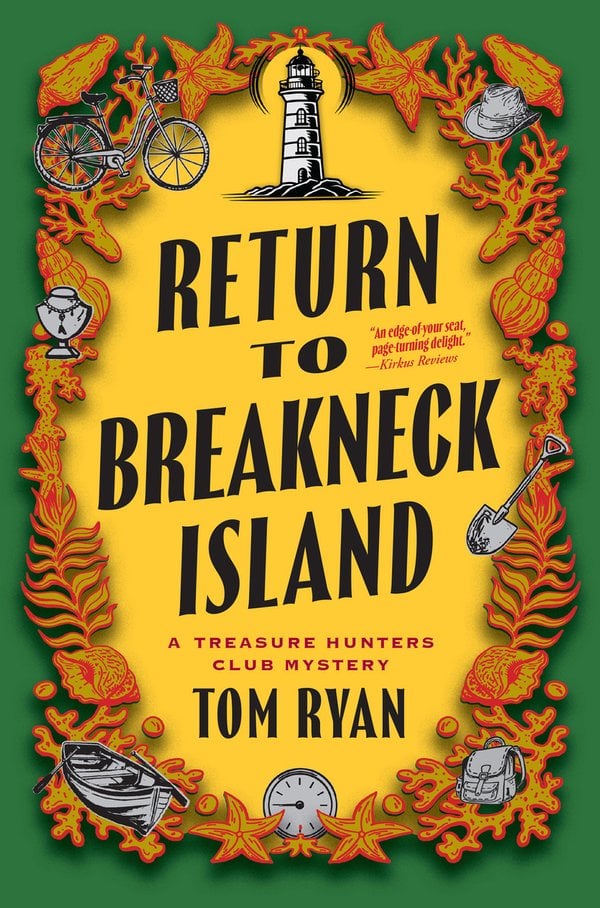
This October, following the standalone novel We Had a Hunch, Ryan revisits Maple Bay in Return to Breakneck Island (Atlantic Crime; October 6, 2026), in which Peter, Cass, and Dandy are reunited in their quest to solve another mystery. On a stormy night in 1932, the MacLeary family—longtime keepers of Breakneck Island’s lighthouse, which sits atop a dangerously rocky cliff—vanished without a trace. Nearly a century later, their disappearance remains a source of speculation, with at least one descendant suspecting foul play.
Tipped off to the story, and the possibility of another lost treasure to go along with it, Cass is once again on the case. But when bodies begin falling (literally), she, Peter, and Dandy all find themselves drawn to Breakneck Island, where their lives are once again on the line.
Now, Tom Ryan talks about digging deep to bring forth the treasures buried within his head and heart space….
*
John B. Valeri: Return to Breakneck Island is a continuation story that expands what came before it by reuniting characters with a new adventure that takes them from land to sea. How do you see this book as an expansion of the world you created in The Treasure Hunters Club? What is your approach to telling a singular story that also moves the characters’ personal story arcs forward?
Tom Ryan: The Treasure Hunters Club wasn’t originally intended to be part of a series, but a few things lined up that made continuing the story feel natural. For one, TTHC was more successful than any of my previous books, and from the day it was published I heard from readers who wanted to return to Maple Bay. More importantly, I’d fallen in love with the town and the characters myself, and I found myself wondering what would happen to them next.
In some ways, that made the second book easier. I’d already done so much of the groundwork: the world was established, the characters were well defined, and there was still plenty to explore in their personal stories. The challenge was finding a new mystery to draw them into.
Since the generational structure of the first book had worked so well—the idea of characters in the present solving a mystery from the past with consequences that still resonate—it felt natural to look backwards again. Enter: the mysterious disappearance of the MacLeary family of Breakneck Island.
JBV: Your returning cast of characters—Cass, Peter & Dandy—are all outwardly looking for treasure but have inward yearnings as well. Tell us about what each character is seeking beyond an alleged hidden bounty and how their quest to find one might ultimately enhance the other.
TR: One of the things I love about this series is the way I built the structure around three separate protagonists. Building the plot around three separate storylines is challenging, and requires a lot of fancy footwork, but it also keeps me interested and allows me a lot of freedom to jump around within the narrative. When I figure out how to pull the separate threads together in the final act, it is incredibly satisfying!
In TTHC, Cass was a real fish out of water, a failed writer who ended up in an unfamiliar town who unexpectedly stumbled into a fantastic story full of adventure and intrigue. When we meet up with her again a year later, she’s written a successful book about that experience, and she’s beginning to consider Maple Bay her new home, but her relationship with Bryson has hit a bit of a rough patch. She learns he’s been keeping a big secret, and it threatens to toss a grenade into the charmed life she’s been building.
In the meantime, Peter is trying to figure out how to manage the legacy his late grandmother left him, and he’s also trying to figure out what his next chapter of life will look like as a single, gay, middle-aged man. When a hot professor shows up in town and seems to be offering solutions to both problems, Peter wonders if maybe his future will be more fulfilling than he’d begun to expect.
Finally, everyone’s favourite character, Dandy, has grown up a lot over the past year. She’s evolved from a naïve, wide-eyed fifteen-year-old into a more confident sixteen-year-old, but when her long absent father shows up in town, she’s forced to explore that side of her family tree for the first time. Add a potential romantic interest and there’s plenty of fuel for her coming-of-age journey.
Each of these storylines plays out more or less independently for much of the book, but they come together at the end in dramatic fashion!
JBV: As mentioned, you use a dual timeline to illuminate the histories and mysteries of the past that are being unearthed in the present. What are the benefits of this structure? The challenges? Do you write (or plot) linearly, or do you find that one storyline dominates and the other comes later?
TR: I plot extensively, and in all directions, so that I can write linearly and efficiently when I begin drafting. In this case, I already knew what kinds of questions I wanted to ask about my contemporary protagonists, so a lot of the early work went into figuring out exactly what happened on Breakneck Island in 1932 and building the characters in that timeline. Once that story was established, I could turn back to my protagonists and ask, “What’s happening with them now, and how can their lives intersect with this old mystery?”
Of course, I needed a death in the present to act as a bridge to the past, and so once I landed on the fabulous Cookie Dodge (such a fun character to write!) everything came together very smoothly.
JBV: Let’s talk about the power of nostalgia. While your books are thoroughly modern, they also evoke the spirit of popular cultural touchstones – Treasure Island, The Goonies, Nancy Drew & the Hardy Boys, etc. What is the power of something new calling back to its forebears? Did you have specific influences in mind when writing these books (versus what we’ve found in them?)? Assuming so, what were they and why do you think they resonated so strongly?
TR: Nostalgia is honestly one of the most important driving forces behind everything I write. I have such vivid, fond memories of being completely consumed by books as a shy, introverted, closeted young reader, and with my own novels, I’m always trying to recreate that kind of immersive reading experience for adults.
My influences are broad and, in many ways, more gestural than specific. I want to tell unique, character-driven stories shaped by the moods and atmospheres of everything from books and films to the old legends and ghost stories that surrounded me growing up in Nova Scotia.
JBV: In the book’s acknowledgments, you talk about the fruitful relationship you have with your editors. Without moving into spoiler territory, can you give us a specific example (or examples) of how their instincts and input strengthened this story? More generally, in what ways does, or can, this collaboration improve a writer’s performance, both in terms of craft itself and mental stamina?
TR: I’m lucky in that I work with two great editors, since I have different publishers on both sides of the border (Grove Atlantic in the states and Simon & Schuster in Canada) and my editors Joe and Adrienne and I work together as a team. It’s a setup that works well for me, because I have two brilliant readers helping guide my manuscripts, which I’ve found really helps me pinpoint what’s working and what’s not working.
This is our third book together, and we’ve been on the same page at every step, which is so reassuring and really lets me know that things are moving in the right direction. I’m a confident writer, and they are great, insightful readers who aren’t afraid to tell me if something isn’t working, which is a recipe for success.
One example: in the first draft of RTBI, there was a significant subplot involving Cass’ parents, who were visiting Maple Bay from the USA. Cass’ central struggle was whether she would decide to move back to the states or stay in Canada, and Joe and Adrienne both pointed out that it was an underwhelming character arc.
I removed her folks and shifted focus to her relationship with Bryson and her attempt to find a new book to write. The result was a much stronger arc that fit beautifully into the overall narrative.
JBV: You transitioned from YA to adult mystery with The Treasure Hunters Club. What are the considerations/challenges of making such a shift? Does writing Dandy’s character allow you to keep your hand in both worlds?
TR: I wrote YA for years, and I value every bit of experience I took from that chapter of my career. Teen readers are sharp, opinionated, and equipped with very finely tuned bullshit detectors, so writing for them taught me to tell tight, focused stories populated by believable characters. All of that has served me incredibly well.
But shifting to an adult audience was absolutely the right decision for me. I felt I had done what I was capable of doing in YA, and I’m enormously proud of those books and everything they taught me, but I was starting to get restless. More importantly, I realized that I needed to start writing books for which I was the primary audience. That meant making the leap to adult mysteries and thrillers, because those are the books I most love to read.
That said, moving on from writing teen fiction didn’t mean I had to stop writing teenagers. I’ve always loved the teen detective trope—check out my last novel, We Had a Hunch, for a deep dive into that world—so including a young sleuth in this series was a no-brainer. One of the pleasures of writing an adult series is that I can actually let Dandy grow up from book to book. She’s sixteen now, but if I’m lucky enough to write several more Treasure Hunters Club mysteries, she may very well be an adult by the time I finish!
JBV: You are a strong advocate for the LGBTQ+ community. How have your own experiences colored the essence of truth that informs your characters’ coming of age/development stories? What do you hope that readers, regardless of age or sexual identity, may glean from the diversity of representation in your books?
TR: When I was writing YA, I made a point of centering queer teen protagonists. There were no gay teenagers in the books I read when I was in high school, so when I had the opportunity to write those characters myself, I took that responsibility seriously. Now that I’m writing for adult audiences, with bigger and more expansive casts, it’s just as important to me that queer characters have meaningful roles to play.
In The Treasure Hunters Club series, Peter is a gay, middle-aged man trying to figure out where he fits in his life and his community, while also getting swept up in some wild and adventurous mysteries. And really, it’s as straightforward as this: I like writing characters who feel real and psychologically authentic, then dropping them into situations that are fun, dangerous, and exciting. A bit of hot gay romance doesn’t hurt, either!
JBV: Leave us with a teaser (and by us, I really mean me—because I can’t wait): What comes next?
TR: Breakneck will be my third October release in as many years, and originally, my next book was scheduled for next October as well. I’ve been working on it for the better part of a year and having an absolute blast, but it’s built around a premise that makes it especially challenging to write. A few months ago, I realized the story really needed more time, and thankfully, my editors were happy to give it to me.
I don’t want to jinx anything by giving away too much just yet, but I can say that it’s a brand-new mystery, set in a new town, with another big, fun cast of characters. I’m having such a good time writing it, and I can’t wait to start sharing more. It’s now planned for spring 2028, and I have a feeling it’s going to be a hell of a lot of fun to promote.
Once that one is off my desk, I’ll be more than ready to dive back into Maple Bay. I already have an idea I’m really excited about, so fingers crossed readers enjoy RTBI and there’s an appetite for more Treasure Hunters Club mysteries!
***

John B. Valeri
John B. Valeri is a book reviewer, author, and host of the web series “Central Booking.” He has contributed to The Big Thrill, CrimeReads, Crimespree Magazine, Criminal Element, Mystery Scene Magazine, The New York Journal of Books, The Strand Magazine, and Suspense Magazine. Visit him online and watch past episodes of “Central Booking” at JohnBValeri.com.