

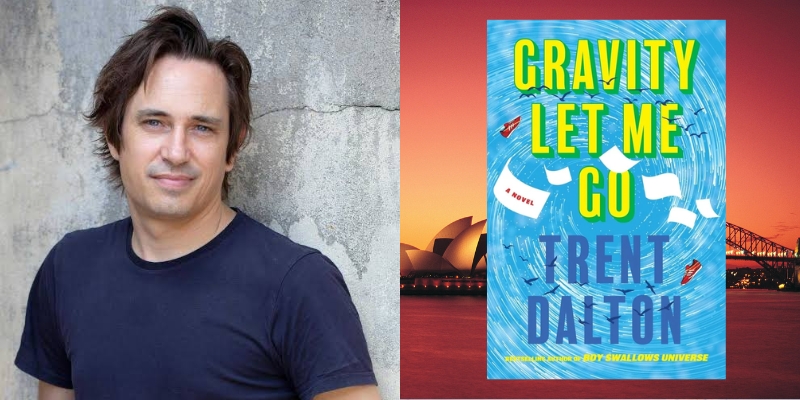
Trent Dalton on Australian Noir, Journalism, and Writing Against a Country's Stereotypes
Alex Dueben speaks with the author of Gravity Let Me Go
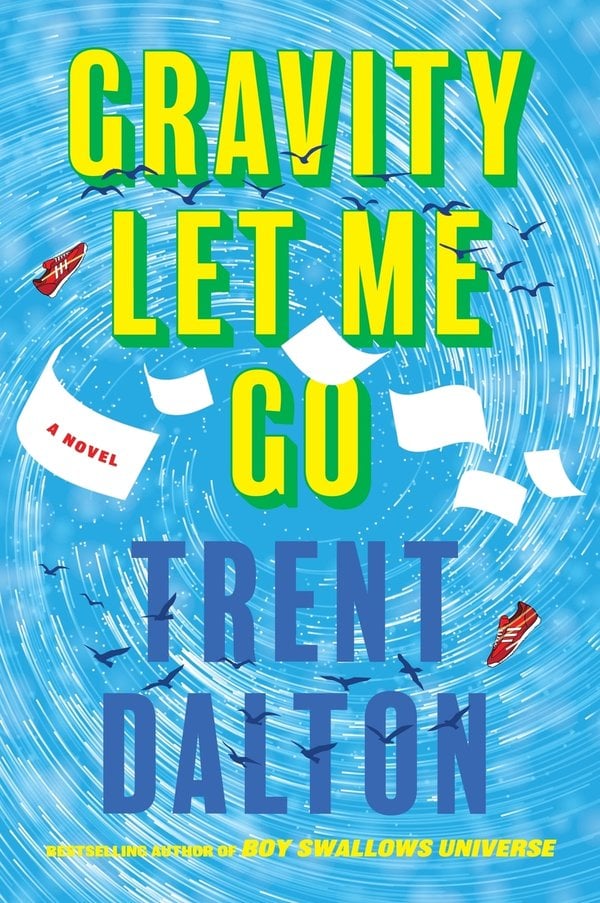
Trent Dalton is one of the biggest contemporary writers in Australia, best known for his debut novel Boy Swallows Universe, a semi-autobiographical coming of age story which was made into an award-winning 2024 Netflix miniseries. His new book Gravity Let Me Go is his fourth novel in less than a decade and opens with true crime writer Noah Cork releasing his first book about a grisly unsolved murder, and though over the course of the novel Cork uncovers the truth behind that murder and others, it’s not really about that.
Or at least not just about crime, just as Boy Swallows Universe was part coming-of-age story, part crime story, and part suburban drama. It’s a book about the guilt we carry with us, and the implications of journalism and crime writing. It’s a book about ambition and a midlife crisis, but at its heart, the book is a love story. One that Dalton admits echoes his own life, and his relationship with his wife Fiona and their two daughters.
Dalton admitted to having a sentimental streak. “That all comes from dark places. All my light comes from bloody dark places,” he said. That interplay between brutality and sentimentality, beauty and violence, is in all his work. We spoke recently late one night (for me) and early one morning (for him) about how when we were kids, video calling the other side of the planet was science fiction, the autobiographical nature of his novels, and interrogating the idea of Australia sold to America.
*
Alex Dueben: We’re both in our forties, so I can say this without being pejorative, Gravity Let Me Go is a novel about midlife.
Trent Dalton: Oh, it sure is. [laughs] It’s a borderline midlife crisis novel. I never really had a crisis as such, but I’m forty-seven and when I was forty-five I started asking some deeper questions. I hope I don’t sound like what we call in Australia, a wanker. [laughs] I climbed this mountain writing my first book, Boy Swallows Universe. It just went way bigger than I ever dreamed of. I climbed a couple of other little smaller mountains. Then I looked back and I was like, you’re missing all the good things going on in the hut at the bottom of the mountain. I was in danger of getting lost up my own backside for a bit there, to be honest. So I’m really touched that you say that it’s a midlife book.
It’s about a journo. I was a journo for twenty years. I was a crime journalist. It was my job to write in-depth 4,000 word articles on horrible crimes that happened in the suburbs of my city, Brisbane, Queensland, Australia. I would get obsessed with these stories and I would always be wanting to write a big book.
Gravity Let Me Go is a story of a true crime journalist who gets so obsessed with the true crime scoop of his lifetime that he’s in danger of missing an even bigger scoop. That’s the scoop related to his wife and kids. It’s literally unfolding inside his own house and he’s in danger of missing it and totally bypassing the most important thing in his life. That’s what I’m talking about the hut at the bottom of the mountain. So it’s sort of all related to my real life.
This journo Noah Cork is having a genuine midlife crisis. I’ve never gotten quite as far as Noah Cork does, but it was definitely inspired by similar questions that I was asking myself about the value of storytelling and the value of ambition and where we go as storytellers if we go a little bit too far. How far should we go in the name of truth, and personal truth as well. I’m so glad you touched on that word midlife.
AD: The book gets into some of these questions that people have started asking more the past few years about true crime and some of the problems with it, but it’s really more about being a writer more generally, and just about ambition.
TD: I did want to touch on that. That’s from real life again. I’d try and justify my actions as a true crime journalist. I would present these big lengthy magazine pieces for The Weekend Australian Magazine. I’d wake up on that Saturday and I would hope and I would pray that the family that I was covering—some family involved on the periphery, or right at the heart of this true crime story—wouldn’t call me and say, thanks for nothing. You’ve made our lives worse.
Because that did happen. I was terrified of those phone calls. No matter how much you tried to justify that you were doing it in the name of journalism and truth, and for whatever reason. You can tell yourself that, but there’s a part of you that knows that people are lapping up the true crime nature of it. All of those things never, ever left my mind when I was doing that. I don’t do that job as much now because I write books, but I lost sleep about that. I lost sleep.
In Gravity, Noah Cork’s written this really grisly story. Essentially the murderer has left a trail of breadcrumbs. This guy finds the body, writes the big book about it. But the victim’s family calls him out. They go, you’re a monster, mate. Don’t try and think you’re doing some noble thing.
This was years ago now, but I remember going too far in my thirties when I was really trying to make a name for myself as a journalist. I remember knocking on the door of a family whose son had just died in a horrific act of violence. Ringing the doorbell of this mum. She was lovely. I was lovely to her. I’m always respectful. But the fact that I was even at her door was possibly questionable.
I remember trying to justify my actions through the intercom saying, I just want to do a story. Maybe if we could do this story, we could stop this happening again. She was really sweet and she said, no, thanks. I went, I’m so sorry to bother you, and left. That afternoon I got a phone call from that woman’s husband. He said, it’s really important to me that you know, what my wife was doing on the other side of that intercom. My wife had just received our son’s ashes in an urn. I just want you to know that she was holding my son’s ashes.
It was just such a powerful thing for a family member to say to me. I think it changed me as a writer, to be honest. All of that’s in Gravity Let Me Go. Sorry to go off on a massive tangent, but it’s on the periphery of the story, this idea of true crime and, and how we as the audience member and as the reader, we’re sometimes part of the problem that makes life so hard for victims when these things happen.
AD: Every journalist knows that famous Janet Malcolm quote, that journalists know what they’re doing is morally indefensible.
TD: We all know that, mate, and that quote will come to you at 2 am. And if Janet Malcolm is talking to you at 2am, you’re not getting back to sleep as a journalist. [laughs]
AD: Journalists, and cops and paramedics and everyone who has to confront trauma, has ways to cope, but they can be destructive and self-destructive.
TD: I’m sorry to keep bringing up Boy Swallows Universe, but I had this crime story up my sleeve. Essentially I was raised by a really dangerously successful heroin dealer. I had these people in my life that were criminals. They were really interesting people, but they had done crimes and they’d done questionable things.
I had this dilemma. I needed to write that story and get it out of my system, but the biggest thing that I’ve been asking myself this past decade is, was I right to do that? Even though I needed to do it. I still had so many questions. There were things that I was angry about, or things that I’d felt that had sort of defined the lives of my three elder brothers and I. I wanted to learn about why all the people I loved had done bad things. I was really interested in that, but should I have done it?
That gets back to Gravity in the sense of what’s at the heart of that story is the guy looking at himself in a moment from his past where he thought he was doing the right thing with storytelling, I won’t say what it was, but he did a thing that tore his family apart. That’s me wrestling with the ongoing question of, I did have this incredible story but what damage does it do to the ones you love?
In my case, all of my family have loved that book, Boy Swallows Universe, and it’s been incredibly healing and beautiful. But my biological dad, Noel Dalton, died before that book came out. I just have to talk to his ghost to try and get some answers. The ghost just keeps not turning up to tell me how he feels. [laughs] It’s these ongoing questions of storytelling that I’m really interested in.
AD: It’s interesting to hear you say that because I think of Boy Swallows Universe as the work of an adult who’s gotten some distance and is very generous in looking back on his childhood. The kind of perspective that comes from getting older and having a certain grace towards your parents, towards the people who raised you, and their circumstances.
TD: Thank you, Alex. I think that’s so true. I wrote a version of that book when I was twenty. I thought I was Jack Kerouac and I wrote this book called Armor. All of the streets in this government housing area that I grew up in Brisbane, they were just the crummiest houses, but they wonderfully had this romantic system where the streets were named after the Knights of the Round Table. So there was Gawain Road and Arthur Street and Lancelot Street. It was just the most romantic place in my head. My brothers and I loved King Arthur. But it was such a dodgy neighborhood.
I called this thing Armor and it was really angry. It was just nothing but angst. It was nothing but anger at the people I just was telling you about who I love dearly. I’m so glad that I waited another eighteen years to actually address it properly with a bit of, you said it, grace. I think grace is such a powerful word. That’s the flip side. I have to bring some grace to my own self. Some very graceful people in my life remind me of that.
My mum was saying the other day, would you stop being so hard on yourself? But it’s something about me, constantly trying to acknowledge that to maintain the grace in my own self and not get too lost in whatever success has come. Always remembering that there are people who are part of that journey, who haven’t felt that same sense of success. I think that’s what I’m also trying to acknowledge as well, when I’m doing all that self-appraisal that Noah Cork does in Gravity.
AD: I think every reader’s opinion of Noah in Gravity changes over the course of the book. Ultimately, you hopefully feel some grace towards him, but he ends up a much darker character than he initially seems at the beginning.
TD: It’s funny, people love or hate the book, and they love or hate Noah. I had this one reader describe him at the start as a lovable idiot, and then he kind of loses his lovability, because you see how deep he goes. You’re exactly right, it does get dark.
To be honest, it’s me exploring a version of myself that I am actually reminding myself to never become. I think it’s me going, don’t you dare ever go that far. Even though at the same time, I wrote this deeply personal thing where my wife read the manuscript and her notes are, you went way too far here, stop it, what is going on in your head. Like, she was worried about me. That’s me constantly wanting to give the reader everything. That big question, what do you hold back.
I made this weird pact when I was writing Boy Swallows Universe, because as a journalist, I did get so many secrets from people, and I did get so many deep stories from people. These sacred, real-life stories that all these wonderful people gave me. I always promised myself, if it ever comes time for me to talk about me, they get everything. That’s my honoring of all the countless people that I got those stories from. I’m going to honor every one of them by being just as open as they were.
But sometimes people aren’t asking for that. Sometimes people just want to hear a yarn. Sometimes people don’t know that Boy Swallows Universe is based in truth. They don’t care. They just love the little thrilling yarn about crime and kids coming of age.
AD: One of the ways that Gravity is a midlife book is that it’s about Noah at what seems like the peak of his career, but it’s also him realizing that he needs to change fundamentally to continue.
TD: Absolutely. I never got to have the deep chat with my dad. He died two years before Boy Swallows Universe came out, and he’s such a character in that book. He was this avid reader and he would have been so proud of this. He died of emphysema. Too many cigarettes. All he did was read books and smoke cigarettes. I never got to have that deep chat.
Noah Cork has a father who’s dying of emphysema. There’s a scene in Gravity, where Noah has word for word, a kind of discussion that I would love to have with my dead dad. It’s from then that he realizes, you are actually in a bad way, mate. You’ve got some stuff to unpack.
To move on, you need to remind yourself of the way your daughter Clem is approaching this craft that you so admire. Journalism and storytelling. You need to remind yourself that it does actually have an incredible function in terms of us learning about ourselves as human beings. Passing on knowledge via storytelling is just one of the most sacred and beautiful acts of sharing that we can possibly have as humans. I fundamentally believe in journalism in that aspect. This is how we get to know about ourselves, and done right, it can be the most powerful thing in the world.
Even in dark times, it can help victims and families heal, because they actually have realized something via you, as a vessel, as a journalist. They’ve realized something about the love they had for the person they’ve lost. That’s just a really beautiful thing, and I hope Noah gets to that place towards the end, where he’s starting to realize some of those important other aspects of writing.
AD: I think I used the word expansive earlier to describe your books and they are these emotional journeys. You think you’re reading one kind of book and it turns out tone something else. Light things are rendered darkly and you have a light touch with dark things.
TD: That is the story of my life. When I’m twelve, and there’s been a drunken fight in our house, and not to paint too dark a picture, but I’m just telling it like it was, there’d be a hole in the wall, and blood around the hole, and over to my left is my brother, staring out the window, looking at a golden orb-weaver spider. Or it’s my brother Jesse singing Kate Bush.
How can all these things be in the same house? That’s exactly what it was like. That is the story of a lot of Australian kids. You might think it’s a domestic family story, you might think it’s a suburban crime noir story. For me, it’s the suburbs of Australia. I talked about it in this thing I wrote. This idea we sold America about Australia in the 1980s, Paul Hogan, put another shrimp on the barbie, mate.
We have the most beautiful landscapes. We have the most beautiful population of open-hearted, warm, loving people who want to have a barbecue with anyone from the States. But we never tell you about what happens at that barbecue at midnight when someone could possibly die from one punch from a drunken father. We don’t say those stories sometimes.
That’s Australia to me. You can walk down a suburban street and see comedy, you can see dark crime, you can see wonder. All of those elements find their way into my books.
AD: One of the things that Gravity Let Me Go definitely is is a love story, though it takes Noah a little while to realize that.
TD: [laughs] Yes! He thought he thought he was in a crime novel.
AD: There’s that great scene with him and his daughter Clem where he has this almost two page monologue of little details about who his wife is and how she does things and what she’s like. It’s such a beautiful, deeply felt scene.
TD: You’re going to get so bored of me linking back to the real world, but I am a father of two teenage daughters, just like Noah Cork is. It’s not like I’m jealous, to be honest. I’m in awe of the relationship my wife has with our two daughters. I think it’s this kind of wonderfully feminine, instinctive thing that they’ve all tapped into as three women in my own house that I see on a daily basis.
I get amazed with how how brilliantly knowledgeable my daughters are of my wife, Fi and how they can just school me on her so brilliantly. Sometimes they’ll go, Dad, she’s not thinking that, she’s thinking this. If you had any bloody insight, if you actually stopped thinking with your head and started thinking with your heart, like you possibly used to when you were twenty, when you first met Fi, then maybe you would have noticed that.
That whole couple of pages is me reflecting that I do often say to the girls, hey, settle down. I know my wife pretty darn well. I know things about her that you would never know. I’m really interested in that too. As a guy who’s in one of those houses now where romance isn’t as big as it once was, because we’re just all trying to just get by as a family. We’re trying to get two kids through high school. Deep love of your wife sort of falls by the wayside sometimes.
It’s something that I always remember, and is something that Noah will remember throughout the course of Gravity. You idiot, you’re in a love story. That’s something I always need to remember. You thought you were in a story where some kid from the wrong side of the tracks gets to live his dream and be a book writer? Even though that story is really compelling, you’re actually in this really beautiful love story.
I’m talking me in real life. My actual story is this beautiful love story where I got to be that woman’s husband, and I got to be the father to those two girls. That’s actually the story I’m in. That’s a really cool realization when you make that at forty-seven.
AD: I loved Clem and Erin, and the book has this very lived in quality. How the family functions, how the household works, and the way that you can see over the course of the book it threatening to fall apart.
TD: If you read my four fiction books, essentially, Boy Swallows Universe is my life in the eighties. All Our Shimmering Skies, which is a World War II story set during the bombing of Darwin. One of the biggest bombings in Australia. To me that story is not a quite a World War II story. It’s a story about me being terrified of this horrendous man my mum married in the 1990s. That story is me processing this period.
Lola in the Mirror is me looking at all the stuff I did as a journalist in my home city about homelessness. Then Gravity Let Me Go is me now. It’s weird that you can kind of plot my work through almost every decade of my life.
I could beg my two daughters, can you read Gravity? Because I swear you will see the biggest tribute to you in it. There’s these two kids Clem and Erin that are totally you girls. They’re too busy to read their dad’s novels. But one day I think they will. For you to say it was lived in, that just means the world to me. I wanted to do a really honest look at our little microcosm of suburbia, and me as a dad trying to make my way with all of that crap I’m telling you about. How does a guy be a good dad if you’ve got all that background.
AD: I would have said that Lola and now Gravity feel like books about you trying to process being a journalist and what that has meant, but also as a way to understand and celebrate Brisbane.
TD: My older brothers read Boy Swallows Universe and went, you painted it so much rosier than it actually was. My brother Jesse went like, that’s funny how you saw it with pinks and purples. My older brother Joel, who saw the brunt of that stuff and protected me from a lot of it, would write that story like a Cormac McCarthy novel. Zero to twenty were genuinely just nerve-wracking. I just remember being just on edge. Honestly, mate, January 10, 2000, I got my first job in journalism.
That was the day I met Fiona, the woman I’m married to to this day. Journalism coincided with love. My role as a journalist was to go around and tell the stories of this city of Brisbane that I’m talking to you from now. All of those things saved my life. I’m sorry if it sounds overly dramatic, but it’s true. That’s why I constantly keep paying tribute to those things. Love, Brisbane, and journalism. All of those things brought me the happiness that I never thought I was ever going to be deserving of, or ever would have any lasting amount of time. I’ve had it genuinely for twenty-seven years now.
Gravity is about is me wrestling with that. Because when you have the Boy Swallows Universe type childhood, you always think the rug’s going to come out from under your feet, because you wouldn’t be allowed to have lasting joy. It’s not true, because I’ve seen it. To the point where I’m almost ready to stop writing about that sort of notion.
I’m excited about the next thing I want to write. I really felt Gravity was, you said it, Alex, like me just getting up to date. Going, all right, I’ve really looked at and analyzed this stuff. I can move forward.
AD: You described all your novels as being somewhat autobiographical. Do you think that being a journalist for so many years, listening to and learning from other people and telling their stories made it possible for you to write about yourself?
TD: That is so true. I remember this amazing moment. I was in this newsroom bureau. I was this feature writer magazine writer. Our chief of staff, Michael McKenna, a great Australian journalist, came bursting in. This is after me doing about eighteen years of going around Brisbane telling other people’s stories, constantly thinking that I had a lot of stuff of my own to tell one day.
There was this retrospective crime story where a notorious Queensland criminal—I won’t say his name—was friends with my stepdad back in the day. They were all criminals coming up through Queensland. This notorious, terrifying guy who shall remain nameless was up on a three person retrospective murder charge. They’d found some new evidence for a case that had happened in the seventies. Michael McKenna comes bursting in and goes, we need to get hold of all the family members of this guy.
I sank into my chair as he was screaming this guy’s name across the bureau. In my head, I was going, I used to play He-Man figures with that guy’s kids when I was a kid. I loved his kids. I remember going, I am actually a footnote in a massive Australian true crime story. It was weirdly groundbreaking to me.
In that moment I had this epiphany. I realized that I knew how I could write my story. I knew that I could be me. It doesn’t have to be a detective. The through line to all this can be me. It can be me secretly sinking into my chair as the colorful feature writer going, I know things that the crime guys don’t know about. I knew people when I was eight that were the darkest, wildest people that these guys would never believe.
That took eighteen years to realize. I had to get out and talk to person after person after person to make that realization. It was so ridiculous, Alex, but I feel like I had to talk to every one of those people that I interviewed to write this stuff. And they’re all in there. All of those people are in these books.
***

Alex Dueben
Alex Dueben has written for The Believer, Vulture, The Millions, The Los Angeles Review of Books, The Brooklyn Rail, and many other publications. He is the writer and editor of the artist monograph Hurricane Nancy, and his debut novel is forthcoming.