
The Power and Promise of Virgin Islands Noir and Mystery
From the introduction to Virgin Islands Noir by Tiphanie Yanique and Richard Georges
Invisible Islands
In the historical writings that we have, the women and men sit and wait in their canoes, showing no sign of aggression. They watch, hands at rest, as the men on the deck of the caravel—dirty from their months of sea travel—watch them back. These women and men have been sent by their people with a purpose: See what the strangers want. See if they are friendly.
Even in Christopher Columbus’s own account, he and his men attack first, offering no warnings as they surround the canoe and open fire. It was only then that the men and women in the canoe revealed themselves to be warriors. They drew bows slicked with waterproof paste, and launched poison-tipped arrows studded with barbs.
In the face of guns firing at them, they defended themselves, their people, and their land. Their boat, designed to tip over in danger, did so. The women and men continued shooting arrows while treading water, critically injuring a number of Columbus’s men—killing one. This is the first armed resistance in the Americas to European colonialism. It happened in the Virgin Islands.
Later, the Kalinago were demonized as aggressive savages who ate people and offered no equality to their women. But this first defensive encounter shows the exact opposite. It reveals a society where men and women alike were warriors—trained and dispatched to defend the tribe. Indeed, oral narratives in the Virgin Islands tell us that it was a woman in the water who actually shot the lethal arrow.
This encounter also reveals a brave people open to peace—they rowed their relatively small canoes up to the large European ships, and just waited. Indeed, it was the invaders, revealed in Columbus’s own letter to monarchs Isabella and Ferdinand, who had plans to devour these people by enslaving them, taking their mineral resources, and forcibly converting them away from the faith practices that had allowed them to live sustainably for a thousand years.
Did the Kalinago actually eat people? Maybe. But the Caribbean, and in particular the Virgin Islands, has continued to be a place and a people considered consumable by outsiders. We are a place where others came to take gold and silver to adorn their own bodies, take land for mono-cropping to feed their own bodies; and a place where enslaved people from the Americas and Africa had their bodies ravaged by forced labor. It’s now a place where the land and people are often presented as if on a platter, for the nourishment and vacationing (and sometimes gluttony) we call tourism. Eating people in all these ways seems particularly noir.
Yet the Virgin Islands, despite our delectableness, is often invisible as a place of resistance, even sometimes as a place at all. Though every enslavement-based European economy owned the Virgin Islands at some point—signaling not only the land’s fertility but also its strategic positioning—many of the people from those nations can’t find the Virgin Islands on a map. Well, making your enslaved holdings invisible might be strategic when you want to tell yourself that you are the civilized ones.
These days, however, the Virgin Islands is often invisible even within our own region—unable to participate in many regional coalitions due to our US and UK colonial status. Because of this political reality, we don’t fully control our borders and laws; this complicates travel and exchange with the rest of the Caribbean. This dynamic can call into question our Caribbeanness, making us pariahs among our own people.
With all this warrior activity, desirability, and invisibility, it’s not a coincidence then that a number of the stories in this collection center the invisible straining to become known and seen. Celeste Rita Baker’s “Pass Through the Mangrove” shows us that even the land itself has desires, which when nurtured will support us in our fights.
In this same vein, the editors have sought to use this anthology as a fighting call for VI literature. The Akashic Noir Series, with its close attention to place, gives the Virgin Islands an opportunity to present a map of itself. A literary We Are Here.
Virgin Islands Noir is almost a decade in the making. Working together, the editors hosted literary festivals, taught creative writing classes, closely mentored new writers, and cemented bonds with established authors. Here, among internationally known names, are writers for whom this will be their first publication. We make sure to give authors from the smaller islands in the archipelago center positioning.
We open the collection with a Greek mythology–influenced story from Virgin Gorda, “Eos and the Copper Coast” by Johanna Gibson, and close the book with Raven Phillips’s “Bush Cat,” a story influenced by St. John mythology. Tiphanie Yanique offers a Carnival story set on a speculative island in the middle of the waters traversed daily by Virgin Islanders.
We include essential groups within our greater community that are often little known or understood by outsiders—such as the Frenchy, Indian, and Arab communities. We consider what it means to be a place where people from all over the world and region continue to pass through—as in Traci O’Dea’s “American Bully” and Gillian Royes’s “The Last Sail,” both stories of people on the run.
The tales in Virgin Islands Noir also engage with the touristic reality of the Virgin Islands. Sometimes it is a Virgin Islander returning from abroad, as with the sister in Rea Vanterpool’s “A Guide to Grape Music,” or the adopted son in Vince Omni’s “Mine Own.” Other times the Virgin Islanders are grappling within the tourism economy, working in shops, hotels, and restaurants, as in Nisha Khiani Savara’s “Jellyfish.”
We see the military as a salient kind of cannibalistic tourism in Sophia Aubin’s “Romancing the Fish Trap.” The lasting legacy of the first visitors, the colonialists, is highlighted in Eugenia O’Neal’s classically noir “An Untimely Death.” Which is to say that even when considering tourism, these stories do so from the perspective of the Virgin Islanders themselves.
Columbus kidnapped his early Caribbean guides, sometimes killing their family members right in front of them. When he first saw the Virgin Islands from his ship, the native guides told him no one lived there and that it was best for him to sail on by. We know, from Columbus’s later logs, that these islands were indeed inhabited. We can only assume that the guides were protecting the people they knew were there—an early use of invisibility as defense.
We thank our ancestors for this protection. And we see how not heeding our ancestors can sometimes lead to great dangers, as in Cadwell Turnbull’s “The Vanishing at Neltjeberg.” We do need defending, but times do arrive when we also need to know we truly exist, if even just for ourselves. Ultimately, the stories here all seek to show that the Virgin Islands is filled with humans living full, complex lives on these islands. This is highlighted in the hurricane story “What Dread Hand” by Richard Georges, and in “Interment” by Hadiya Sewer.
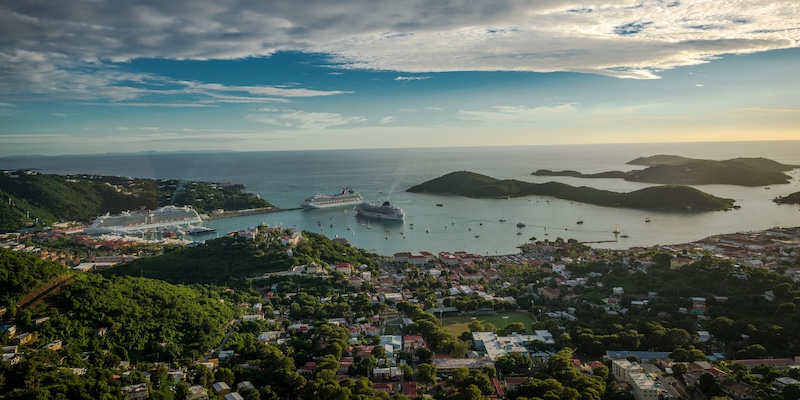
The writers here represent the greater Virgin Islands, made up of the territories separated, by colonialism, into the British Virgin Islands and the United States Virgin Islands. In sidestepping this political distinction, we honor both the everyday experiences of Virgin Islanders as well as the creative possibilities of fiction.
Most Virgin Islanders who are native (in the U.S. parlance) or belongers (in the British parlance) have family ties across these national borders anyway. Many Virgin Islanders are both natives and belongers. Some work in one territory and reside in another. Then there are those who live and work on the water that connects all the islands, as represented in Tobias S. Buckell’s story, “Off the Rock.”
The VI is made up of about a hundred islands, so we have always been home to both journeyers and newcomers. It’s no mistake that many of the writers here now live outside the Virgin Islands (“VI North,” these locales are often called) or are native to other lands.
It’s true, though, that Virgin Islanders are a suspicious tribe. How could you blame us? The oral tradition, kept alive by storytellers like Gilbert Sprauve, Elmore Stoutt, and Glen Kwabena Davis, has been a safe way to keep our stories from being disappeared, but also from being co-opted and appropriated by nefarious outsiders and newcomers. These culture protectors continue to be necessary.
But the Virgin Islands is also at a groundswell moment in its artistic understanding of itself. In his 2022 Laureate Lecture entitled “Stone by Bloody Stone,” the poet laureate of the Virgin Islands, Richard Georges, argued that if we are going to define ourselves politically and understand ourselves culturally, we need to develop a written national Virgin Islands literature. As Tiphanie Yanique wrote in a 2015 essay, “The Story of My Life (and Yours),” one of the things that literature tells us is who we are—indeed, that we are.
If we have a literature, then we are being read, heard, received, found, and also seen. There are risks here, to be sure—being visible also means being vulnerable. And certainly, some of the established authors featured here have experienced the pain that comes from this vulnerability.
Virgin Islanders keep our secrets close—especially the darker ones. We want to ensure we make a good impression—especially if our livelihoods depend on it, which they often do. For us, Virgin Islands Noir is a major anthology—one of the first to likely reach beyond the islands themselves.
But the Virgin Islands is a place literally named for an innocence fearful of exploitation, so it was initially discomforting to many of the writers here that this vision of us would be in noir—a literary genre that highlights crime and disturbia. Over a number of years, the editors charged the storytellers here to write real.
It’s true that sometimes we are the innocent virgins of St. Ursula’s pilgrimage, as Columbus named us. But one way to claim you exist as a fully complex humanity is to admit that you also have your dangerous sides. Sometimes, maybe, we will be the ones to devour you.
***
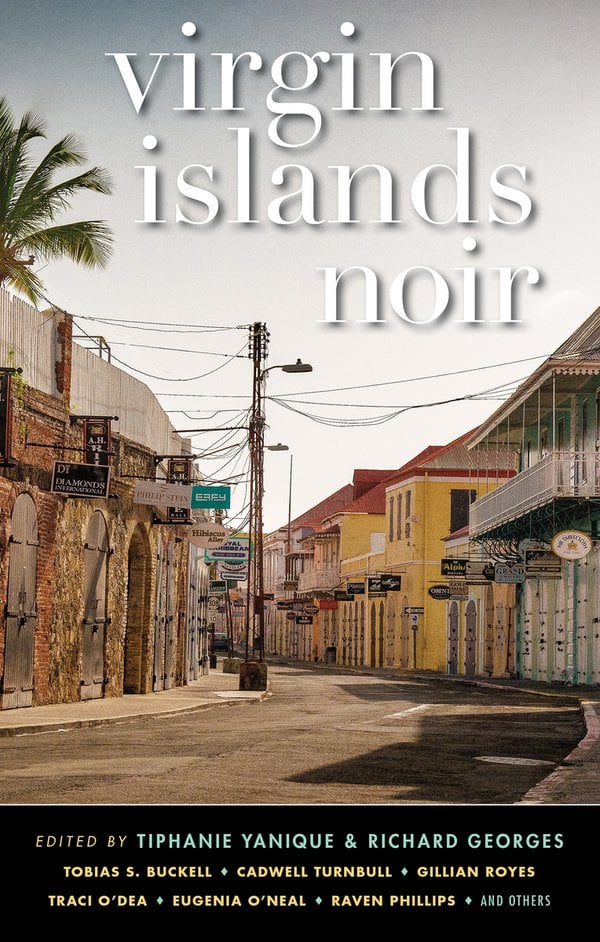

Tiphanie Yanique and Richard Georges
Tiphanie Yanique is a creative writer and educator. Her books include Land of Love and Drowning, which won the Flaherty-Dunnan First Novel Prize, the Phillis Wheatley Book Award, and an award from the American Academy of Arts and Letters. Her writing has also won a Felix Dennis Prize, a Pushcart Prize, and a Boston Review Prize. Yanique was born and raised in the Virgin Islands and is a professor at Emory University. Richard Georges is the first Virgin Islands poet laureate and the author of three previous poetry collections: Make Us All Islands, Giant, and Epiphaneia, winner of the 2020 OCM Bocas Prize for Caribbean Literature. His poetry and fiction have appeared in Wasafiri, Small Axe, the White Review, Pree, Prelude, and Wildness, among others. A fellow of the Stellenbosch Institute of Advanced Study and a Pushcart Prize nominee, Georges is a founding editor of Moko. He lives in Tortola, British Virgin Islands.