What Crime Novels Would the Greatest Women Pilots of All Time Enjoy Reading?
Mary Wine and Cindy Dees answer an absurd question with some very serious recommendations
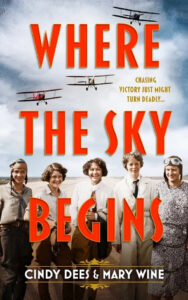
Between the two of us, (Mary Wine and Cindy Dees) we’ve published over 200 novels in the historical, romantic, suspense, and thriller genres. So when we sat down to write Where the Skies Begin, we knew exactly what we had: a true story almost too good to be fiction. In 1929, twenty women climbed into primitive, fragile aircraft and raced 2,800 miles across America in the first-ever National Women’s Air Race. Before it was over, there were mysterious deaths, sabotage, emergency landings in the desert, and a conspiracy to stop the race before they ever reached the finish line.
These women weren’t just daredevils chasing glory. They were pioneers fighting for their lives and their right to be taken seriously — and the danger that stalked them across the continent was very, very real. Researching their stories sent us deep into the history of women who broke every rule society had, which got us thinking: if these women were reading crime fiction, what stories would these mavericks of aviation choose? Our answer is below, and we’d bet every one of them would finish the book in a single sitting.
Amelia Earhart (1897–1937):
And Then There Were None by Agatha Christie
Earhart vanished over the Pacific in 1937 — the greatest unsolved mystery in aviation history. Christie published And Then There Were None two years later, and it is, at its heart, the story of people plucked from the world and never fully explained. Ten strangers. An island with no way off. A killer no one can identify, even after the body count makes it impossible that the culprit is still alive. Earhart knew better than anyone what it felt like to simply disappear into an enormous and indifferent sky — and we think she would have loved how Christie’s masterpiece captures the terror of knowing some mysteries refuse to be solved.
Bessie Coleman (1892–1926):
Devil in a Blue Dress by Walter Mosley
Bessie Coleman was turned away from every flight school in America. So she taught herself French and sailed to France to earn her pilot’s license, becoming the first African American and first Native American woman ever to fly. When she came home a celebrated aviator, she still couldn’t enter through the front door of most venues where she performed. Walter Mosley’s detective, Easy Rawlins, navigates a 1940s Los Angeles stacked just as deliberately against him, solving crimes in a city that will never fully let him belong. The moral intelligence Mosley brings to Easy, the calm, furious competence of someone who knows the system and beats it anyway, would have felt immediately, deeply familiar to Bessie Coleman.
Harriet Quimby (1875–1912):
The Alienist by Caleb Carr
Before Quimby was a pilot, she was a journalist and screenwriter — sharp, observant, and savvy about the power of a good story. She earned her license in 1911 and crossed the English Channel solo in 1912, timing the flight for maximum publicity. Caleb Carr’s The Alienist is set in 1890s New York, where a journalist and a criminal psychologist team up to hunt a serial killer through gaslit streets that look exactly like the world Quimby grew up in. The book has the same quality Quimby herself possessed: it understands that in a world dominated by men, the sharpest pencil in the room usually belongs to the person they’re not watching.
Amy Johnson (1903–1941):
Code Name Verity by Elizabeth Wein
Amy Johnson flew solo from England to Australia in 1930. A decade later, she was ferrying aircraft for the Air Transport Auxiliary during World War II when she disappeared over the Thames Estuary in 1941 — her death as mysterious as her flying was spectacular. Elizabeth Wein’s Code Name Verity is about a female WWII pilot and spy captured by the Nazis, told in two voices across two timelines, both of them built around the question of what women will sacrifice for each other and for something larger than themselves. It is one of the most devastating novels ever written about women in wartime aviation. Amy Johnson would have read it in one sitting and been wrecked by the ending.
Sabiha Gökçen (1913–2001):
The Janissary Tree by Jason Goodwin
Gökçen was the adopted daughter of Mustafa Kemal Atatürk and the world’s first female combat pilot, flying bombing missions in the 1930s before most Western women had even seen a cockpit. Jason Goodwin’s The Janissary Tree unfolds in the Ottoman world her grandfather’s generation knew — all palace intrigue, military conspiracies, and the ancient tensions between tradition and modernity — solved by Yashim, an Ottoman detective who, like Gökçen herself, operates in spaces where people assume he doesn’t belong. The Istanbul Goodwin conjures would feel like home to Sabiha Gökçen.
Jacqueline Cochran (1906–1980):
The Day of the Jackal by Frederick Forsyth
Cochran held more speed, altitude, and distance records than any pilot alive, male or female, was the first woman to break the sound barrier, and ran the entire WASP program during World War II. She did everything at maximum throttle, with absolute precision. Forsyth’s The Day of the Jackal is perhaps the most ruthlessly precise thriller ever written — a meticulous, relentless account of a professional assassin’s plan to kill Charles de Gaulle, executed with the kind of technical exactitude that would make an engineer weep with pleasure. A woman who spent her career mastering things nobody thought she could do would have enormous respect for a novel that’s a masterclass in executing a plan with no margin for error.
Jerrie Mock (1925–2014):
Big Little Lies by Liane Moriarty
Mock was an Ohio housewife — the papers were very keen to mention that — when she climbed into a single-engine Cessna in 1964 and became the first woman to fly solo around the world, completing 23,000 miles in 29 days. The “housewife” framing was meant to diminish her. It did not. Moriarty’s Big Little Lies is built entirely around that same gap between how the world sees suburban women and what those women are actually made of. It’s a book about underestimation as a superpower — and nobody understood that dynamic better than the woman who circled the entire planet while the press was busy wondering what she was making for dinner.
Valentina Tereshkova (1937–present):
Child 44 by Tom Rob Smith
In 1963, Tereshkova orbited Earth 48 times in three days, becoming the first woman in space. She did this inside the Soviet system — a system that simultaneously celebrated and controlled her, that made her a hero and a propaganda instrument, that gave her everything and asked everything in return. Tom Rob Smith’s Child 44 is set in Stalinist Soviet Russia, where an MGB officer investigates a series of child murders in a country that has officially declared crime doesn’t exist. The suffocating bureaucratic logic, the constant negotiation between loyalty and conscience, the sense that survival requires flawless navigation of an unforgiving system — Tereshkova would recognize all of it.
Wally Funk (1939–present):
The Thursday Murder Club by Richard Osman
Wally Funk passed every astronaut test NASA gave her in the early 1960s. She was faster, sharper, and more capable than most of the men who got to go. She was told to go home anyway. She waited sixty years, kept flying, kept teaching thousands of students, and in 2021 flew to space on Blue Origin at age 82 — making her the oldest person ever to do so. Richard Osman’s The Thursday Murder Club is about four retirees in a quiet English village who the world has largely stopped taking seriously. They solve murders the police cannot and are absolutely formidable. Wally Funk would read this book and feel profoundly seen.
Eileen Collins (1956–present):
The Hunt for Red October by Tom Clancy
Collins was a U.S. Air Force test pilot who became the first woman to pilot a Space Shuttle in 1995 and the first woman to command one in 1999. She logged 6,700 flight hours in more than 30 aircraft types. She is, in every meaningful sense, a commander. Clancy’s The Hunt for Red October is a novel about a submarine captain making impossible decisions under crushing pressure, with every life aboard his vessel depending on his technical mastery and his ability to read human nature under fire. A woman who commanded the Space Shuttle would find this deeply satisfying, and she’d also be quietly annoyed that it took Clancy 400 pages to figure out what she’d have known by page 50.
Notable Mentions — Because I Can’t In Good Conscience Leave These Women Out:
Raymonde de Laroche — the first woman in the world to earn a pilot’s license, in 1910 — would have been enchanted by The Mystery of the Yellow Room by Gaston Leroux, the locked-room masterpiece published the same year she first flew. A woman who did the impossible by walking through a door nobody thought should open would have a weakness for mysteries built around rooms that shouldn’t be escapable.
Louise Thaden — the first woman ever to beat the men in the prestigious Bendix Trophy Race in 1936 — gets Gone Girl by Gillian Flynn, because a woman who spent her career being catastrophically underestimated, and winning anyway, would find deep and possibly unsettling satisfaction in a novel whose entire architecture is built around the most dangerous thing you can do: assume you know exactly what a woman is capable of.
Beryl Markham — the British-Kenyan aviator who became the first person to fly solo nonstop across the Atlantic east to west in 1936, and who wrote the greatest aviation memoir ever published — gets The No. 1 Ladies’ Detective Agency by Alexander McCall Smith. It’s set on the African continent she loved, it celebrates a woman who solves problems quietly and brilliantly, and it has exactly the same quality as West with the Night: the deep, earned pleasure of a life fully and fearlessly lived.
Hanna Reitsch — Germany’s most gifted test pilot, a record-setter who was also a devoted Nazi — is the most complicated figure on this list, and she gets the most complicated book: Philip Kerr’s March Violets, the first of the Bernie Gunther series. Gunther is a Berlin detective doing his job inside the Third Reich, navigating impossible moral terrain with his integrity battered but intact. It is a novel about what it costs to be skilled and complicit, and what it means to serve a system that history will not forgive.
Christa McAuliffe — the teacher and first private citizen selected for spaceflight, killed in the Challenger disaster — gets The Teacher by Freida McFadden, a psychological thriller that takes the archetype McAuliffe so purely embodied — the beloved, dedicated teacher — and detonates it. It’s dark, it’s twisty, and we think McAuliffe, who had a famously sharp sense of humor, would have been utterly delighted by it.
***

Mary Wine and Cindy Dees
Cindy Dees is a New York Times and USA Today bestselling author of more than 120 suspense and thriller novels. Mary Wine is the author of more than 80 historical and thriller fiction novels. Their new novel, Where the Skies Begin, is based on the true story of twenty women pilots who raced across America in 1929.