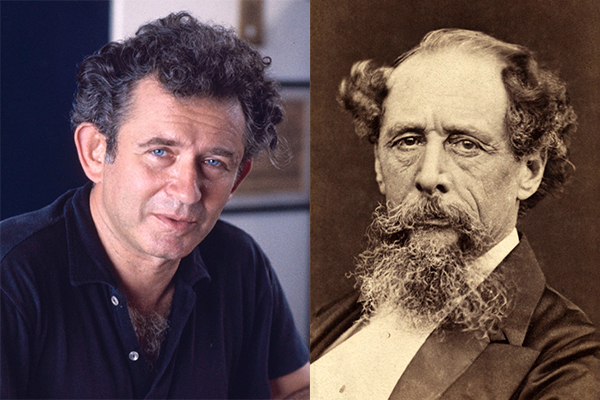
What do Norman Mailer and Charles Dickens Have in Common?
On the power of directly addressing audiences.
It might seem strange to attempt to put Norman Mailer and Charles Dickens in conversation, or even to pair them as interlocutors collaborating on much of anything, except of course that both were writers, nearly a century apart, who had an equally central role in the cultures of their different social worlds.
There are more obvious connections, like their negative histories with women, or how both had works released in both whole and serialized formats, or how their sentences could travel for miles before parking at a period… but more than this, they were both novelists with their fingers on the pulse of contemporary social questions and concerns, as well as journalists who addressed their publics directly, engaging with their audiences on as interpersonal a level as was possible by the forums in which they shared their ideas. (In case I seem biased in noticing similarities between these two men in particular, I’ll disclose my conflicting associations: I am a 19th century historian and a Dickens specialist, and I am also married to the youngest son of Norman Mailer, though I never met the man and have never had a research investment in his work. In this analysis, I’m shilling for neither. Just observing.)
Both Dickens and Mailer pivoted, eventually, from exclusively writing novels to embracing simultaneous careers as journalists, not only writing articles and criticism about contemporary issues, but also eventually creating their own publications for their respective cities: London, and New York. Dickens published Household Words 1850 to 1859. Then, due to differences with that publisher, Dickens shut down the project and started its successor, All the Year Round, which ran from 1859 to 1895. In October of 1955, Norman Mailer launched The Village Voice with his colleagues Ed Fancher and Dan Wolf. It is impossible to overstate the necessity, the centrality of these publications to their respective worlds; they were unique for adding a sense of rapport to reportage, for combining a tone of informality and “telling it straight” with in-depth inquiries. To have access to, and read, these publications meant experiencing a level of access, of “being in the know,” of being part of an intellectual current that ran vertically through the demographic world. These publications were cheap and ubiquitous and intended for everyone, anyone, to pick up.
But as their careers progressed, they also made themselves extraordinarily accessible in another way. In a sense, the last thing both Dickens and Mailer ever wanted to be was a novelist; Dickens wanted to be an actor and playwright, Mailer wanted to become an actor and filmmaker and even a politician… but more than categorize their ambitions in “career categories,” I’d like to ruminate on how men had performative personalities and limitless charisma (even despite the turbulent and problematic elements in their personal lives), and how they loved to be in the spotlight and exercise their creative impulses in means beyond the page. So, they pursued the arts in myriad ways… but they also went on stages as themselves, talked with audiences as themselves, and orchestrated elaborate events to play out their ideas.
It’s easy to refer to these men, a century apart at the height of their popularity and power, as “modern public intellectuals.” Indeed, to my estimation (as a 19th century historian): until Dickens, such an accessible, widely-known throughout all the classes arbiter of culture had not existed. Mailer is the obvious—the only—inheritor of this tradition for the 20th century, especially as technology evolved away from the theater to talk-shows.
Both Mailer and Dickens became celebrities, and had their personal lives and various scandals splashed in tabloid pages… their personal and public personas became intertwined, sometimes to uncomfortable or awkward levels. A humorous example that comes to mind is how Hans Christian Anderson invited himself to stay at Dickens’s home, and lived there, without the family’s blessing, for six weeks.
Now, it’s important to stress that Dickens and Mailer had very different approaches to these levels of approachability and engagement with social ills. Dickens did not get as down and dirty with the issues as Mailer did… Mailer, who himself ran for the Mayor of New York City in 1969, on a ticket with Jimmy Breslin for City Council President, and who debated a host of feminist scholars (Diana Trilling, Germaine Greer, Jill Johnston, Jacqueline Ceballos, Betty Friedan, Susan Sontag, and Elizabeth Hardwick) at New York City’s Town Hall in 1971. Mailer’s impulse to reform society was caught up in an unusual kind of radicalism that involved questioning and arguing with everything he deemed worthy of debate. He was part of the “New Journalism” movement, and traveled all over the country, covering various phenomena from various political rallies (like Miami and the Siege of Chicago, about the Democratic and Republican National Conventions of 1968 to the moon landing (Of a Fire on the Moon in 1969). In 1960, he wrote Superman Goes to the Supermarket, about the appearance of JFK at the 1960 DNNC… which suggested that JFK’s election over Richard Nixon would prevent America’s sway towards totalitarianism.
Dickens was greatly invested in exposing the socioeconomic and living conditions of low-class Londoners, and often made working-class characters the centers of his stories. He wrote about systemic injustice in The Pickwick Papers, child exploitation of all kinds and cruelty towards lower-class women in Oliver Twist, the abuse of children in the education system in Nicholas Nickleby, and financial hardship (to the point of beggary) in The Old Curiosity Shop, among other serious social problems. Just three years later, he would finish his novel Hard Times (1854), his novel most committed to social reform, addressing child labor and other institutionalized abuses, the oppression of the working classes, and even the growing issue of industrial pollution. Dickens himself knew about penury firsthand; when he was a child, he had to leave school to work in factories after his debtor father was sent away to Marshalsea Prison.
This didn’t necessarily make him a progressive, though. Hugh Cunningham, a professor of social history at the University of Kent, argues that while Dickens “helped create a climate of opinion,” he did not articulate a “coherent doctrine” of how society should be reformed – and that the author was at times as much in danger of being seen as a conservative as a radical. Indeed, argues Cunningham, Dickens shared the Victorian establishment’s fear of the mob, publishing Barnaby Rudge (1840), which is very much a criticism of mob mentality and action. And Dickens had basically zero sympathy for the working class Chartist labour movement. And he was decidedly not a trade unionist. And he preferred “strong prison discipline for those who broke the law.”
But he was mired in contemporary debates about societal and political good. In writing Hard Times, for example, he critiqued the contemporary theory of utilitarianism, which suggests that the best course of action is the course that creates the greatest amount of “good” for the greatest number of people, placing himself in opposition to leading socioeconomic and political philosophers like Jeremy Bentham and Thomas Malthus.
“[He was] certainly alive to the issues posed by child labour in the new work situation of the industrial revolution, but it is striking that none of his child heroes or victims was directly involved in such work,” Prof Cunningham suggests. She notes that his critiques of the terrible education system were less criticisms of the state’s allotment of resources and more about the nebulous issue of “the way in which the ethos of a school and the quality of teaching could make or mar a child.” “Although in his journalism and novels he attacked specific targets – Poor Law legislation in Oliver Twist, the brutal Yorkshire schools in Nicholas Nickleby, the law [Pickwick Papers and Bleak House], government bureaucracy, lethargy and nepotism in Little Dorrit, extremist utilitarianism in Hard Times – it’s hard to trace any direct consequences on reformist legislation in any of those areas to Dickens’s influence,” argues Prof Malcolm Andrews, editor of the Dickensian, the journal of the Dickens Fellowship. His agenda was more to appeal to the humanity of his readers than challenge governmental policies.
It is worth saying, though, that Dickens died very young, at 59, perhaps if he had lived as long as Mailer (who died at age 86), he would have had more to offer in this regard. In 1967, for example, Mailer wrote the novel Why Are We in Vietnam? which is about how, in the words of scholar Maggie McKinley (who wrote the preface to the 2017 edition of the novel), “corrupt capitalism, corporate elitism, American imperialism, and aggressive hyper-masculinity” lead to war. In October of that year, Mailer participated in the March on the Pentagon to protest the Vietnam War, and wrote an experimental nonfiction account inspired by it called Armies of the Night, which was published in 1968 and won the Pulitzer Prize for nonfiction. Mailer’s activism and his fiction were braided together.
They wrote a century apart in different continents, but Dickens and Mailer both worked to build an informed and engaged population, engaging with them directly, as their peers.

Olivia Rutigliano
Olivia Rutigliano is an Editor at Lit Hub and CrimeReads. Her other work appears in Vanity Fair, Vulture, Lapham's Quarterly, AirMail, the Los Angeles Review of Books, Public Books, The Baffler, Bright Wall/Dark Room, Politics/Letters, The Toast, Truly Adventurous, and elsewhere. She has a PhD from the departments of English/comparative literature and theatre at Columbia University, where she was the Marion E. Ponsford fellow. She hosts the podcasst "Culture Schlock" at Lit Hub Radio. She is on instagram at @oldebean, twitter at @oldrutigliano, and bluesky at @oliviarutigliano.bsky.social.