What is the extent of Sherlock Holmes's random scientific knowledge?
He doesn't know that the Earth revolves around the Sun... but he knows evolutionary biology like the back of his hand?
Holmes’s scientific knowledge is somewhat incoherent from text to text.
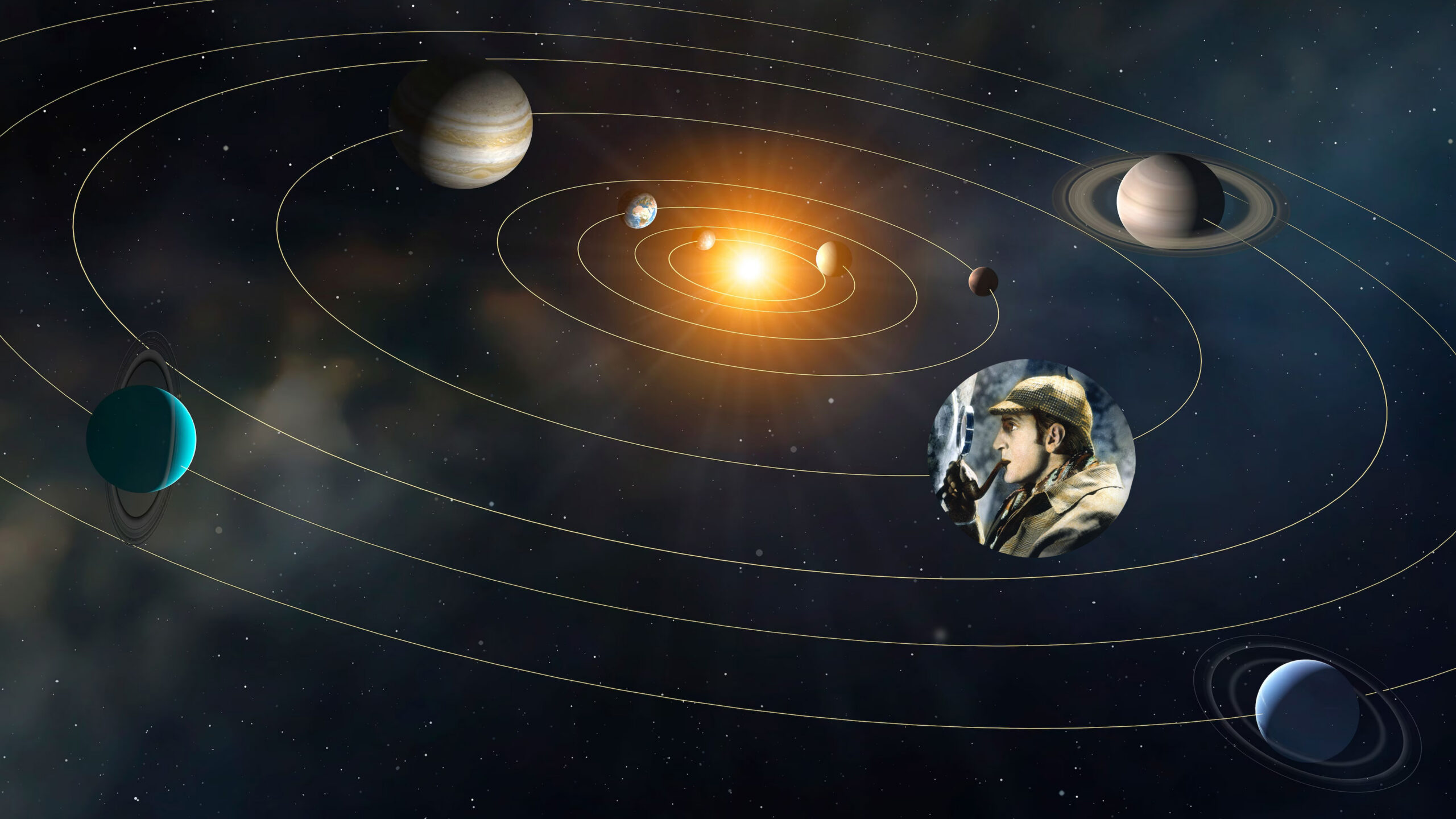
In A Study in Scarlet, Holmes shocks Watson by remarking that he does not know about the Copernican heliocentric theory of the universe or the names of the nine planets in the solar system. Why? Because it is not relevant for him in crime-solving. “You say that we go round the sun” he brays. “If we went round the moon it would not make a pennyworth of difference to me or to my work.”
But in The Sign of the Four, the following account, he is suddenly a secular scholar familiar with numerous important works of philosophy and science from the Enlightenment through the present—particularly evolutionary biology and geology (including William Winwood Reade’s secular “universal” history of the world “from Nebula to Nation:” The Martyrdom of Man, a fringe scientific text that Doyle himself esteemed). From The Sign of the Four, onward, Holmes is clearly grounded as a product of the nineteenth century intellectual milieu, shaped by the theories of Charles Darwin, the uniformitarian geologist Charles Lyell, and the French naturalist paleontologist Georges Cuvier.
Holmes’s entire scientific persona can be read as a kind of performance, especially because Holmes’s interaction with contemporary Victorian scientific thought and involves more cherry-picking than a commitment to any one field or school of thought, as the scholar Jonathan Cranfield has noted. This might be a palimpsestic feature of the stories—the result of inconsistencies caused by changes in Conan Doyle’s own attitudes and beliefs throughout the four decades he wrote the series: his increasing disinterest in the stories themselves (popular fiction that he despised and did not always pay close attention to), his own ever-conflicted relationship with questions of faith and science (starting when he was a student, informed by a foundational text he read while attending the University of Edinburgh, The Martyrdom of Man), or even his gradual loss of interest in formal science as he became increasingly invested in spiritualism and the occult.
This change in Holmes’s scientific awareness is awkwardly addressed later, in a funny bit of revisionism—in the 1893 story “The Five Orange Pips” Conan Doyle has Holmes ask Watson if he remembers this earlier exchange on their first case, in which Holmes had given Watson the impression that his grasps of “Philosophy, astronomy, and politics were marked at zero,” with “Botany variable, geology profound as regards the mud-stains from any region within fifty miles of town, chemistry eccentric, anatomy unsystematic, sensational literature and crime records unique.”
But now, Holmes addresses apparent mastery of many schools of thought, stressing that he is not opposed to learning more when the opportunity requires it. In this exchange, he proves his fluency in early nineteenth century biology, attributing his entire deductive methodology to Cuvier’s process of extrapolating a whole creature’s bone structure from a remaining fragment: “As Cuvier could correctly describe a whole animal by the contemplation of a single bone, so the observer who has thoroughly understood one link in a series of incidents should be able to accurately state all the other ones, both before and after.” Stories after A Study in Scarlet allow Holmes to cite the great thinkers who have fostered his unique and exciting brand of crime-solving, performing the incorporation of scientific research into popular entertainment.
As such, the schoalr Lawrence Frank has theorized that Holmes was a means by which Conan Doyle’s “radical theories depicting the world as godless and driven by chance were made palatable to an otherwise censorious middle-class readership.” Jonathan Cranfield disagrees, arguing that Holmes’s work surprisingly upholds mainstream bourgeois values, rather than transmits anything particularly progressive that might have challenged various norms. He notes that Holmes’s existence as “an intellectual iconoclast” and “a bohemian outsider” seems to account for his having distinct ideas and would therefore seem to facilitate the transmission of secular, scientific ideas to an unsuspecting reading public—except that Holmes himself undercuts this by supporting “nationalism, property rights, the laws of exchange, the sanctity of wedding vows, and the inviolability of the middle-class home” as well as, crucially, religion.
In the 1893 story “The Naval Treaty,” Holmes admires a beautiful flower and tells Watson offhandedly that the beauty of nature is an indication of the existence of God. “Our highest assurance of the goodness of Providence seems to me to rest in the flowers,” he says.” More than allow this to remain a shocking anomaly, Cranfield notes, Conan Doyle has Holmes relate his assumption to his deductive process. “There is nothing in which deduction is so necessary as in religion. It can be built up as an exact science by the reasoner.” Cranfield argues that moments like this reveal how Holmes’s faith in God is part of his deductive reasoning, rather than running contrarily to it. Thus, the scientific worldview that Holmes promotes is nuanced and occasionally runs contradictorily to some of the ideas promoted by the scientific schools to which he subscribes.
What he advances, instead, is a kind of aggregate of Victorian science—a mélange of major contemporary schools of thought, coexisting with one another and alternatingly taking precedence at various points. It is through his science of deduction that Holmes filters numerous contemporary scientific approaches: secular science, such as the kind practiced at the University of Edinburgh, and a more religiously tinged one, such as the kind taught by Oxford and Cambridge. Rather than promote an already-established unified scientific theory, he instead presents a new, fluid field that relates to numerous popular approaches to science, individually.
Holmes’s science of deduction is influenced most dramatically, though, by contemporary theories about the biological causes for criminal acts. “I have a theory,” Holmes informs Watson in “The Empty House, “that the individual represents in his development the whole procession of his ancestors, and that such a sudden turn to good or evil stands for some strong influence which came into the line of his pedigree. The person becomes, as it were, the epitome of the history of his own family.” Holmes is articulating a common assumption about how someone might turn to criminal behavior; that criminality either is or is not already in one’s blood, and that the indicators of this would also be present in one’s bodily appearance.
During the Victorian era, the theory that individual identity was knowable via visual indicators was a common thread connecting new scientific fields of criminology and sociology. This period saw numerous scientific approaches that sought to understand the criminal mind—most famously, the criminal-anthropological theories of Cesare Lombroso, who, in his large treatise L’Uomo delinquente drew on older schools of physiognomy to devise how criminality might be represented bodily—that is, perceptibly and visually. Lombroso theorized that the criminally-inclined came about these qualities hereditarily, and that there were physiological markers that suggested one’s predisposition to such qualities, revealing their atavistic natures. Lombroso’s British counterpart, Havelock Ellis, expanded Lombroso’s theories to definitively assess social factors as affecting these so-called ingrained qualities of criminality.

Olivia Rutigliano
Olivia Rutigliano is an Editor at Lit Hub and CrimeReads. Her other work appears in Vanity Fair, Vulture, Lapham's Quarterly, AirMail, the Los Angeles Review of Books, Public Books, The Baffler, Bright Wall/Dark Room, Politics/Letters, The Toast, Truly Adventurous, and elsewhere. She has a PhD from the departments of English/comparative literature and theatre at Columbia University, where she was the Marion E. Ponsford fellow. She hosts the podcasst "Culture Schlock" at Lit Hub Radio. She is on instagram at @oldebean, twitter at @oldrutigliano, and bluesky at @oliviarutigliano.bsky.social.