
What to Watch Now, International Edition: Infernal Affairs (2002)
An iconic Hong Kong thriller.
Story/Mood: A cop (Tony Leung) has his identity erased in order to go undercover to take down a feared gang boss. The gang boss plants one of his own (Andy Lau) as a mole in the police. What follows is a fast-paced, high stakes game of cat and mouse as the two undercover men try to outwit each other while fighting to maintain their “true” allegiances. If the plot of this classic Hong Kong action movie sounds familiar it’s because Martin Scorsese remade it as The Departed (2006), starring Matt Damon and Leonardo DiCaprio.
The clever plotting of twists within twists, the brisk edits, and the tight runtime make for a highly suspenseful and edge-of-your-seat movie experience. If you haven’t seen Infernal Affairs before, one aspect that might throw you off or be confusing is the casting of different actors as the younger (but still adult) versions of Leung and Lau’s characters. I had forgotten that that was the case when rewatching. The younger versions didn’t immediately look like their older selves to me, but once I realized what was happening, it all made sense.
Lost in Translation: A telling change from the Hong Kong film to Scorsese’s Hollywood version is that in Scorsese’s film, the two main characters’ romantic interests are combined into a single female character (a psychiatrist played by Vera Farmiga). Whereas in Infernal Affairs, Lau’s fiancé (Sammy Cheng) is a novelist writing a book about someone with split personalities, and Leung is attracted to his psychiatrist (Kelly Chen). Even though the women don’t play a huge part in Infernal Affairs, keeping them separate strengthens the story for me and allows them to exist as personalities in their own right and not just as a device to heighten the conflict between the two men.
Memorable Moment: When Lau’s character figures out that the gang has a mole in it by noticing the system that Leung uses to communicate to the one man in the police department who knows who he really is and is supervising him. Now Lau has to expose the mole in his boss’s gang without revealing that the police have been infiltrated by a mole too.
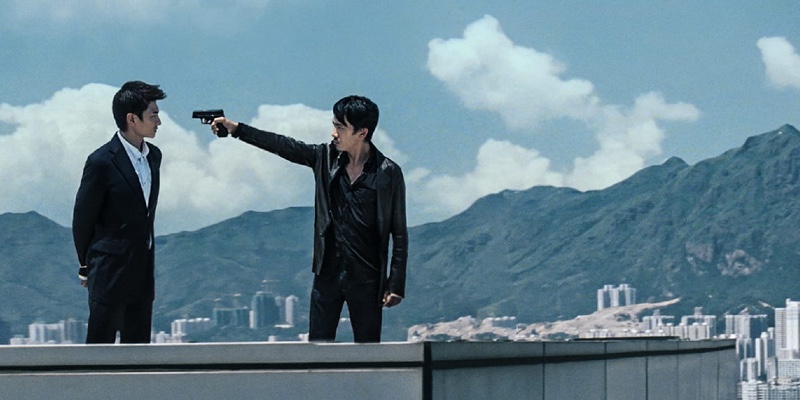
There’s also the classic showdown on the rooftop which co-director Andrew Lau says was at first written for someplace dark, like a disco. “I just ask why, maybe we go to high space… and I asked some location scout: Okay, I want a rooftop surrounded by the city and that kind of thing, so they choose here. When I come here I was like, oh, 360 degrees surrounded by city, and also one interesting thing is the reflection… I still remember the first shot Tony Leung walks through here, I use the camera angle to shoot the reflection. That’s something like black and white, are you good guy or bad guy? When you’re in the mirror maybe you are good guy, maybe here you are bad guy, God knows.”
Crew: Infernal Affairs became such a hit that it was followed the very next year by Infernal Affairs II (a prequel to the original) and Infernal Affairs III (a prequel and sequel). Andrew Lau says: “I was nervous when the film came out, back then, the movie industry in Hong Kong was going through a slump and it felt like a very big risk. I always told myself that if this film bombs in the box office, then this is it, but luckily it was a huge success. I didn’t expect it to be a worldwide phenomenon, I never expected Martin Scorsese to remake Infernal Affairs.”
Where to Watch: Streaming on HBO Max, multiple platforms. The Criterion Collection has interviews with the filmmakers.
Other notes: 101 minutes. In Cantonese with English subtitles.

Radha Vatsal
Radha Vatsal is the Film/TV Columnist for CrimeReads. She is the author of No. 10 Doyers Street and the Kitty Weeks mysteries, and her essays have appeared in the The New York Times, The Atlantic, the Los Angeles Review of Books, and elsewhere. She holds a Ph.D. in Film History from Duke University. You can find her on Instagram or email: rvatsal@lithub.com