What to Watch Now, International Edition: Silent Friend (2025)
Tony Leung, Léa Seydoux, and the mystery of...plants.
Story/Mood: Have you ever felt watched by a tree? As if the plants around you were aware of your presence, your comings and goings? This could be the theme of a horror movie, but in Silent Friend, it’s an invitation to see the world differently, from the perspective of a gingko tree and botanical life—life forms that are everywhere, and yet strangers among us. Silent Friend takes place over three time periods—2020, 1972, and 1908—but in a single location: the botanical garden of an old German university.
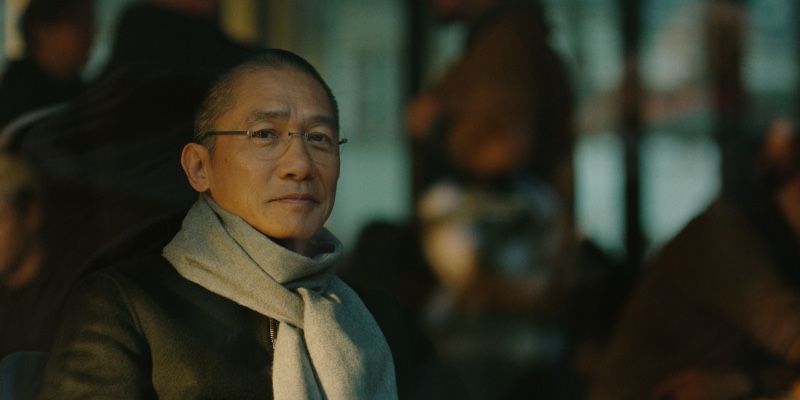
In 2020, during Covid lockdown, a visiting professor (Tony Leung Chiu-Wai—Infernal Affairs, The Grandmaster) examines botanical consciousness with the help of a botanist (Léa Seydoux—No Time To Die). In 1972, a young student does the same by studying a potted geranium; in 1908, Grete, the first female student admitted to the university, studies plant life through photography. The mood is dreamy, thought-provoking, and grabbed my attention throughout.
The Look: Silent Friend is shot in 35 mm black and white for 1908; in grainy, lush color for 1972; and in precise digital color for 2020. The most glorious shots are from the perspective of the gingko—taken from high up in its leaves, imagined action of the roots, time-lapse shots of sprouting. It all feels so real it’s almost as if you can see the bark moving. Like Sirāt, Silent Friend holds you with its narrative but is also a movie-going experience.
Crew: Hungarian writer-director Ildiko Enyedi said in a press statement: “While the tree is fundamental, this is a film made by humans and will be visioned by humans in a movie theater, within our narrow and very special sensory limits. It’s an invitation for a conversation between humans. I would never dare to tell anyone how a tree perceives the world. I just would like to draw attention to the fact that it is a complex being with its own perceptional world, its ‘Umwelt’ equally valid to ours. We are not the default, our perception does not describe the world ‘objectively.’”
She adds that she wrote the role for Tony Leung. “I needed not only the brilliant actor but also the person I sensed behind him… My producers tried to convince me to find someone else. As they said, he is very choosy, turns down most offers and never ever made a European independent film. I am so thankful that he took the risk and immediately, after reading the script, accepted the role.”
Enyedi’s inspirations for the film include Thomas Nagel’s 1974 paper, “What Is It Like to Be a Bat;” neuroscientist Anil Seth’s book, Being You; and the gorgeous photography of Anna Atkins and Karl Blossfeld.
Memorable Moment: All the extreme close-ups and “points of view” of the plants. But also the excruciating depiction of Grete’s university entrance exam during which she’s quizzed at length by a panel of all male examiners on plant sexuality and botanical reproduction. Watching it today, it’s difficult to imagine how women kept their cool and managed to get any professional work done in the face of such hostile interrogation.
Where to Watch: Currently in limited theatrical release. Keep an eye out for it at theaters and on streaming platforms.
Other notes: 147 minutes—which fly by. In English and German with English subtitles. Someone on the internet described the film as “2.5 hours in which Tony Leung befriends a tree.” And then added, that it’s brilliant. I don’t know about you, but that description made me want to watch it immediately!

Radha Vatsal
Radha Vatsal is the Film/TV Columnist for CrimeReads. She is the author of No. 10 Doyers Street and the Kitty Weeks mysteries, and her essays have appeared in the The New York Times, The Atlantic, the Los Angeles Review of Books, and elsewhere. She holds a Ph.D. in Film History from Duke University. You can find her on Instagram or email: rvatsal@lithub.com