

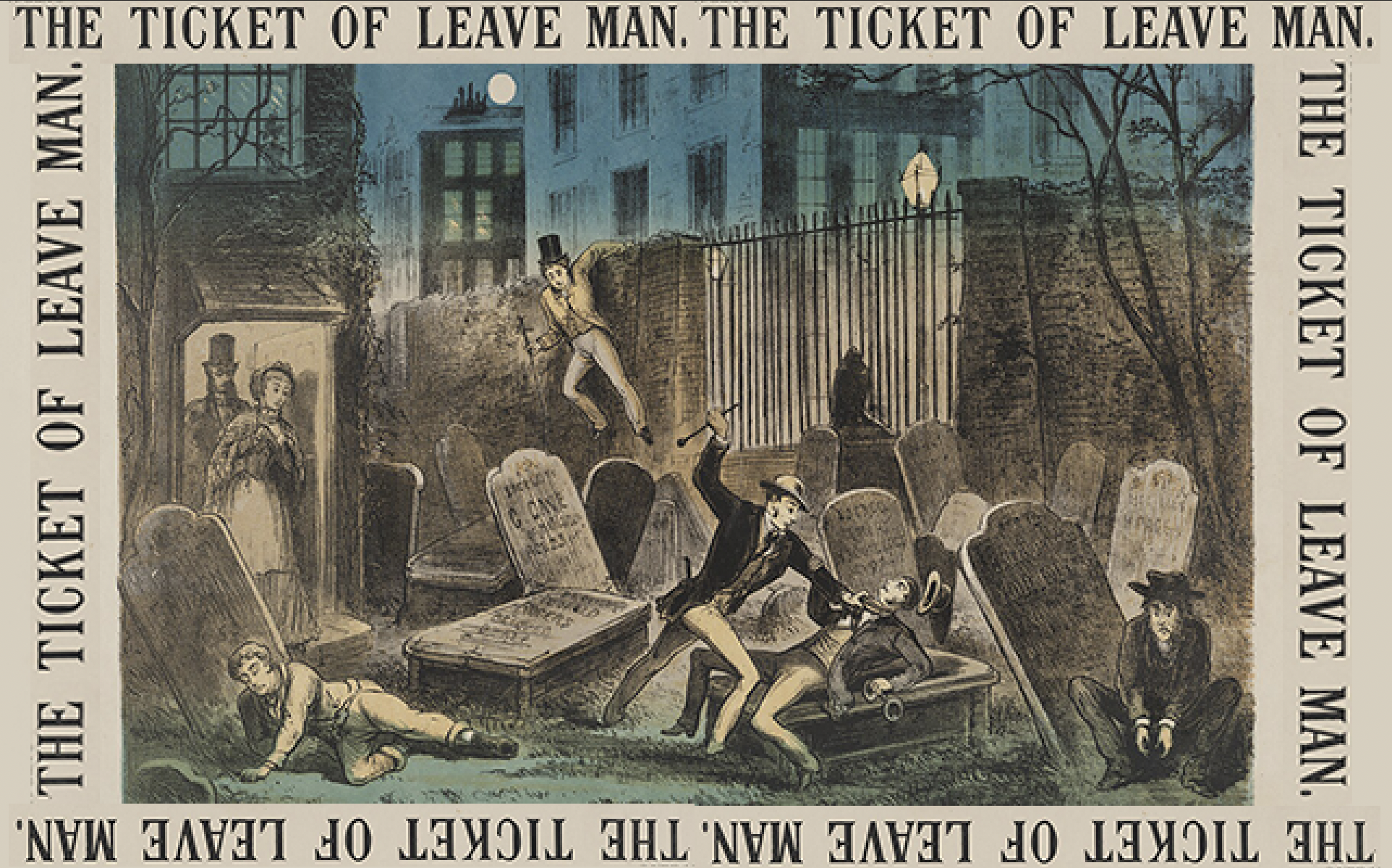
What was the most popular detective play in Victorian England?
On "The Ticket-of-Leave Man" by Tom Taylor and the popularity of crime plays!
Twenty years after the job of “detective” was established in Britain, via the Criminal Investigation Division of the New Metropolitan Police in 1842, detectives began appearing on the stage. In Britain, the first official detective character on theatrical record is from Tom Taylor’s The Ticket-of-Leave-Man in 1863. The play inspired several illegitimate sequels, including two that same year: The Detective, or A Ticket-of-Leave by C. H. Hazlewood and The Return of a Ticket-of-Leave (author unknown). Like many plays produced in the Victorian era, The Ticket-of-Leave Man was itself an adaptation of a French play, which Taylor rewrote in two weeks for a total sum of £200; it was based on the drama Léonard, ou Le Retour de Melun (1860) by Edouard Brisebarre and Eugene Nus—which owed much, in turn, to Eugène-François Vidocq’s highly popular memoirs, published in France from 1828 to 1829 and hastily translated to English.
It was the most popular… but it wasn’t the only one in its genre. Vidocq—a former criminal who, in 1813, established France’s first criminological investigative bureau, the Sûreté nationale—was an extraordinarily popular figure on both sides of the Channel. In 1829, in Britain, there were two separate theatrical adaptations of his memoirs, including Douglas Jerrold’s Vidocq! The French Police Spy and John Baldwin Buckstone’s Vidocq, The French Police Spy. Another adaptation, by Frederick Marchant, was produced in London in 1863, the same year as The Ticket-of-Leave Man. Although the detective would not officially arrive on the British stage until the midcentury, the early curiosity for stories about Vidocq, a dashing proto detective, contextualizes the impending explosion of detective characters in several forms of entertainment.
Tom Taylor wrote a second play featuring a detective, the romantic drama Mary Warner, in 1869. Dion Boucicault prominently included detectives in his melodramas Foul Play (1868) and Presumptive Evidence (1869), as well as in his American play The Shaughraun (1874). Other detective plays included G. B. Ellis’s The Female Detective (1865), William Travers’s The Boy Detective (1867), Clement Scott’s The Detective (1875), Henry Arthur Jones’s The Silver King (1881), Mark Melford’s The Secrets of the Police (1886) and E. Stockton and E. V. Hudson’s Handcuffs (1893). Detectives also appear in Watts Phillips’s Maude’s Peril (1867), and W.S. Gilbert’s A Sensation Novel (1871).
It’s no secret that Victorian (crime) writers like Charles Dickens and Wilkie Collins had theatrical ambitions, and wrote many works intended solely for the stage. But popular detective and crime novels were also commonly adapted for the stage during this time, bringing stories by Dickens and Collins to new formal identities.
Bleak House found itself with a great many theatrical versions—often, as in the case of Henry A. Rendle’s 1875 melodrama Chesney Wold, John Pringle Burnett’s 1876 melodrama Jo, and George Lander’s Bleak House, or Poor Jo in 1876, centering different characters than the novel.
Wilkie Collins, who adapted eight of his own novels into plays, dramatized his mysteries more than any other genre: No Name (twice, in 1863 and 1870), Armadale (once in 1866, and once as entitled Miss Gwilt in 1875), The Woman in White (1871), and The Moonstone (1877). (Collins’s prolific playwriting was likely motivated by the desire to retain theatrical copyright, after a pirated production of The Woman in White played at London’s Surrey Theater just ten weeks after the novel concluded serialization in 1860.) But Dickens and Collins were not alone in seeing their novels find their ways to the sage… in 1899, we must not forget, William Gillette would produce and star in his own adaptation of the Sherlock Holmes stories, with permission from Arthur Conan Doyle.
Until Gillette’s Holmes, the most significant of any of these plays was The Ticket-of-Leave Man, which burst onto the scene, satiating the evident demand within the British public for a true detective play. It broke records with its run of 407 nights at London’s Olympic Theatre in 1863. In the play, a young countryman named Robert “Bob” Brierly—new to London—is accidentally embroiled in a counterfeiting scheme that is swiftly busted by the world-class plainclothes police inspector and master of disguise, Detective Jack Hawkshaw. Though Brierly is innocent, Hawkshaw arrests him. Several years later, Brierly returns from his prison sentence a “ticket-of-leave man” (a parolee). He is hardworking, world-weary, and thirsty for justice—discovering a chance to avenge his past when Hawkshaw reenters his life. Hawkshaw is intent on capturing the same counterfeiters who had gotten away before and are now attempting to pull off a burglary, but his comeback is motivated by personal vengeance as well: it is revealed that one of the criminals, the sinister Jem “Tiger” Dalton, had been responsible for both the mental deterioration and slow death of Hawkshaw’s dear friend Joe Skirritt. Thus, Hawkshaw and Brierly join forces, infiltrating the counterfeiting ring to bring down the criminals at last.
The Ticket-of-Leave Man isn’t well known today. Most of Tom Taylor’s works are not. Well, except for Our American Cousin, which was the comedy that Abraham Lincoln was watching when he was assassinated.

Olivia Rutigliano
Olivia Rutigliano is an Editor at Lit Hub and CrimeReads. Her other work appears in Vanity Fair, Vulture, Lapham's Quarterly, AirMail, the Los Angeles Review of Books, Public Books, The Baffler, Bright Wall/Dark Room, Politics/Letters, The Toast, Truly Adventurous, and elsewhere. She has a PhD from the departments of English/comparative literature and theatre at Columbia University, where she was the Marion E. Ponsford fellow. She hosts the podcasst "Culture Schlock" at Lit Hub Radio. She is on instagram at @oldebean, twitter at @oldrutigliano, and bluesky at @oliviarutigliano.bsky.social.