Why Tour Guides Make the Best Detectives
Michelle Chouinard on some lessons learned taking her fictional character's job for a spin in real life.
When a crime-fiction conference recently came to San Francisco, a friend of mine issued me a challenge: since Capri Sanzio, the protagonist of my current mystery series, is a true-crime walking tour guide in San Francisco, I should try my hand at giving a walking tour for the conference attendees.
It’ll be a great way to connect with people, she said.
It’ll be great research into what Capri does, she said.
It’ll be an experience you’ll never forget, she said.
She wasn’t wrong—it was all of those things. But in addition, I learned two very important lessons during my brief stint as a true-crime tour guide. First, I learned that giving walking tours is hard work, and the people who do it as a job are extremely talented and deserve every dollar of the tip you should definitely give them. But more importantly for my own job, I learned that the talents you need to be a tour guide are also the ideal skills for being an amateur detective.
1) Tour guides have to be observant, and good at analyzing situations.
When I was exploring locations for tour stops, I had to pay careful attention to surroundings, not only to make sure that my guests wouldn’t block sidewalks or stand in busy streets, but to see what sort of accidental subtext might be at play. For example, at one stop, as I outlined how brothels and gambling dens popped up during San Francisco’s gold rush era, I found myself standing in front of what looked very much like a modern-day ‘massage’ parlor. A real tour guide would have noted the uncomfortable irony of this, and would have circumvented it (or, at least, highlighted it for dramatic effect). This eye for tracking what’s going on around you, even beneath the obvious, is absolutely crucial for a good detective.
2) Tour guides have to be good at reading people.
Tour guides are essentially entertainers, mobile storytellers who weave tales to a traveling band of guests. As such, you have to constantly make sure your storytelling is effective. Are you talking too much? Have you explained things clearly? Have your guests been walking too long, and need a longer stop to rest? To know, you have to be able to read faces and body language, even while you’re in the middle of yarn-spinning and trying to remember the exact year such-and-such person did such-and-such thing. The ability to track external clues in order to glimpse internal truths is another skill that comes in awfully handy when interviewing suspects in a murder investigation.
3) Tour guides have to be able to deal with the unexpected.
Weather changes (especially in San Francisco). Baby raccoons run out of backyards and across the path of your group (yes, this happened to me once). Streets that were closed to traffic when you did your trial run are now open to cars that threaten to run over your guests (don’t worry, nobody got hurt). And, sometimes, entire monuments disappear—between the time I did my first iteration of the tour and the second, a major fountain was completely removed from Embarcadero Plaza, and Portsmouth Square, San Francisco’s founding plaza, had been completely torn down for retrofitting. I found that second part out literally the day I did the tour, and had to revise on the spot. I learned the hard way that tour guides have to be able to think quickly and adjust instantly, all while pretending everything is exactly as they intended it in the first place—a perfect skill for a detective who has to revise their theories on the spot, or fight off a suspect who turns out to be a murderer.
4) Tour guides know all the nooks and crannies of their city.
All the best cafes and the most scenic views, all the small alleys with hidden speakeasies and temporary art displays. All the short cuts that aren’t on the map, and the back doors you can dive into when a burst of rain—or a homicidal maniac—suddenly hits. All the neighborhoods where different subcultures dwell, illicit substances can be found, and the forgotten and downtrodden find sanctuary. Whether tracking down a criminal or running from one, tour guides definitely have home-field advantage. And this is especially true in San Francisco, where a left turn might send you running up a steep hill, driving the wrong way down a one-way street, or dead-ending onto an unexpected cliff.
5) Tour guides know how to research anybody and anything.
Even for my one short tour, I had to do days and days of research into gold-rush era San Francisco—and I didn’t have to do nearly as much as a professional tour guide would. On any given day, a tour guide might have to research the Summer of Love, the gold rush, the history of LGBTQ+ rights, the Gilded Age, the intricacies of different styles of Victorians, or a thousand other topics. Even if you have an eidetic memory, there’s always be something new to learn—you can’t know everything, so you have to know how to find out anything. This means you develop a network of expert contacts throughout the City—architects, historians, marine biologists. It also means knowing your way around available archives—newspapers, city directories, urban planning maps, photo collections. So, when you turn your mind to solving crimes, whether you need to track down a list of suspects, suss out who really owns that mysterious factory down on the pier, or figure out how internet scams work, you’ve already got a wealth of knowledge, skill, experience, and sources to draw from.
So yes, after trying to impersonate Capri over the course of two walking tours, I have a newfound respect for how difficult her job is, and I’m more convinced than ever that her profession makes her the ideal amateur sleuth. She’s smart, adaptable, quick-thinking, and knows San Francisco like the back of her hand. And that means I can continue to throw her repeatedly into the jaws of dangerous murderers, secure in the knowledge that she’s more than equipped to battle her way out of those situations.
Not like I had any plans to stop, anyway.
***
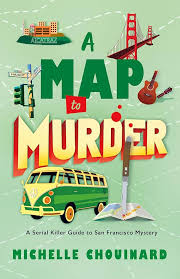

Michelle Chouinard
MICHELLE CHOUINARD is the Mary Higgins Clark Award–nominated, USA Today bestselling author of the Serial Killer Guide to San Francisco Mysteries, and, under M. M. Chouinard, the USA Today and Publishers Weekly bestselling author of nine previous mysteries. Michelle has a PhD in developmental psychology from Stanford University and was one of UC Merced’s founding faculty members. She lives in the Bay Area, where she’s held together by caffeine and dry shampoo.