
Why We Love Reluctant Heroes
A brief meditation on the most relatable trope in the canon
Growing up in a small town in Upstate, New York, I didn’t really think much about stuff like reluctant heroism or martyrdom or what happens in the vacuum of space. I did, however, grow up hooked on video games and within a twenty-foot distance door-to-door from a gas station equipped with a small (but pretty good) video rental section.
To find the ideas contained within the story I would end up creating, I didn’t need to look much further than John McClane, Sarah Connor, Han Solo, or Bill and Ted (excellent!) Heck, even my video game addiction played a role. Link was just a chill dude living in the woods doing occasional violence on chickens before Calamity struck, after all. Out of all of the media I consumed and all the would-be heroes I witnessed, the one that stuck with me was Alex Guest. You may know him, though, as The Last Starfighter.
For the unindoctrinated, Alex is a regular guy who likes to hang out in his trailer park and play his favorite video game, Starfighter. I relate heavily to this guy. One day, Alex finally, after so much grinding, manages to crack the top of the leaderboard and achieve the high score. Bitchin’, right? In fact, it’s so bitchin’ that Alex gets to meet the guy who developed the game, Starfighter’s creator, an alien named Centauri. With little to no time for pageantry, Centauri reveals that Starfighter was created as a recruitment tool to find the galaxy’s best pilots and draft them into a war against a formidable alien race. Bummer.
I’ve spent a lot of time thinking about this movie, and movies like this. Alex has his whole life taken away from him. Anything that he’d experienced up until this point kind of just vanishes as he’s met with a singular goal of saving the universe. This is oftentimes what happens in these stories, and for the sake of entertainment, the heroes lean into their journey.
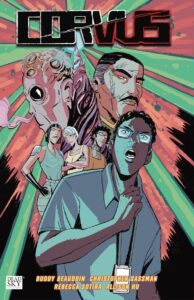
But what would I do? I can’t say my life has been all that remarkable, but I’ve got goals and ambitions and a metric ton of trauma to heal and human beings to woo. I must woo! I don’t think I’d lean in. I’d panic. I’d lose my mind. That reaction to the idea of anyone thinking I could be a hero is where Corvus was born.
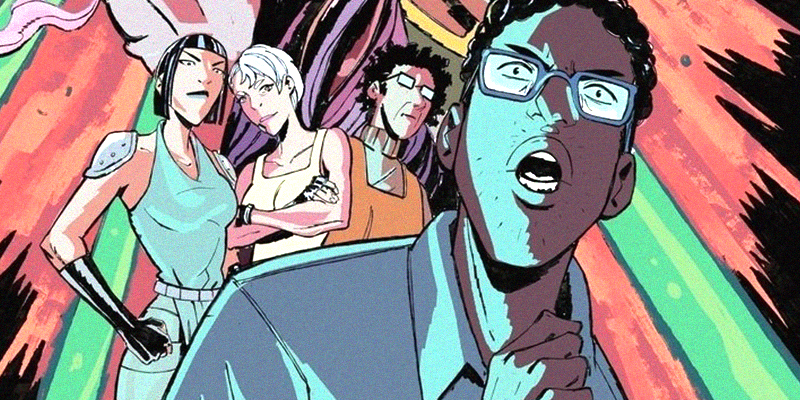
Corvus is a story where all of the heroes are reluctant. The main trio is made up of Kara Huang, the captain for lack of a better term, Sig, named after Sigourney Weaver who played the consummate badass Ellen Ripley (also a reluctant hero), and my main man Daryn Dall. Daryn is the Alex of this story. This is a team of strangers, but what they all have in common is proficiency in a video game called Quest 4 War. Daryn, third best in all the galaxy, gets picked up by Kara and Sig who are first and second best respectively, and the trio takes to the sky, to beat on some evil alien dudes called The Mare.
The Mare are a race of psychic beings who get in your head and make you relive the worst and most traumatic moments of your life on a loop until the sudden and inevitable end of something like that occurs. This means that the crew doesn’t necessarily have the luxury of leaning in. They’re being barraged by their own humanity. They’re constantly in survival mode with no time to discover what the idea of heroism means for them.
With no real family back home, Daryn eventually learns to find family in his crewmates. He learns how to stop hiding from himself in a video game and how to trust in others. Through infantessimally small odds, he learns to heal. One thing that he struggles with, though, is accepting his fate as the hero. If he’s going to save the world, some of that needs to be on his terms.
The closest character I can relate this idea to is Ender Wiggin, from Ender’s Game. Sure, Ender is raised knowing what’s at stake, and he trains for it. But his childhood is taken away from him. His ability to make any kind of decision on what he wants his life to be is removed and replaced with the singular mission of accepting a fate that has been assigned to him. His entire identity becomes something that is by and large outside of himself.
By the end of the first story, if Ender’s only recourse to achieve his goal were to become a martyr, he would do it. If winning meant flying his entire fleet into the heart of the Formic Homeworld, that’s what he would have done. So would Daryn. In fact, he tries.
I think that’s what happens when your identity is stripped away for an idea, an assigned role. It’s drilled into your head over and over again that you are the only hope. You have to be the hero. You have to lose yourself to it. We see it in Ancient Greece, in Christianity, in Judaism, in Islam. When who you are becomes what you believe, of course you’d give your life. What meaning does personhood have now? Heavy…
This is why I think reluctant hero stories resonate so much with people. The idea of heroism, of being recognized, of being beloved, of doing the right thing and helping others even when it is dangerous for you, is very human. This is why we love Die Hard, and Terminator 2, and Star Wars, and The Legend of Zelda, and yes, even Bill & Ted’s Excellent Adventures. The heroes contained within are removed from their mundane lives and given a purpose larger than themselves. We see it with Neo, and Frodo, and Dr. Ian Malcom, Peter Parker, and Katniss Everdeen, and Harry Potter and in the Bible. We love these stories and these characters because they are who we want to be. This is why reluctant hero stories are so goddamn good.
Now, go read Corvus. It’s not half as good as any of these stories, but it’d mean a lot to me.
***

Buddy Beaudoin
Buddy Beaudoin is a professional comic book letterer with credits under DC, MadCave Studios, Aftershock, Sumerian, Scout, and more. Corvus is his first written comic to not be self-published. He is stoked.