
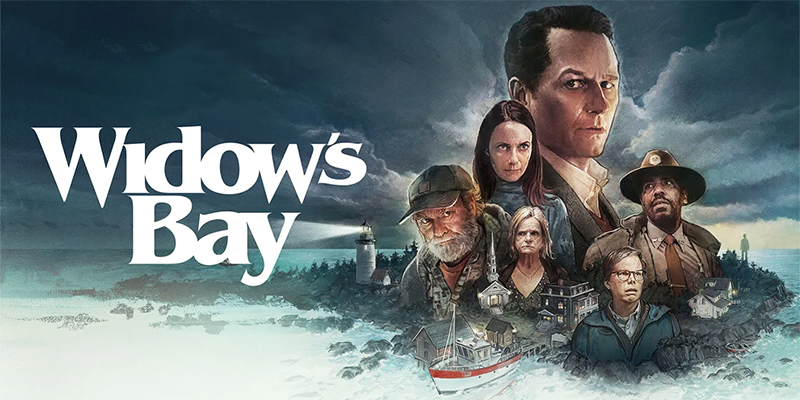
Widow's Bay is
the Best Show on TV
It's Jaws meets Twin Peaks inside the loving embrace of Stephen King. Who could ask for anything more?
In the last few weeks, if I’ve spoken to anyone, I’ve advised them to watch Widow’s Bay.
News of the show, which airs on Apple TV+, came to me via a recommendation, as well; CrimeReads Editor-in-Chief Dwyer Murphy told me about it, noting that it would be “up my alley,” when we had a call upon my return from maternity leave. This was just before Memorial Day, and I spent the weekend catching up on the (then) five available episodes. I found it extraordinary. I informed Dwyer when we checked back in, the following week, that I was obsessed. “I haven’t been this excited about a show in a long time,” I told him.
Since then, I’ve been positively evangelical about it. I can’t even count how many people I’ve recommended it to. Thirteen people I’ve begged to watch have indeed watched and are now hooked. (Full confession: I sat down four of these people on separate occasions and forced them to watch.)
It has a perfect premise, I tell people. Here’s a quick synopsis: the mayor of a small New England island town is desperate to turn it into a tourist destination, à la Martha’s Vineyard. The only problem is: it’s not a regular New England town… it’s a Stephen King New England town.
Tell me this isn’t one of the best conceit you’ve ever heard. I dare you.
But the execution is just as good. Created by Katie Dippold, the veteran Parks and Recreation writer who wrote the screenplay for The Heat and other comedies, Widow’s Bay is a tour-de-force of slow-burning plot, a masterclass of the character-driven thriller. Our protagonist is Tom Loftis (the great Matthew Rhys), the uptight mayor of Widow’s Bay, an island steeped up to its lighthouse spires in spooky local lore. It’s like Stephen King’s Castle Rock, or actually, Stephen King’s Derry, the Maine towns where lots of his novels are set (for the former: The Dead Zone, Cujo, The Body, The Dark Half, Needful Things, etc.; for the latter, It, Insomnia, Dreamcatcher, and 11/22/63, etc.,)—places that, when you look at them retrospectively, have had a lot of weird things happen there. Widow’s Bay is rich in allusions—but its two core texts, I think, are Jaws and The Shining. If I have to pick a third, I’d add Twin Peaks. A fourth? Halloween.
According to local legends shared by the superstitious old-timers who’ve resided on the island their whole lives, Widow’s Bay has had its fair share of spooky stuff: hauntings, disappearances, possessions, freak accidents, serial killers… the list goes on. The younger generation doesn’t really buy all this, and neither does Loftis, who was born and raised off-island and therefore (thinks he) has a worldlier perspective. He wants to make Widow’s Bay into the next Bar Harbor, even Martha’s Vineyard, and he’d really love it if the quirky islanders (resolute in the notion that Widow’s Bay is “cursed”) didn’t get in the way. He’s got a travel writer coming for a visit from the New York Times, and if all goes well, soon, tourists will be pouring in.
Some of the islanders are neutral on this… but others, like the seasoned fisherman Wyck Crawford (Stephen Root), think that Tom is willfully lining up lambs for the slaughter. A thick, “unnatural” fog has just rolled in, signaling that things are about to get a lot worse. The island is waking up, Wyck tells Loftis, which means that the usual spate of ghoulish happenings are going to seem like a walk in the park. Something much worse is about to happen. “Close the port. Shutter the businesses. Sound the siren.” But Tom refuses. “You refuse to accept our history, to accept the truth,” Wick tells him. “And I’ve lived with that for years, but now it’s gonna get people killed.”
An easy character template for this element of Widow’s Bay is Mayor Vaughn (Murray Hamilton) from Jaws (1975)—downplaying any real threats, and insisting on importing masses of people into an environment that is clearly dangerous for them, for commercial gain. But, we learn quickly, that Loftis is more nuanced than this—his deep denial about the quality of the place he lives in is not born from greed, but from a lot of things, mostly involving family and a desire to be a good father. Loftis’s teenage son Evan (Kingston Rumi Southwick) is clearly bored out of his mind living there, and spends his days (and nights) smoking pot and getting into trouble. Loftis, a single father, can’t get through to him.
Why doesn’t Evan leave? Why doesn’t anyone—everyone—leave this place? Most can’t. Or that’s the thought. “Did you know,” the New York Times reporter Arthur Lloyd (Bashir Salahuddin) asks Loftis in the first episode, “that there’s people on this island who think that if you’re born here, you can’t leave?” He recounts stories that locals have told him, about born-islanders who traveled to the mainland and died. Loftis insists that the belief is just an old superstition. And yet… he doesn’t let his son leave the island. Curious.
The best part of the show is the ensemble cast, especially the City Hall employees. The series is peopled with veteran character actors, who all know exactly what they’re doing. Tom’s co-workers are all islanders of different ages, Patricia (Kate O’Brien), Dale (Jeff Hiller), Ruth (K Callan), and Rosemary (Dale Dickey), all of whom are very used to the nature of Widow’s Bay. When Loftis asks his team to show the Times reporter around, he gives them a strict itinerary. “Hills Beach, Ardor Point, The Seeded Rye, and Cobble Pond. That’s it. Keep it light.”
Dale asks him, “So I guess you don’t want me to take him to the old hospital?”
Tom stares. “No, I don’t, Dale. And I think you knew that.”
“It’s perfectly safe to drive by the old hospital,” Rosemary chimes in, picking her nails. “You just can’t stop.”
It’s hysterical the way so many of these characters clearly have learned to live with the terrifying ludicrousness of their situation. I’ve never seen a show riff on the horror genre (and in a way that feels so unique… I mean, it almost solves a problem with its source texts? Which is, if all this shit is happening in Castle Rock, why doesn’t everybody just move? But here, they literally can’t leave the island or they’ll die, probably. Problem solved.
Widow’s Bay is extremely successful at the things most horror comedies try to do and few are ever able to pull off: 1. freshly derive, and 2. feel totally non-derivative. Perhaps it’s because it braids together so many antecedent texts that it can’t feel too close to one. Or, perhaps it’s because it’s so character driven, that the plot, at times, feels almost secondary. Each episode (four of which are directed by Hiro Murai, three by Samuel Davidson, two by Andrew DeYoung, and one by Ti West) takes its time unfolding, taking us deep into the interior lives of various players. Patricia, a delightfully odd Town Hall employee (who resembles, and is styled to resemble even more, Shelley Duvall in The Shining), gets two episodes largely devoted to her backstory and development, for example. Characters who start out small get more play as the show goes on, like Bechir Clemmons (Kevin Carroll), the town’s deadpan sheriff, a transplant who does not want to get mixed up with anything supernatural.
Anticipation and tension build slowly but effectively in each installment; for most of each episode, Widow’s Bay is a story of one stony-faced man dealing with a parade of kooky locals, from negligent waitresses to harebrained civil servants to slow-moving old people. He’s the straight guy, the foil, to a whole population of eccentrics. It’s like Newhart, but with an edge. A big, craggy edge over a bunch of pointy rocks.
The series is rich in the most quotable dialogue, and pitch-perfect deliveries, I’ve experienced in a while. It’s a proper comedy, with throwaway lines just as amusing as the spoken vehicles for plot points. For a horror show, there are surprisingly few “scary” moments; when attempting to break down the show’s vibe for a friend, I approximated that Widow’s Bay is 60% comedy and 40% suspense, with half of that latter percentage being suspense wrought from horror. For what it’s worth, every scaredy-cat I know has tuned in and stuck with it… it’s just too deliciously fun to miss.
It is, for my money, the single best TV show of the year. It’s gripping, it’s hilarious, and watching each of its forty-minute episodes feels like taking a strange little vacation. Enjoy your stay!

Olivia Rutigliano
Olivia Rutigliano is an Editor at Lit Hub and CrimeReads. Her other work appears in Vanity Fair, Vulture, Lapham's Quarterly, AirMail, the Los Angeles Review of Books, Public Books, The Baffler, Bright Wall/Dark Room, Politics/Letters, The Toast, Truly Adventurous, and elsewhere. She has a PhD from the departments of English/comparative literature and theatre at Columbia University, where she was the Marion E. Ponsford fellow. She hosts the podcasst "Culture Schlock" at Lit Hub Radio. She is on instagram at @oldebean, twitter at @oldrutigliano, and bluesky at @oliviarutigliano.bsky.social.