


Will Ferguson on the Japanese Backpacking Trek That Inspired His Latest Mystery
A story in 3 photos across Okinawa and Nagasaki
A missing lens cap, a mistaken headline, and a Catholic church in southern Japan: these are the pieces of the puzzle that needed to come to together for me to write my novel Officer Shimada and the Disappearing Girl.
It’s the story of a young woman who gets on an elevator in a bar building in Nagasaki—and then vanishes between floors. When the elevator opens, she has disappeared. It’s what is known as an impossible crime, a locked-room—or rather sealed elevator—mystery. And it took me thirty years to put the pieces together.
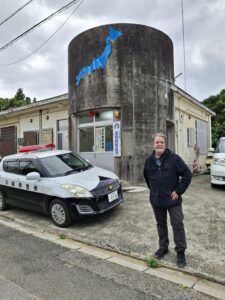 Exhibit A: Photograph of the author in front of the southernmost police station in Japan
The story begins when I was a much younger man, backpacking with a traveling companion across the islands of Okinawa. When we got to Ishigaki we realized we were only a short ferry ride away from the southernmost point in all of Japan: Hateruma, a small island with barely 600 people. We caught the last ferry over, camped on the beach, and walked down the southernmost point the next day. We had reached the end of Japan; from there we could only turn around and come back.
At a shop in the island’s only village, I noticed the lens cap to my camera was missing. We’d been tramping all over Hateruma, so who knows where I lost it. The lady at the counter suggested I stop by Hateruma’s police station, the southernmost in Japan, to see if my lens cap had turned up. It hadn’t. The sole officer stationed there kindly went through the Lost and Found box to no avail. (I imagine my lens cap is still out there, probably wedged between coral rocks at the end of Japan.)
We thanked the officer, and as we left I noticed a bulletin board out front, the type you see at any Japanese police box, listing Japan’s Most Wanted: a rogue’s gallery of murderous mugshots. And I thought, What would this police officer do if any of these cutthroats actually showed up on his island?
From this came the character of Officer Shimada. He first appeared in my novel The Finder, which received the Arthur Ellis Award for Crime Fiction, but only in a supporting role. I knew there was more to him. I knew he could carry a novel on his own, but how? I have returned to Hateruma several times, most recently in 2026, when the photo here was taken, and have been mulling it over ever since.
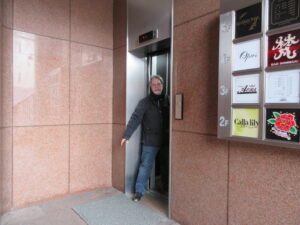 Exhibit B: The author stepping into an elevator in a bar building in Nagasaki
I spent five years in southern Japan. It’s where my wife is from and where my extended family still resides. We go back often, and on one trip I was sitting on the train reading the Daily Yomiuri newspaper when I came upon a disturbing story about a British hostess who had gone missing from a bar building in Tokyo. Her friends had gone to meet her, had waited at the elevator for her to come down, but she had “disappeared.” I hadn’t read the headline or the story closely enough, as I almost missed my stop and had to scramble to get off in time.
It percolated in the back of my mind, though. How does someone disappear from an elevator? Of course, the real hostess had left the bar earlier and her friends didn’t mean she had literally disappeared, but had departed and couldn’t be found. It ended tragically, but my misunderstanding of that story gnawed at me. How could someone disappear inside an elevator?
I started reading John Dickson Carr, master of the locked-room impossible crime novel, and, following his lead, I eliminated the obvious solutions—a hidden hatch or secret panel, a disguise, having her slip out at another floor on the way down or hiding in the elevator somehow—and I eventually came up with a solution to the problem. The story couldn’t take place on Hateruma, because Hateruma doesn’t have any elevators. I believe there aren’t any buildings over two-stories on the island. So, Officer Shimada would have to travel to a city to help solve this mystery.
But who was the girl on the elevator? Who was waiting for her on the first floor, and why did she vanish? This brought me to the final piece of the puzzle.
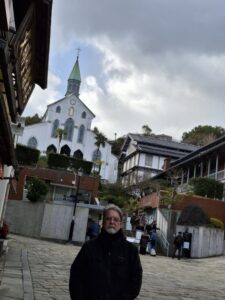 Exhibit C: The author outside Oura Cathedral in Nagasaki
One of the frustrating aspects of John Dickson Carr’s works, and one of the reasons he is little known today even though he rivaled Agatha Christie in his time, is that he often gets too caught up in the machinations of his puzzles and forgets the human aspect of it, is too clever by half, as it were. I had a solution to my disappearing act, but the story needed heart. The question remained: Who was the girl in the elevator? What was her background, and why was she running?
I struggled with this, even though the answer was right in front of me. I’d spent my first two years in Japan on the Amakusa Islands south of Nagasaki. This region is home to Japan’s oldest Catholic community, one that dates back to the 1500s with the arrival of the Jesuits. Driven underground and relentlessly persecuted by the Shoguns, the Catholics of southern Japan went into hiding for 250 years before re-emerging, defiant and dogged in their faith.
My wife went to an all-girls Catholic high school in southern Japan, taught by nuns. She enjoyed her time there, but the girls who boarded at the school must have felt lonely.
It was on a visit to the Oura Cathedral in Nagasaki, that I suddenly saw it: the girl in the elevator was from a Catholic fishing village and had run away from boarding school and was secretly working at a hostess bar much to her family’s dismay. Who was waiting for her at the bottom of the elevator? Her younger brother, sent over to bring her home. But she never gets off the elevator. She vanishes between floors and is never seen again.
What does her brother do? He becomes a police inspector, obsessed with finding missing persons. And who does he cross paths with? Officer Shimada. Together, they join forces to unravel the mystery.
It took thirty years from the time I first wandered into that police station on Hateruma Island to when the pieces of the story finally clicked into place. When people ask me “How long did it take you to write Officer Shimada and the Disappearing Girl?” I say, “decades.”
***


Will Ferguson
Will Ferguson is the author of 419, which won the Giller Prize in 2012; The Finder, which received the Arthur Ellis Award for Crime Fiction in 2021; and Officer Shimada and the Disappearing Girl. With his brother, Ian Ferguson, he is author of the Miranda Abbott cozy mystery series.