
(A.C.A.G.) All Cops Are Grotesque: Writing the Southern Gothic Police Officer
"[M]oving from physical deformity to social deformity has given rise to...a surprising but perhaps inevitable evolution."
Following the murder of George Floyd at the hands of Minneapolis police officer Derek Chauvin, Black Lives Matter protests spread across the United States. Among multi-vocal chants of “No Justice, No Peace,” I first heard the rallying cry of A.C.A.B. (All Cops Are Bastards). I was surprised to learn the acronym actually originated in early twentieth century Britain, mostly because A.C.A.B. functioned as a very culturally specific piece of rhetoric in 2020, an unwavering refusal of the reflexive “not all cops” defense: if policing is structurally corrupt, the slogan argues, no officer stands outside that corruption. Or, more to the point, within a bastardized system, all cops are bastards.
While A.C.A.B. embodies a relatively severe stance, there remains a general erosion of trust between American civilians and police in the age of social media, camera phones, and body cams. Entire Youtube channels are dedicated to breaking down constitutional violations unfolding frame by frame. Misconduct lawsuits and seven-figure settlements have become a persistent feature of civic life. Calls to “Defund the police” metastasized into Internet-flavored irony when social media demanded the “defunding” of Paw Patrol, a children’s program featuring a cloyingly enthusiastic police dog—a popular post at the time, “All dogs go to heaven. Except for those class traitors in Paw Patrol.”
But in fiction—especially crime fiction, a genre structurally dependent on the existence of law enforcement—the controversies of modern policing present an immediate problem: how does one write a police officer (especially as a main character, such as a police procedural) when the archetype represents a hotly contested site of modern discourse? When I was seeking representation for my new novel Blood River Witch, a Southern Gothic noir with a Sheriff’s deputy at the center, I encountered at least a dozen agents who flatly refused to read any manuscript featuring a police main character, as if the figure itself had become not only culturally complicated, but narratively untenable. The problem, then, is not simply political but also aesthetic: what does it mean to center a story on a figure whose authority immediately provokes polarized reactions before the story even begins? For that matter, what does it mean for readers? What does it mean that so many of us return to the well of crime fiction to slake our thirst for corrupt cops, virtuous lawmen, and those who fall somewhere in the middle—are we, too, complicit in the valorization of institutional power? It’s a pressing question best reframed through a brief detour into the Southern Gothic, itself a forebearer of the modern crime novel, where we are reminded of certain grotesque truths about fraught characters.
*
In the aftermath of the Civil War, the American South underwent a period of long overdue transformation, an era aptly referred to as Reconstruction. The sordid infrastructure of American slavery was dismantled (at least nominally, given the predatory practices of sharecropping, Jim Crow laws, red-lining, and so on). Concurrently, the specter of industrialization pressured the southern economy, and the human horror of World War One tested the limits of religious faith. For southern writers, firsthand witnesses to the south’s economic, spiritual, and social rupture, this period of existential instability gave rise to the Southern Gothic.
As the name implies, the Southern Gothic translated conventions of the gothic into the American south: so, instead of crumbling castles, characters occupy dilapidated plantations; instead of pale ghosts wandering passageways, dark family secrets creep from the family Bible. The gothic imagery of decay and darkness provided Southern Gothic writers—among them, William Faulkner, Flannery O’Connor, Carson McCullers—a bleak color palette to imagine the decay of old moral boundary lines, and emerging from that muddied middle of dissolved boundaries comes the grotesque character.
[T]he police officer…carries with them the basic DNA of the Southern Gothic grotesque: someone who is a part of a community while also positioned beyond the internal logic of community.
The term “grotesque” comes pre-loaded with aesthetic connotations, but in the context of the Southern Gothic, its usage is relatively specific: a character whose physical, mental, or even spiritual deformity allows them to inhabit previously uninhabitable “old order” binaries, residing somewhere in the space between normal/abnormal, sane/insane, good/evil. Take for instance the grotesque character of The Misfit of O’Connor’s “A Good Man Is Hard To Find,” a killer whose liturgical nihilism uneasily collapses spirituality and human cruelty; or, Benjy Compson of Faulkner’s The Sound and the Fury, whose mental disability renders his impressionistic, stream-of-consciousness narration the most credible witness to his family’s collapse. In both cases, the grotesque represents a kind of category crisis as these characters exist simultaneously within and beyond a rotting system. As a result, the grotesque becomes a convenient scapegoat, a uniquely vulnerable figure onto whom communities project their anxieties about deviance, disorder, and decay.
While early Southern Gothic often rendered the grotesque vividly through bodily or mental deformity, contemporary writers have expanded the grotesque beyond those terms, a gentle turn away from sensationalizing disability. For example, moving from physical deformity to social deformity has given rise to the grotesque cop of Southern Gothic crime fiction—a surprising but perhaps inevitable evolution. After all, the police officer, regardless of time period or region, carries with them the basic DNA of the Southern Gothic grotesque: someone who is a part of a community while also positioned beyond the internal logic of community. But in the past decade in particular, the police officer accumulates even sharper grotesque features in response to cultural anxieties surrounding policing: someone who wields the power of the law while only rarely subject to the same power, or even more grotesque, someone whose commitment to protection may accelerate into violent destruction. Translated into narrative, especially the Southern Gothic, which already has a penchant for exaggeration, the grotesque cop serves as a particularly narrow aperture through which we can collapse twenty-first century “old order” boundaries and, in doing so, inhabit otherwise uninhabitable anxieties about the decay of modern American institutions.
*
HBO’s True Detective breathed new life into the Southern Gothic through the character of Rust Cohle (played by Matthew McConaughey). Cohle represents a distinctly modern evolution of the grotesque: he is not physically or mentally deformed, but he is epistemologically deformed. As a detective, Cohle is tasked with uncovering meaning, yet his past and the present investigation leads him toward a radical skepticism of meaning itself. His spiral into unflagging nihilism forces us to take seriously what those around him refuse: the incurable atavism of human cruelty, regardless of which side of the law you’re on.
In the realm of crime fiction proper, S.A. Cosby’s All The Sinner’s Bleed introduces us to Titus Crown, a Black Sheriff of a small county in Virginia, who oversees the hunt for a serial killer. The book is a masterclass in the art of escalation: as the plot progresses, the investigation gets wrapped up with racial strife, good-old-boy politics, small-town vendettas, and the fallout from an officer-involved shooting of a Black boy. What makes Titus a particularly compelling character is precisely what makes him uniquely grotesque: he is rigidly, obsessively dedicated to doing things the “right way,” refusing to reinforce malicious stereotypes of a Black man as well as those of law enforcement; these two refusals see Titus uneasily navigating separate sites of identity, resulting in Titus’ spiritual exile from his fellow officers and the community, as his strict code leads him to be viewed as both a citizen and an outsider. His resulting grotesque status forces us to sit with the frighteningly relevant concern about one’s ability to maintain individual moral judgment within a system that imposes its own.
[W]e return to the grotesque cop of crime fiction precisely because they bring us directly (and unapologetically) into the necessary discomfort of the present day
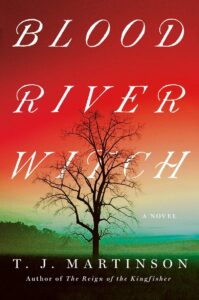
My own novel, Blood River Witch, emerges from a similar effort to extend the grotesque within the Southern Gothic police procedural. The novel follows Deputy Alicia Moore as she investigates the ritualistic murder of her ex-fiancé along the banks of Kentucky’s Blood River—a killing that echoes an unsolved occultist crime from twenty years prior, one in which Alicia herself was loosely implicated, earning her the enduring nickname of “Blood River Witch.” Like Titus Crown, Alicia’s authority is inseparable from the suspicion that surrounds her. Though she occupies a position of institutional power as a sheriff’s deputy, she remains a social outcast within the very community she serves, her past transforming her into both witness and suspect, an agent of the law and its evasive object. Her grotesque status is further sharpened by the gendered dynamics of that suspicion, as her proximity to violence renders her account of events vulnerable to the reflexive disbelief of a woman’s testimony. What emerges is not simply a character navigating a murder investigation, but a figure through whom the instability and weaponization of authority becomes visible.
With these examples in mind, we return to a question posed earlier—namely, why do we, writers and readers of crime fiction, return to the well of police procedurals with the expectation of, and a readerly desire for, corruption, abuse of power, and overstepping of limits? A hasty answer to that question might be that these stories allow us to bear witness to power’s corruption and the catharsis of the consequences, but it seems more likely to me that we return to the grotesque cop of crime fiction precisely because they bring us directly (and unapologetically) into the necessary discomfort of the present day. As did Faulkner and O’Connor, we bear daily witness to the decay of once-stable American institutions, a decay neatly embodied by the untenable contradictions of the grotesque cop: peace through violence, respect through bravado, and legitimacy through unquestioned authority. And it’s through the grotesque cop of crime fiction that we can bear to face the unsettling yet irresistible truth: the figures we entrust with maintaining order are not aberrations of American society’s most innate contradictions, but their most visible expression.
***

T.J. Martinson
T.J. MARTINSON is the author of The Reign of the Kingfisher (Flatiron, 2019), an extremely well-reviewed debut that merged the genres of superheroes and noir, and Her New Eyes. He is an assistant professor of English at Murray State University, teaching courses in creative writing and literature. He holds a PhD in English from Indiana University and a MA in Literary Studies from Eastern Illinois University. His latest novel, Blood River Witch, is now available.