
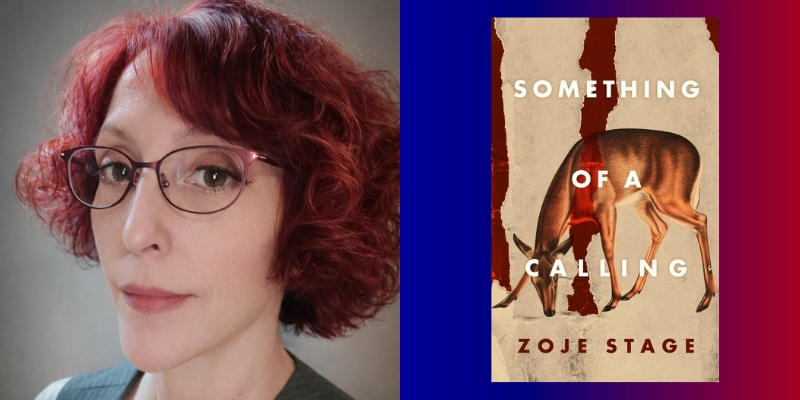
Zoje Stage on Writing Genre Fiction in An Era of Extreme Political Division
The author of Something of a Calling reflects on sensitivity, language, and mystery's layers
Incorporating real-world political or social issues into a commercial novel has always been tricky, if not questionable. Is it necessary for the story, or the character? Will a clearly defined position turn off readers who don’t share that point of view?
For a long time, I maintained that I didn’t want to incorporate overtly political ideas into my work—and I didn’t. For the observant reader, certain elements of my personal belief systems probably poked through, but in general it was a pretty broad line that was easy to traverse.
That isn’t true anymore.
The space between political/not-political is razor thin, and in recent years, seemingly everything has an obvious “leaning”; it’s strange and disheartening how almost all aspects of our current lives now exist on a “side.” And in an environment where reader reviews are often the loudest voices—thanks to social media and quarrelsome algorithms—a writer’s choices are noticed, and often commented on. Ironically, while readers are assessing what “side” a book or author is on, we authors—because of those reader comments—are making similar judgements in return.
Practically every author I know, regardless of genre, has been accused by a reader of politicizing their work—even if our only intention was character development. Here’s an example regarding my novel Wonderland: a reader was outraged because while my main female character went upstairs to install the curtains, her husband stayed in the kitchen to wash the dishes. This was deemed feminist and “woke”—and wrong. And the reader saw the rest of the book through the lens of my being a libtard, and gave it a rock-bottom rating.
What is a genre writer to do in this climate of hypersensitivity?
This might not be how all authors are choosing to respond, but at this point, I’m opting to embrace it: If unintentionally political things are now interpreted as political, why should I withhold my beliefs anymore? If I put it all out there, at least I can make a robust point rather than a murky one. And as the world becomes more volatile, I can’t pretend to hide from things that are fundamental to who I am.
In my mind, a novel like Something of a Calling isn’t overtly political—but it has a clear POV. I personally don’t think that caring about animals or caring about the earth needs to be a “blue” or “red” position—but I’m well aware that some readers will see it that way. And in this instance, the point of the story was…the point. This wasn’t just an exercise in writing a compelling or entertaining novel, but a very intentional desire to write about something I deeply care about.
I understand it’s a double-edged sword from the reader’s perspective: when the world feels like a dumpster fire, you want pastimes that are distracting, that let you “not think” for a while. As a consumer, I definitely need my share of that too. But as a creator, I feel like my priorities have changed—at least for the moment.
This past winter I was depressed for several months and I didn’t write during that period. And that’s a bad place to be as an author, as writing is often the one thing that makes me feel fully alive. But with so many difficult things going on in this country and the world, my ideas felt like “so what,” “who cares,” “How are my quaint hours of making sentences going to fix anything?”
While I continue to have no illusions about saving the world with genre fiction, it was a compromise to accept that I could at least “save myself” by attempting to write things that feel meaningful and purposeful. Politics—and the systemic power-grab by billionaires—often makes me feel powerless. I try to live my beliefs, and I’ve voted in every general election (and most primaries) since I was old enough to vote. But nothing I do as an individual feels like enough, not when civilization has been rearranged to benefit only those with the most money.
But…I’m a writer. Words have power—which was why one of the key dystopian goals in 1984 was to eliminate words in an effort to eliminate thoughts. This tactic is now being attempted by our own government (though there will still be trans people even if the administration erases “trans” from documents and websites).
Writers have the ability to express the collective unconscious, and shine a light on the ugliness that the eradication of words can’t erase. This, too, is a power that we could lose—most precipitously to A.I., but also through censorship. So, in this precarious moment in history, I’m using my genre fiction not to try and sway anyone, but to feel more engaged in my own passion.
Will writing about things I truly care about cause me to lose some readers? Maybe. But I am not a content-creating machine: I am a deeply empathetic person who is affected by the world around me. Something of a Calling probably won’t change your mind about anything, and that’s fine. But some readers may experience moments of feeling connected, and feeling relieved that they aren’t alone in loving animals perhaps more than their current love of people.
There are many reasons why someone picks up a particular book—to be entertained, to feel something, to live for a moment through another person’s imagination. These are all valid. And it’s equally fair for genre fiction to serve multilayered functions: we’re not beholden to uncomplicated page-turners; we have the capacity to reflect the world around us, and build bridges to readers with similar passions and concerns.
Books have a way of making people feel a little less alone, and there’s no reason that genre fiction can’t use all the writer’s tools to explore those connections.
***
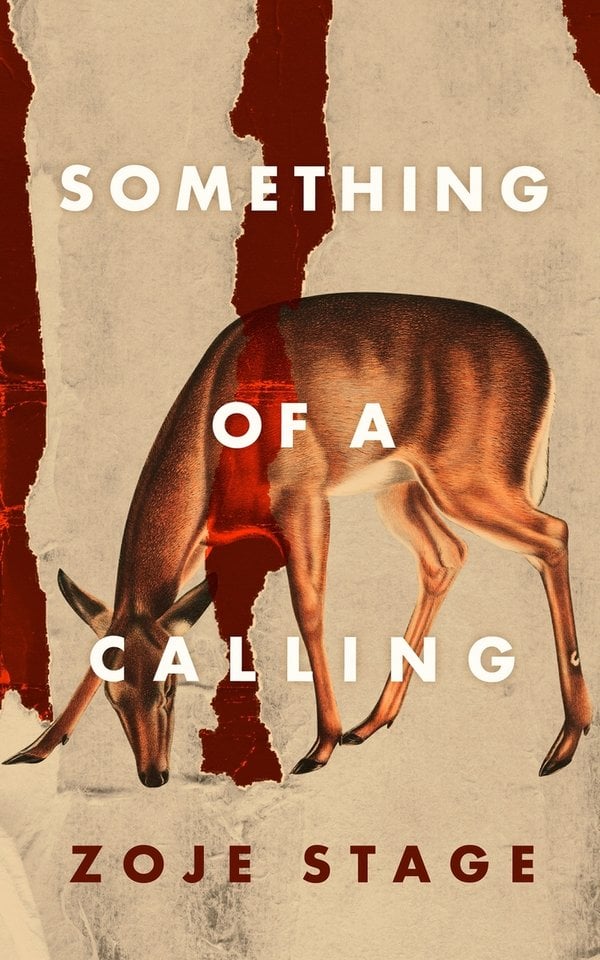

Zoje Stage
Zoje Stage is the USA Today and internationally bestselling author of Baby Teeth and Wonderland. A former filmmaker with a penchant for the dark and suspenseful, she lives in Pittsburgh..