100 Years of Russian Espionage in the U.S.
Robert McCaw chronicles a century of Russian spy operations - and some very high profile arrests - in the U.S.
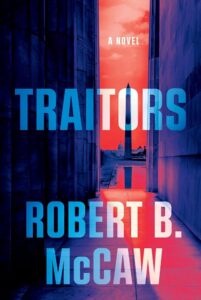
Traitors, my new geopolitical spy thriller, is a fictional account of a network of Russian agents that penetrates the highest levels of the U.S. government. Although some readers might dismiss this situation as unrealistic, history, unfortunately, suggests otherwise.
Russian espionage in the U.S. has been heavily documented since the 1930s. Back then, Jacob Golos, a Ukrainian-born Bolshevik, escaped imprisonment in Tsarist Russia to become a key liaison between the Communist Party USA and Soviet intelligence in the 1930s. He recruited agents in the U.S., focusing on those who might eventually advance to influential positions. After his death, Golos’s paramour and collaborator, Elizabeth Bentley, an American Communist sympathizer, took over his network. After becoming increasingly disillusioned with the Communist Party, she subsequently defected to the U.S., helping to usher in the onset of the McCarthy era. Whittaker Chambers, a prominent American journalist and author, was also a Soviet spy, serving as a Soviet courier and organizer of the Ware Group, a collection of government employees with communist sympathies. Whittaker, too, became disenchanted with Communism and ultimately betrayed his Russian handlers. He then accused and exposed Alger Hiss, a US State Department lawyer, who was ultimately convicted of perjury for lying about his Soviet connections.
The 1940s saw Soviet Russia pull off one of the greatest espionage feats in history—the theft of America’s atomic secrets from the Manhattan Project. The networks the Russians had established during the 1930s facilitated the success of this initiative. Experts estimated that the pilfered information substantially accelerated the Soviet quest for the bomb. That led to the 1950s convictions of Fuchs, Gold, Greenglass, and Sobell, as well as Julius and Ethel Rosenberg. Julius Rosenberg was accused of recruiting and leading the spies who passed design information to the Kremlin about the “Fat Man” atomic bomb of the type dropped on Nagasaki. Both Julius and his wife were ultimately executed in the electric chair at Sing Sing Prison in 1953.
After WWII, Soviet espionage in the U.S. shifted from specific targets, like the Manhattan Project, to broad categories of U.S. military and industrial activities. Between 1950 and 1980, U.S. Naval Officer John Walker provided his Soviet handlers with information on encoded Navy communications. William Fisher, AKA Rudolf Abel, a British-born Soviet intelligence officer, ran covert Soviet networks in the U.S. Jack Dunlap, a U.S. Army sergeant stationed at the NSA, subsequently provided Russia with highly classified cryptographic data. William Kampiles, a CIA employee, and Christopher Boyce, a politically disenchanted defense contractor, provided the Russians with technical materials on U.S. surveillance satellites.
The next two decades from 1980 to 2000 produced a plethora of Soviet spies, Harold Nicholson, a high-ranking CIA officer who served as a chief of station; Earl Pitts, a 13-year veteran of the FBI assigned to the Bureau’s New York Russian counterintelligence squad; and retired U.S. Army Reserve Colonel George Trofimoff, the highest-ranking U.S. military officer ever convicted of espionage. But the true stars of Russian espionage during this period were Robert Hanssen and Aldrich Ames. Hanssen, a senior FBI counterintelligence officer, provided the Soviets with reams of damaging information, including disclosures that led to the execution of several U.S. spies inside Russia. Aldrich Ames is widely regarded as the most notorious and damaging spy in CIA history, having compromised numerous CIA Soviet assets. During the same period, hundreds of SVR and GRU officers served in the U.S. under diplomatic cover.
Russian espionage in the U.S. continued into the 21st century. The “illegals program” was probably the most high-profile case during this period. It involved ten deep-cover operatives in the U.S. Arrested in 2010, they were subsequently traded back to Russia as part of a prisoner exchange. Then, in 2015, the FBI outed the Evgeny Buryakov spy ring. Working under commercial cover as a banker, Buryakov provided the Kremlin with information about U.S. sanctions and alternative energy sources.
During this period, Russian espionage in the U.S. shifted to the theft of American technology, hacking government and commercial networks, and an increasing focus on disinformation through social media and phony websites. At the same time, Maria Butina, acting as an unregistered Kremlin agent, sought to influence American policy through her extensive contacts with conservative groups such as the National Rifle Association. The Russian SolarWinds cyberattack, unveiled in 2020, was one of the most sophisticated launched by Russia. It enabled the Russians to invade over 18,000 U.S. government and commercial sites and eavesdrop on communications, including the U.S. Homeland Security and Treasury departments, for months before being discovered.
America, however, is not the only target of Russian espionage. Russia has conducted espionage operations in virtually every Western country, placing special emphasis on efforts in the UK, Germany, Japan, Norway, and the Czech Republic.
In recent years, the U.S. has expelled a hundred or more Russian diplomatic personnel, closed several Russian consulates, and indicted more than 50 individuals for crimes perpetrated by Russia or Russian-backed entities, ranging from the theft of sensitive information to the planning of assassinations. The actual numbers are undoubtedly higher since it would be unreasonable to assume we have eliminated the Russian spy threat. According to former FBI Director Wray, the bureau viewed Russia as a “top counterintelligence priority” and that the Russia counterintelligence threat “continues to loom large.” Thus, the prospect of a Traitors-like Russian conspiracy in the U.S. is all too real.
Traitors is, of course, fiction, but it offers a plausible and timely glimpse into the escalating shadow conflict between the U.S. and Russia, as well as the potential consequences if such covert actions continue to intensify. First and foremost, it raises awareness of the possibility of malign Russian influence in our government. In an age where some factions in America praise the Russian leadership’s hard-right cultural and social views and policies, as well as its strong-arm tactics, it is critical to remember that the Russian government seeks to damage, if not destroy, America and the stability of the post-WWII democratic order.
Second, Traitors demonstrates that Russian espionage goes far beyond the theft of military and industrial secrets. It includes extensive disinformation campaigns designed to sow dissension, turn Americans against one another, exacerbate our growing distrust of institutions, and weaken our society. Nor is the negative effect of Russian espionage confined to the U.S. Russian spies have long sought to influence American foreign policy in ways favorable to Russia and its allies, while undermining our international alliances.
Third, while much international espionage has shifted to communications intercepts, satellite reconnaissance, and cyber hacking, many espionage goals require people on the ground. Traitors shows the potential value of traditional human intelligence, especially that provided by spies in high places.
Fourth, Traitors recognizes that Russia is not the only American adversary attempting to steal our secrets, divide our citizens, and manipulate our national agenda. China, Iran, North Korea, and even some of our own allies have learned from the Russian playbook and have attempted to steal classified information and manipulate our populace.
Fifth, Traitors ultimately serves as a warning. We cannot let down our guard.
Lastly, and perhaps most importantly, in Robert Cooper, Traitors acknowledges the indispensability of smart, dedicated, and fearless people of the highest integrity working to root out foreign espionage. In that sense, Traitors pays tribute to the thousands of dedicated public servants who devote their professional lives to protecting our country, often at great personal cost.
***

Robert McCaw
Robert B. McCaw, a graduate of Georgetown University, served as a lieutenant in the US Army and earned a law degree from the University of Virginia. He was a partner in a major international law firm based in Washington, DC, and New York City. He's also the author of the Koa Kane Hawaiian mystery series. He lives with his wife in New York and La Jolla, San Diego.