

4 Lesser-Known Mexican Gothic and Historical Horror Mysteries
Cynthia Gómez recommends Amparo Dávila, Rosario Castellanos, and more
I’ve been a fan of Gothic literature since before I even knew what the word meant. When I was eight or nine our family listened to Dracula (an abridged version) on a road trip; I was reading The Secret Garden for fun when I was ten. Together, those served as my gateway drug, leading me to the trashy Goth wonderland of V.C. Andrews, and then to Jane Eyre, which I read in the basement guest room of my grandparents’ house in the mountains, a place only reachable by a narrow, winding road.
I adored everything about the Gothic: the dread, the longing, the loneliness, the drama, the trailing skirts and secrets tucked away behind closed doors. But, as I grew older, I started to wish for books that went beyond the very Anglocentric canon I’d been exposed to. I hungered for authors to at least acknowledge the colonialism and white supremacy that just might have a little something to do with all those fancy houses and their decaying wealth.
That hunger began to be satisfied, finally, when I was twenty, and I studied abroad in Mexico City and took a twentieth-century Mexican literature class with a positively effervescent instructor, Marcela Palma. Her lectures were always full of gushing book recommendations, each one closing with a plea: “léanselo, muchachos.” Read this one, kids. So I read that one, and the next one, and the next, a treasure of books that set those fog-shrouded hillsides and isolated manors in their true context, as resting atop a mountain of colonial rot.
Those books, along with so many of the Gothic texts before and since, have all left their mark on me. When I was outlining and writing my queer Gothic novel, Muñeca, I would sometimes find myself turning a page (okay, scrolling down one in my laptop) to find their little inky fingerprints here and there. Here are four of those texts, all books that English-speaking readers and lovers of the Gothic may be less familiar with.
*

Amparo Dávila, The Houseguest and Other Stories
In the title story, a wife entirely dependent on her neglectful, contemptuous husband is forced to accept his houseguest, even as the guest’s behavior goes from menacing to terrifying. Is this guest even human? Dávila deliberately leaves us grasping at clues.
That same ambiguity runs throughout “Oscar,” in which a mysterious figure in the basement keeps an entire family—especially the women—in thrall to his violent whims. The saddest thing about “Oscar” is how the family takes for granted that Oscar will be kept in the basement, miserable, with no existence except as a shameful secret. In both “Musique Concrete” and “End of a Struggle,” the narrators are men whose love and concern for their female partners turns out to be rooted in possession and contempt, with a sick violence at their core.
Dávila’s writing has been rightly compared to Shirley Jackson’s: for both of these writers, the threat and the horror are very often coming from inside the house. This reality, which informs so many Gothic novels, is very much the starting point of Muñeca.

Rosario Castellanos, The Book of Lamentations
Chris Baldick, in the Introduction to The Oxford Book of Gothic Tales, defines a Gothic text as being made up of “a fearful sense of inheritance in time with a claustrophobic sense of enclosure in space, these two dimensions reinforcing one another to produce an impression of a sickening descent into disintegration.” Rosario Castellanos’ The Book of Lamentations exemplifies this to perfection.
The book is suffused with dread and violence, the inheritance of Mexico’s centuries-long oppression of its indigenous population. Set in the Mexican state of Chiapas, the novel transposes that state’s nineteenth-century indigenous rebellions to the early twentieth century, during a time of rural land reform, a brief moment when the ruling landowning class feared losing a tiny bit of their grip on wealth and power. (They needn’t have worried.)
Castellanos’ writing hums with moral outrage; she gives no quarter to the ruling class and its genteel white ladies who speak in utterly banal tones about causing the death of their servants’ children. But this book is equally dismissive of the peasants, who are depicted as a superstitious, mindlessly violent mass.
It’s this sort of unconscious class blindness that I wanted to respond to in Muñeca. The people in my book who concern themselves the most with morality and justice are the poor and working-class characters, especially the class-conscious ones. (With one notable exception.)
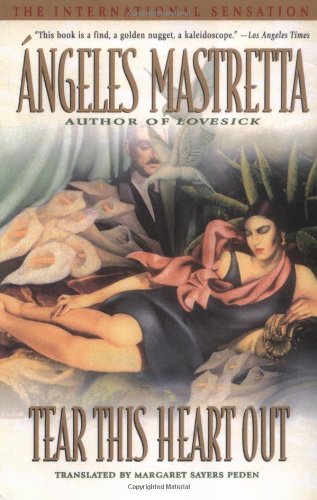
Ángeles Mastretta, Tear This Heart Out
Okay, so Ángeles Mastretta’s Tear This Heart Out isn’t really a Gothic novel, but I love it anyway. It’s an epic about a naive teenager who marries a ruthless, amoral, scheming politician nearly twice her age, in the period where the once-radical dreams of the Mexican Revolution were channeled into FDR-style reforms and the calcification of one-party rule.
Readers of Muñeca will recognize the name of the politician, Andrés, whose wife, Catalina “Cati” Guzmán, gradually comes to see just who she’s married to and ends up becoming a formidable match for him. Cati’s dry, sardonic voice, even in the face of horrors, and the book’s almost picaresque structure, make this delightful. As does the ending.

Sergio Galindo, The Precipice
Sergio Galindo’s The Precipice, set in the highlands of Veracruz in the mid-twentieth century, is absolutely Gothic. Esther Coviella is the wide-eyed newlywed brought to a fog-shrouded estate on the edge of the titular precipice. Her husband Hugo, the younger son of a prestigious landowning family, struggles to step into his expected role as master of the estate, and he chooses to express this frustration through brutal violence that threatens others and, eventually, himself.
We can read this brutality as not only a statement about Hugo’s character, but as inherent to the hierarchy that Hugo is attempting to stand atop of. The basic lesson of this book—that rigid social hierarchies are awash in violence that will never wash off, that will cling to us if we try to scale them—was so powerful that it soaked its way into the bones of Muñeca without me realizing it.
***


Cynthia Gómez
Cynthia Gómez is the author of Muñeca and the story collection The Nightmare Box and Other Stories. She is a Tin House and VONA alumn whose short fiction has published in Fantasy Magazine, Strange Horizons, Pseudopod, Nightmare Magazine, and numerous anthologies. She lives in Oakland.