Co-Writing a Cold War Thriller With My Father – Forty Years After His Death
Beau L'Amour on collaborating with his father, Louis L'Amour.
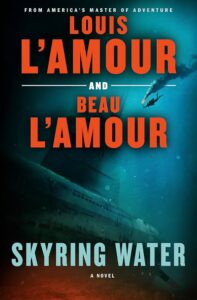
Several months ago, I finished co-writing a novel with my father, bestselling writer Louis L’Amour. But Dad passed away thirty-eight years ago. So, that makes the process … somewhat different than one might expect.
Our book, Skyring Water, began its life in the late 1950s as a contemporary adventure story. This early incarnation followed a half dozen desperate characters as they headed down the coast of Chile to recover a treasure known only to the crew of a Nazi U-boat. Stylistically, it was a bit dated even at that time, and Louis was never particularly happy with it. In addition, right around that same time, changes in the publishing industry made it considerably more difficult for writers to sell work outside the genre for which they were best known. Although my father very much wanted the chance to occasionally write something other than westerns, he eventually put the manuscript in a drawer where it sat for a couple of decades. Westerns were selling and he had a family to care for.
It took him over 20 years but, as his fame increased, he was able to subtly stretch the edges of the genre. By the mid 1980s, Dad could finally sell whatever sort of story he wanted to write. On several occasions, he and I discussed how his unpublished novel might be revised and brought up to date. But it was not to be. Diagnosed with inoperable cancer, Dad turned his attention to writing his memoir, Education of a Wandering Man. He passed away before we could return to the project.
With a lot of luck and a little ingenuity my family and I have managed to keep Dad’s career alive for almost four decades. Eventually, I realized that the moment had come. The intervening years had been an excellent training ground. I had edited dozens of Dad’s short stories, lightly revising some, completely rewriting a few others. I had adapted or been in charge of the adaptation of around sixty L’Amour audio drama productions and produced and written a couple of movies, as well as our award-winning graphic novel, Law of the Desert Born. I created the Louis L’Amour’s Lost Treasures series: two collections of unfinished works; Dad’s first novel; and over thirty postscripts added to the already existing books. Together, they tell the story behind the stories — the biography of his professional life. I knew my subject inside and out.
But unlike No Traveller Returns, the Lost Treasures novel that I co-wrote with my father, the best presentation of Skyring Water was not going to be an archeological reconstruction of Louis’s style from a unique time period. Given that it could be the last Louis L’Amour novel, it had to become the finest example of the sort of book he might have written at the end of his career. That was an era when great thriller writers like Frederick Forsyth, Robert Ludlum, John le Carré, Tom Clancy, Ken Follett and Clive Cussler battled it out on the bestseller lists, and the genre had moved on from the sly quips of James Bond. So, I needed for Dad and me to create something that might have fit into the landscape of the 1980s, yet also something that might still be meaningful in 2026. It was a very demanding assignment!
The first requirement was research. I was born in 1961, the year that most of the story takes place. So, my vague early memories, travels in England and Ireland in the later ’60s, and the deep research I had done on my father’s life gave me an introduction to that time period … a frame of reference for further study. But every aspect still had to be checked: the language the characters used, the history, the science, the geography.
The character Dad had created for the U-boat’s commander was underdeveloped. As the story progressed, he slipped from importance. As soon as I began to correct that deficiency the entire novel snapped into focus. Anton Voss became the pivot around which every other character rotated, and both a mentor and an adversary to Mike Fowler, the protagonist. Ultimately, Voss turned into one of the most fascinating, devious, and heroic characters I have ever “been inside of.”
One of Dad’s concerns had been that the original draft had too many characters. Shifting the genre from an old-school adventure to a complex Cold War thriller put that large cast to work in ways that better supported the story. Intertwining their backstories in a realistic manner also helped give both the characters and the narrative more depth.
My co-writer was silent. He had set the tone for my entire life and work, and he had contributed a rough draft and several discussions decades earlier, but I couldn’t call him up or drop by his home to talk about it. What I could do was to meet him on the page, to get something down then see if it worked … to let our story talk back to me. It was a long process and working on such a big book I was forced, for better or for worse, to continually stare into the abyss of the blank piece of paper … or computer screen. Nothing has made me appreciate my father more than to think of how often he offered that tiny act of bravery. He did it every morning, often when we had very little and the wolves were just outside the door. He did it without blinking, complaining, or ever letting us know its challenges. For that I am eternally grateful.
***

Beau L'Amour
Beau L’Amour is a writer, art director, and editor. He has written and produced several films, including USA Network’s The Diamond of Jeru. Since 1988 he has been the manager of the estate of his father, Louis L’Amour.