

A Brief History of Stolen Paintings
Felix Francis on why stealing paintings is a losing game.
At five minutes past seven in the morning of Monday 21st August 1911, Vincenzo Peruggia, an Italian decorator, walked into the Louvre in Paris dressed in a white workman’s smock similar to the ones routinely worn by the museum employees. Less than half an hour later, he casually walked out again into the Paris sunshine with Leonardo da Vinci’s Mona Lisa tucked under his arm.
Hailed as the greatest art theft of the twentieth century, it thrust the Mona Lisa, into the public consciousness as the most famous painting in the world, a title it still holds.
So, what happened next?
Peruggia kept the painting in his Paris apartment, hidden at one point under the very same table at which he was twice questioned by the police about his possible involvement in the theft. Two years later, he packed it into the false bottom of a wooden crate and took it by train to Italy.
In Florence, using the pseudonym Leonard V., Peruggia tried to sell the masterpiece to a local art dealer Alfredo Geri for half a million Italian lira (then worth US$100,000 – about $3 million in today’s money).
That was his mistake.
Geri simply called the Carabinieri and Peruggia was arrested.
The Mona Lisa was returned to the Louvre and went back on display in January 1914 to great acclaim, its superstar status now assured forever, while Peruggia was taken away to prison and largely forgotten.
Such has been the fate for very many art thieves, yet it doesn’t seem to put them off trying.
On March 22nd, 2026, four masked men entered a museum near the Italian city of Palma and made off with three paintings, one each by Renoir, Cézanne and Matisse, each of them reportedly worth millions.
But to what end? Do the thieves intend to keep the paintings? Because selling them is fraught with danger.
There is an international register of stolen art, which every reputable art dealer would be a fool not to consult before touching anything.
Maybe the paintings were stolen to order by some mysterious ‘Mr. Big’ who wants them simply for his own personal enjoyment and satisfaction – he can hardly show them off to others in case they are recognized.
So, what value do the missing paintings really have?
They are just pieces of canvas stretched onto wooden frames, covered with a few ounces of colored oils. The materials alone would cost no more than a few dollars. What makes them worth the millions is partly determined by the skill of the artists who applied the oils to the canvases, but more specifically by what someone else is prepared to pay to acquire them. And no one in their right mind would buy something stolen, at whatever price.
Occasionally, a famous artwork is not so much stolen as kidnapped and held for a ransom.
Edvard Munch’s iconic The Scream was taken from the National Gallery of Norway in Oslo during the opening ceremony of the Lillehammer Winter Olympics in February 1994. One million US dollars was demanded for its safe return.
The gallery refused to pay, but the painting was nevertheless recovered three months later during a sting operation by the police when the thieves mistakenly believed they were about to get rich.
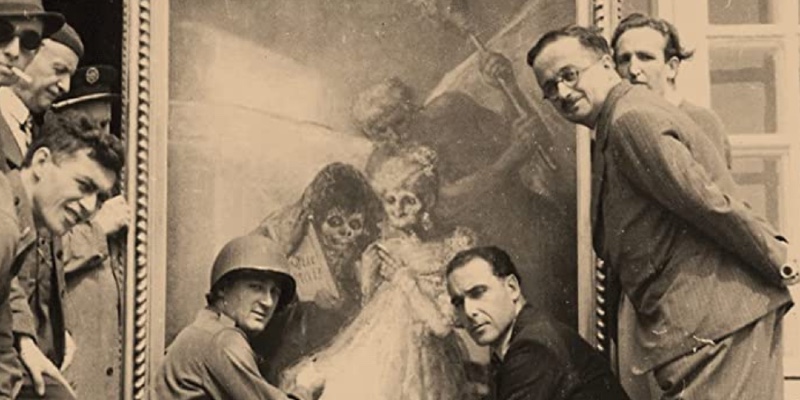
The biggest art theft of all time was the systematic looting of an estimated twenty percent of all European art – more than two million pieces – by the Nazis between 1933 and the end of World War II, much of it from displaced and murdered Jewish families, but also from the national galleries of occupied countries. The Mona Lisa only escaped such a fate by being secretly moved to the south of France in August 1939, as a precaution against expected hostilities.
Over more than ten years, Adolf Hitler, Hermann Göring, Joachim von Ribbentrop, and others amassed vast personal collections, while at the same time purging all German galleries and museums of what they called ‘degenerate art’ – Cubism, Futurism, Dadaism and other ‘modern art’ – either by destruction or by selling them abroad.
Towards the end of the war, a Monuments, Fine Arts, and Archives taskforce was set up by the Allied forces. Known as the Monuments Men, they were charged with finding and cataloging Nazi looted art, and then returning it to its rightful owners, a process that is still ongoing today, more than eighty years later, although over a hundred thousand pieces remain unfound.
President Clinton signed into law the Nazi War Crimes Disclosure Act 1988, which requires American art galleries and museums to research the provenance of all the works they hold to ensure none are part of the Nazi loot.
As a result of a US Supreme Court ruling, five paintings by Gustav Klimt were returned to Maria Altman in 2006 after she successfully argued they had been stolen by the Nazis from her Czech sugar-magnate uncle, Ferdinand Bloch-Bauer, two of them being of Bloch-Bauer’s wife, Adele.
The five were subsequently sold at auction for US$325 million.
Another Gustav Klimt, Rose Bushes Under The Trees, the only Klimt in the National Collection of France, having hung in Musée d’Orsay in Paris for many decades, was proved in 2021 to have been forcibly sold under Nazi duress by Nora Stiasny, an Austrian Jew, who was then transported to Poland and murdered. The painting has since been returned to her heirs.
And in 2025, a photograph of the eighteenth-century Portrait of a Lady by Italian artist Giuseppe Ghislandi, stolen in 1940 from Amsterdam-based Jewish art dealer Jacques Goudstikker, was inadvertently published by a real estate agent in the online listing for a seaside property in Mar del Plata, just outside Buenos Aires.
The painting was shown hanging above a green velvet sofa in the living room of a house that was being sold by the daughter of Friedrich Kadgien, a former high-ranking Nazi, who had escaped to Argentina via Switzerland in 1945.
After a tip-off from a Dutch newspaper, the house was raided by police, and numerous other suspected Nazi-looted works were also discovered, including twenty-two paintings by the French artist Henri Matisse, and the daughter was arrested for handling stolen property.
So, stealing works of fine art is a mug’s game.
You will almost invariably be found out eventually.
Far safer to sell something that is easier to fence, like the heist of the French Crown Jewels at the Louvre in October 2025, which included an emerald and diamond necklace, a wedding gift from Napoleon Bonaparte to his second wife Empress Marie-Louise; a pearl and diamond diadem, a brooch, and a decorative boddice bow containing more than 2,600 diamonds belonging to Empress Eugénie, the wife of Napoleon III; and a tiara, necklace, and a single earring from a sapphire set worn by Queen Marie-Amélie.
The stolen items are valued at over US$100 million.
The missing pieces of jewelry have been added to the Interpol Stolen Works of Art database, but they would be easy to break up and melt down, and the untraceable precious stones could then be sold individually.
In my latest novel, The Chase, my protagonist is a London art dealer accused of selling a forged Sir Alfred Munnings painting. Uncover the world of dodgy dealings in the art market – fortunes and reputations can be lost by just the slightest whiff of scandal.
Order your copy today to find out what happens.
***

Felix Francis
The New York Times, The London Sunday Times and International bestseller, acclaimed author, Felix Francis, was born in Oxford, England, son of the famous mystery author, Dick Francis and his wife, Mary Francis. Felix graduated from London University. His initial career led him to become a successful teacher of A-level physic. But he could not deny that his family's gift of writing had been passed along to him, and he started his second career--as an author--where he found his knowledge of physics was a great advantage. His many other accomplishments include being an expert outdoorsman, marksman and pilot. Felix Francis resides in England with his wife, Debbie, their family and two Irish Setters and a Cavapoo.