

A Murder of Poets: Or, the Inescapable Connections Between Crime Fiction and Poetry
Poet-writers, poet-detectives, and a long history of murder ballads...
“Murder will out…”
–Geoffrey Chaucer, The Canterbury Tales
Poetry and pathology. Verse and victim. Meter and murder and mayhem. Poetry and crime fiction seem to go together like, well, rhyme and reason. Crime novelist and CWA Diamond Dagger winner Martin Edwards has been quoted as saying that the pair share “the importance of form and structure.” And Fred Dannay, co-author with his cousin Manfred B. Lee of the beloved Ellery Queen novels, believed that both poets and detectives are driven by a desire to create order out of chaos.
The Poet-Crime Writer
Given this, it’s no surprise that Edgar Allan Poe, the father of mystery and detective fiction, is a poet of the first order, as well as the writer of The Murders in the Rue Morgue, the first modern detective story. The most prestigious award in crime fiction, The Edgar, bears his name, under the auspices of the Mystery Writers of America.
Poe is not alone, the list of poets turned crime writers is distinguished and varied and very, very long—from Sir Arthur Conan Doyle and Guy de Maupassant to Agatha Christie and Dorothy L. Sayers and Sophie Hannah. Norwegian Queen of Crime Karin Fossum writes poetry, as does August Snow author and playwright Stephen Mack Jones. Noir novelist Reed Farrel Coleman began as a poet. Feminist poet and author Rita Mae Brown writes two popular cozy series, one co-written by feline Sneaky Pie Brown.
The list goes on and on…. Scratch a poet, find a crime writer.
The Poet-Detective
The most enigmatic of lyric cops is surely Adam Dalgliesh, P.D. James’ poet-detective. The Detective Chief-Inspector of Scotland Yard appears in the fourteen Adam Dalgliesh mysteries spanning from 1962 to 2008; he also appears in two of James’s Cordelia Gray novels.
Dalgliesh is a serious, introspective man, a critically acclaimed poet dedicated to the pursuit of the perfect metaphor as well as the pursuit of justice. He has suffered much, losing his wife and child in childbirth, and as a result is reluctant to commit to a serious relationship again. Over the course of the series, he rises to the rank of Commander of the Metropolitan Police in New Scotland Yard, and opens his heart to Emma Lavenham. His empathy and insight into the human condition inform his work and infuse his poetry.
I read all of P.D. James in my twenties and have been rereading her oeuvre since becoming a mystery writer myself. Dalgliesh is one of my favorite detectives, cerebral, handsome, and brooding. You can see the new series Dalgliesh with Bertie Carvel playing the detective-poet on Acorn TV.
Of course, there are other works with poets as sleuths. Jane Austen, a poet as well as a novelist, serves as the heroine of Stephanie Barron’s popular Jane Austen Mysteries. The inimitable Oscar Wilde solves the crime in Oscar Wilde and a Death of No Importance, by British broadcaster, author, royal watcher, and former politician Gyles Daubeney Brandreth. In The Vanished Bride: A Brontë Sisters Mystery by Bella Ellis, you’ll find poets/novelists/siblings Charlotte, Emily, and Anne on the case.
Even Edgar Allan Poe gets his chance to help play sleuth in The Pale Blue Eye, by Louis Bayard. The novel is wonderful, but after you read it, watch the excellent film adaptation on Netflix; Harry Melling plays the young West Point cadet Poe and Christian Bale the retired detective who enlists his help to solve the grisly murders plaguing the academy.
And my personal favorite, Mark Thielman’s A Meter for Murder, featuring blind poet John Milton in 17th century London, as the amateur sleuth investigating the murder of a member of the House of Commons. This clever novella won the prestigious Black Orchid Award.
The Murder-Poem
Forget love and beauty and nature and the meaning of the cosmos. Death comes in at #2 on Poem Analysis’s list of common themes in poetry, and murder most foul is a large subset of the mortal category. There’s even a volume of poetry dedicated solely to murder, fittingly called Killer Verse. These “poems of murder and mayhem” comprise a darkly entertaining collection of poems edited by Harold Schechter and Kurt Brown. If this collection is any indication, when poets write about murder, they tend to stick to the tried-and-true killers: Cain and Abel, Lizzie Borden, Jack the Ripper, hit men, and the like. If you need a quick murder fix, check it out.
The Poetry Connection
Perhaps the most on-the-nose ties between poetry and crime fiction come in those novels where poets and poetry play right into the plot. Take Michael Connelly’s The Poet, in which a serial cop killer leaves tantalizing clues in the form of Edgar Allan Poe—again with Poe!—with his victims. Or Murder on the Poet’s Walk by Ellery Adams, a murderous romp revealing the darker side of poets. And most on-the-nose of all: Diana Killian’s Poetic Death series…
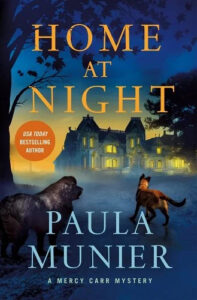
…Unless you count HOME AT NIGHT, my latest Mercy Carr mystery. Think Possession meets Julia Spencer-Fleming—with dogs. Mercy is house hunting and falls in love with Grackle Tree Farm, an old Victorian manor in the woods with a dark past populated with—you guessed it—dead poets. The story was inspired by one of my all-time favorite novels, Possession, by A.S. Byatt. The Booker Award winning tour-de-force is not a murder mystery per se but rather a literary detective story about two graduate students who delve into the secret lives of two 19th century poets.
As I wrote and researched HOME AT NIGHT, what at first seemed impossible, at least for me—combining poetry and mystery—came to seem inevitable. And why not? Ultimately, poetry aims to express the mystery of life—the ineffable—and crime fiction aims to make sense of the unthinkable. The ineffable and the unthinkable—now that’s the stuff that dreams are made of….
***

Paula Munier
Paula Munier is the Senior Agent and Director of Storytelling for Talcott Notch Literary and the USA TODAY bestselling author of the Mercy Carr mysteries. A Borrowing of Bones, the first in the series, was nominated for the Mary Higgins Clark Award and named the Dogwise Book of the Year. Blind Search also won a Dogwise Award. The Hiding Place and The Wedding Plot both appeared on several "Best Of" lists. Home at Night was named Library Journal’s Mystery Pick of the Month. The Night Woods, the sixth book in the series, earned a starred Library Journal review among other acclaim. The Snow Lies Deep—which PW called "captivating"—debuted in December 2025. Along with her love of nature, Paula credits the hero dogs of Mission K9 Rescue, her own rescue animals, and a deep affection for New England as her series’ major influences. She’s also written three popular books on writing: Plot Perfect, The Writer’s Guide to Beginnings, and Writing with Quiet Hands, as well as Happier Every Day and the memoir Fixing Freddie: The True Story of a Boy, a Mom, and a Very, Very Bad Beagle. She lives in New England with her family and four rescue dogs and Ursula The Cat, a rescue torbie tabby who does not think much of the dogs. For more, check out www.paulamunier.com.