
A Roundtable Discussion on Genre Mashups and Shared Worlds
Authors from a new cross-genre anthology discuss balance, expectations, and shared realities
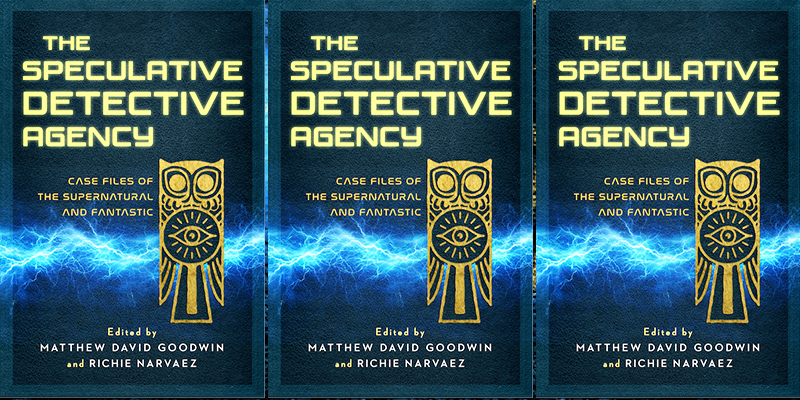
The following roundtable discussion features a variety of contributors to a new anthology, A Speculative Detective Agency: Case Files of the Supernatural and Fantastic, as they answer questions from editor Richie Narvaez. You can find copies of The Speculative Detective Agency here.
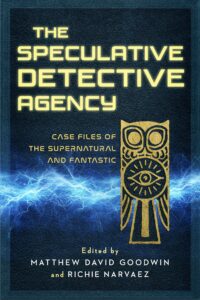
The new anthology A Speculative Detective Agency: Case Files of the Supernatural and Fantastic (Diversion Books, October 2026), edited by Matthew David Goodwin and Richie Narvaez, presents sixteen cross-genre stories set in a shared world in which an international group of investigators help people with their experiences of the unexplained. What appealed to you about writing within this shared reality?
Lincoln Michel: Fiction writing is typically a lonely enterprise where we lock ourselves in our rooms, chain ourselves to the keyboard, and howl into the void while we pound the keys. So writing in collaboration was a nice change of pace. The idea of a shared detective universe was a fun idea, and, for me at least, my best writing comes when I’m having fun.
Nadia Amina Rabbani: I really loved the idea of a shared world. For my story, “A Special Detective,” I took the information provided about the agency and themes I wanted to work with and wove them together. I did struggle with how to explicitly integrate the story with other stories. It felt almost sacrilegious to pilfer details from other stories even though I know that helps tie the world together.
Scott Adlerberg: I liked the idea of working within a set of ground rules all the contributors had to follow. That put constraints on the type of story we could all write, but at the same time, it left you free within those constraints to be as imaginative as possible. The challenge was to take those shared world points we had to use and to incorporate them into the story in as natural and unaffected a way as possible.
Victor De Anda: I found the shared reality of the SDA interesting, and constraints are always good. But it also felt wide open in terms of what else I could bring to the story. The real challenge for me was finding a way to bring something different to the mix. When I inquired to Richie about submissions, he told me that they already had plenty of ghost stories they were considering. So I brought in an old cryptid friend of mine, Ahuizotl.
Alex Grecian: I’m used to writing alone, but I’ve written a few comics and I like the idea (at least) of collaborating. This was collaboration, but without boundaries. I wrote the first draft, then read Monique Laban’s marvelous story “Anomaly Fixed” and things clicked into place. She wrote about possessed buildings and I was writing about the moon possessing people, so it was a no-brainer to incorporate her detective into my story.
“That juxtaposition between this wondrous, supernatural world and this dry, bureaucratic process was extremely funny to me…” –Monique LabanMonique Laban: It’s counterintuitive, but what excited me most about contributing to this anthology was that it is premised on an organization’s renewal of its membership in a professional association based on the strength of its employees’ self-reported performance reviews. That juxtaposition between this wondrous, supernatural world and this dry, bureaucratic process was extremely funny to me and reminded me a lot of the 1997 movie Men in Black. With the idea that every agent had to share a recent job highlight, my main challenge was thinking of a mystery my agent could solve that would be notable without altering other agents’ potential missions. I considered, for instance, writing a story about the Winchester Mystery House, but worried a mission involving a location with that big of a reputation would require a more senior detective with more experience in, say, seances, and in “Anomaly Fixed,” I wanted to keep my junior agent’s skills more modest.
The anthology asks you mash up (at least) two genres. What is the value, do you think, in blending genres?
Nadia Amina Rabbani: One of the fun parts of working within a genre is playing with expectations. Readers approach a genre with the knowledge of the generally accepted boundaries and their own experience with it. When you mix genres, you get to pick and choose, splice and stitch pieces as serve the story and their own whims.
Monique Laban: I love mashups because they allow me to approach genres with new questions about why they work and what I enjoy about them; I always ask myself who I want to be in conversation with when I’m writing a new piece. This question inevitably becomes a fun excuse to make up what-if scenarios and build a syllabus for myself of materials I want to draw on. Such as, what if Nancy Drew grew a little jaded with her mysteries? What are normal employees at the Overlook Hotel like during its peak season? What if Shirley Jackson developed a video game? I really like to emphasize having fun and pulling from various sources, whether across genres, disciplines, and mediums, within my own process.
Victor De Anda: Mixing genres allows you to bring multiple elements into a story, which can be attractive to a reader, and gives a story more depth. The combination allows for a tension that pulls the reader in and makes the story a bit more memorable. At least that was my goal with “Hecho En Mexico.”
Scott Adlerberg: The value lies in building a story that can engage the reader in hopefully unexpected ways. You can create a strong sense of suspense, mystery, and unease, maybe even a touch of wonder. In particular, I love the zone where the mystery story meets the horror story. I like also where those two genres meet the psychological thriller. You can really evoke tension in that zone and a sense of ambiguity. Does a bizarre crime have a rational explanation, or will the solution involve the supernatural? If there’s a narrator, is that person reliable as a storyteller? By mashing up genres you can really take the reader, even in a short story, on an unpredictable journey.
Alex Grecian: I’ve always mashed up genres. Genre is a sales and marketing tool, and I don’t feel like it’s my responsibility to decide what category a story fits into. So as I’m writing, anything goes. There are hardcore readers of every genre, and I love them, but I think everyday readers want to come to something and be surprised.
Lincoln Michel: I know many writers, including some genre writers, scoff at the idea that genre means anything more than a marketing label. I disagree. I think genres are, in a sense, grand conversations that stretch through time. When you write in a genre, you are adding your voice to that conversation. You are agreeing with, rebutting, subverting, and building on the work that has come before. Mashing up genres lets you do that twice.
Genres come with certain reader expectations. For example, a whodunit reader wants a puzzle, or a horror reader wants to be unsettled. How did you try to satisfy those sets of expectations with your story?
Victor De Anda: I followed the story patterns from the X-Files TV show. A detective procedural that seems puzzling and Earthbound at first but is uncovered as something much more by the end. My goal was to offer both mystery and cryptid readers something different.
Alex Grecian: I keep those thoughts at bay when I’m writing. I never think in terms of genre. If I actually consider tropes or expectations, my tendency would be to try to subvert them, and that might not fit the story I’m writing. For “Tranquility” the only real question was whether the man was actually possessed by the moon, and I didn’t know that until I got to the climactic scene.
Nadia Amina Rabbani: As a reader, my mind can’t help but do wild conspiracy style boards with yarn connecting every dot. So, I try to write things that might surprise me if I were the reader, sometimes by subverting genre expectations.
Lincoln Michel: My favorite work tends to strike a balance between meeting and subverting expectations. If you meet the expectations too neatly, your work is formulaic. If you subvert incessantly, you likely lose what is appealing in the genre to begin with. I aim for a balance of meeting expectations enough to provide the pleasures of the genre—at least the pleasures as I see them—but still have enough surprise and strangeness that it feels unique to me.
Monique Laban: I chose a trope that I love shared between both genres: a glamorous setting, like Hercule Poirot on vacation or Eleanor Vance at Hill House. But beyond that, my instinct is to actually give myself even tighter restrictions and focus on sticking to arbitrary rules early on in drafting so that I can find the tone of the story first. So, my agent does not use dialogue tags even if other characters speak directly to her. This blending of her answers and her inner thoughts make for an eerie, not-quite-grounded environment that balances this feeling of hauntedness with the deliberate slow-burn of noir .
Scott Adlerberg: In “The Case of the Singular Hands,” I set up a situation where a man claims he is being haunted by something spectral and spooky. Then a killing occurs, and it happens in a locked room. So it’s basically a classic situation, using both horror and whodunit elements, and the story’s detective has to find out what’s behind the creepy phenomena and the murder. Is it something truly ghostly or something temporal?
Have you ever encountered something speculative yourself—a ghost, an alien, magic—and how did it affect you?
Lincoln Michel: All I can say is that I could give the SDA a lead or two to investigate . . .
Victor De Anda: Although I’ve never had an alien encounter, I’ve always wanted to. And I’ve always wondered whether the cattle mutilations we’ve heard about over the years were really performed by aliens, or by something much different.
Monique Laban: I have never had a speculative encounter. I think it’s partially because I want to experience one so badly. I once spent a weekend in the Hotel Monteleone and did everything I could to get possessed by the ghost of Tennessee Williams. Of course nothing happened, I wanted it too much.
Scott Adlerberg: I have not. And in all honesty, I’m not someone who is a believer in those things you’d classify as speculative. But I’m fascinated by the uncanny and the hard to explain regardless and in the psychology of people who do hew toward a belief in the speculative. That’s probably why I love reading that sort of fiction and why I love writing it.
Alex Grecian: I don’t know what ghosts are, and I’m not sure I subscribe to the idea that they’re dead people, but most of my friends have encountered them, and I’ve certainly encountered quite a few. (There was an old lady who used to come into my bedroom and show me her brooch.) I think places build energy, and that energy is interpreted by us in wildly different ways.
Nadia Amina Rabbani: As a child, I was terrified of the dark. (This may or may not still be the case.) Every creak as the house settled, every movement in the corner of my eye was something monstrous out to get me. I was so scared I wouldn’t cry out to my parents for fear it would draw the darkness to me. I never vanquished whatever was stalking me and maybe it’s still there just outside my sight?
***

Richie Narvaez
Richie Narvaez is the award-winning author of two novels and two short story collections. He teaches at Sarah Lawrence College and the Fashion Institute of Technology. His new anthology, The Speculative Detective Agency, is now available from Diversion Books.